

2.3 Further Removal of the Degeneracy of the N-electron States
45
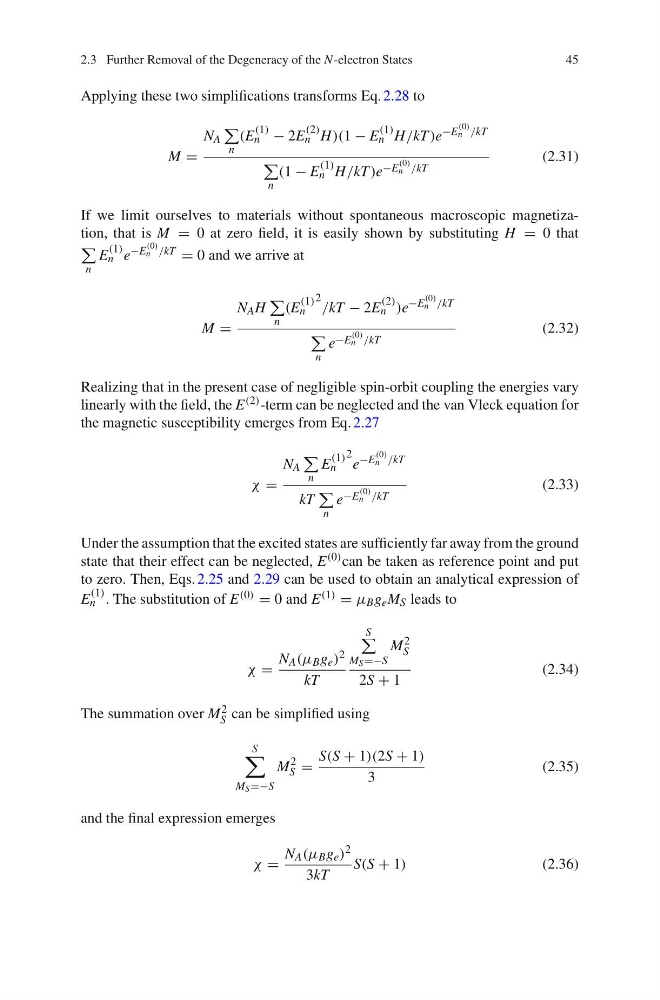
Applying these two simplifications transforms Eq. 2.28 to
M =
N A
n
(E
(1)
n − 2E
(2)
n H)(1 − E
(1)
n H/kT )e −E
(0)
n /kT
n
(1 − E
(1)
n H/kT )e −E
(0)
n /kT
(2.31)
If we limit ourselves to materials without spontaneous macroscopic magnetization, that is M = 0 at zero field, it is easily shown by substituting H = 0 that
n
E
(1)
n e −E
(0)
n /kT = 0 and we arrive at
M =
N A H
n
(E
(1)
n
2
/kT − 2E
(2)
n )e −E
(0)
n /kT
n
e −E
(0)
n /kT
(2.32)
Realizing that in the present case of negligible spin-orbit coupling the energies vary
linearly with the field, the E (2) -term can be neglected and the van Vleck equation for
the magnetic susceptibility emerges from Eq. 2.27
χ =
N A
n
E
(1)
n
2
e −E
(0)
n /kT
kT
n
e −E
(0)
n /kT
(2.33)
Under the assumption that the excited states are sufficiently far away from the ground
state that their effect can be neglected, E (0) can be taken as reference point and put
to zero. Then, Eqs. 2.25 and 2.29 can be used to obtain an analytical expression of
E
(1)
n . The substitution of E (0) = 0 and E (1) = μ B g e M S leads to
χ =
N A (μ B g e ) 2
kT
S
M S =−S
M 2
S
2S + 1
(2.34)
The summation over M 2
S can be simplified using
S
M S =−S
M
2
S =
S(S + 1)(2S + 1)
3
(2.35)
and the final expression emerges
χ =
N A (μ B g e ) 2
3kT
S(S + 1)
(2.36)
45
Applying these two simplifications transforms Eq. 2.28 to
M =
N A
n
(E
(1)
n − 2E
(2)
n H)(1 − E
(1)
n H/kT )e −E
(0)
n /kT
n
(1 − E
(1)
n H/kT )e −E
(0)
n /kT
(2.31)
If we limit ourselves to materials without spontaneous macroscopic magnetization, that is M = 0 at zero field, it is easily shown by substituting H = 0 that
n
E
(1)
n e −E
(0)
n /kT = 0 and we arrive at
M =
N A H
n
(E
(1)
n
2
/kT − 2E
(2)
n )e −E
(0)
n /kT
n
e −E
(0)
n /kT
(2.32)
Realizing that in the present case of negligible spin-orbit coupling the energies vary
linearly with the field, the E (2) -term can be neglected and the van Vleck equation for
the magnetic susceptibility emerges from Eq. 2.27
χ =
N A
n
E
(1)
n
2
e −E
(0)
n /kT
kT
n
e −E
(0)
n /kT
(2.33)
Under the assumption that the excited states are sufficiently far away from the ground
state that their effect can be neglected, E (0) can be taken as reference point and put
to zero. Then, Eqs. 2.25 and 2.29 can be used to obtain an analytical expression of
E
(1)
n . The substitution of E (0) = 0 and E (1) = μ B g e M S leads to
χ =
N A (μ B g e ) 2
kT
S
M S =−S
M 2
S
2S + 1
(2.34)
The summation over M 2
S can be simplified using
S
M S =−S
M
2
S =
S(S + 1)(2S + 1)
3
(2.35)
and the final expression emerges
χ =
N A (μ B g e ) 2
3kT
S(S + 1)
(2.36)