

42
2 One Magnetic Center
ˆ
S 2
z , the effect of ˆ
S 2
x,y is most easily determined via the ladder operators S ± .Fromthe
definitions ˆ
S x =
1
2 ( ˆ
S + + ˆ
S − ) and ˆ
S y =−
1
2i ( ˆ
S + − ˆ
S − ) one arrives at
ˆ
S 2
x =
1
4
ˆ
S + ˆ
S + + ˆ
S − ˆ
S − + ˆ
S + ˆ
S − + ˆ
S − ˆ
S +
ˆ
S 2
y =−
1
4
ˆ
S + ˆ
S + + ˆ
S − ˆ
S − − ˆ
S + ˆ
S − − ˆ
S − ˆ
S +
(2.17)
Using Eq. 1.23, it is easily seen that the first and the last term give zero when applied
on |1, 1 and that the other terms result in
ˆ
S
− ˆ
S
− |1, 1=2|1, −1
ˆ
S
+ ˆ
S
− |1, 1=2|1, 1
(2.18)
which defines the action of ˆ
S 2 and ˆ
S 2
x,y,z on |1, 1 as follows
ˆ
S
2 |1, 1=S(S + 1)|1, 1=2|1, 1 ˆ
S
2
z |1, 1=|1, 1
ˆ
S
2
x |1, 1=
1
2
|1, −1+
1
2
|1, 1
ˆ
S
2
y |1, 1=−
1
2
|1, −1+
1
2
|1, 1 (2.19)
Using the definition of Eq. 2.15 the matrix element becomes
1, 1| ˆ
H ZFS |1, 1=D
1 −
1
3
· 2
+
1
2
E −
1
2
E =
1
3
D
(2.20)
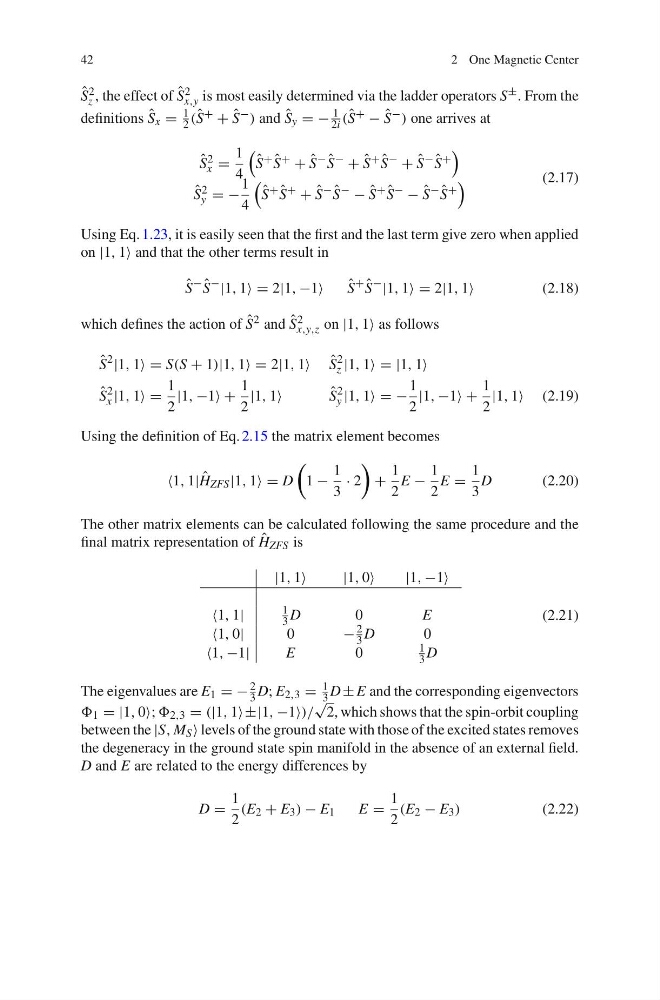
The other matrix elements can be calculated following the same procedure and the
final matrix representation of ˆ
H ZFS is
|1, 1| 1, 0| 1, −1
1, 1|
1
3 D
0
E
1, 0|
0
−
2
3 D
0
1, −1|
E
0
1
3 D
(2.21)
The eigenvalues are E 1 =−
2
3 D; E 2,3 =
1
3 D ± E and the corresponding eigenvectors
1 =|1, 0; 2,3 = (|1, 1±|1, −1)/
√
2, which shows that the spin-orbit coupling
between the |S, M S levels of the ground state with those of the excited states removes
the degeneracy in the ground state spin manifold in the absence of an external field.
D and E are related to the energy differences by
D =
1
2
(E 2 + E 3 ) − E 1
E =
1
2
(E 2 − E 3 )
(2.22)
2 One Magnetic Center
ˆ
S 2
z , the effect of ˆ
S 2
x,y is most easily determined via the ladder operators S ± .Fromthe
definitions ˆ
S x =
1
2 ( ˆ
S + + ˆ
S − ) and ˆ
S y =−
1
2i ( ˆ
S + − ˆ
S − ) one arrives at
ˆ
S 2
x =
1
4
ˆ
S + ˆ
S + + ˆ
S − ˆ
S − + ˆ
S + ˆ
S − + ˆ
S − ˆ
S +
ˆ
S 2
y =−
1
4
ˆ
S + ˆ
S + + ˆ
S − ˆ
S − − ˆ
S + ˆ
S − − ˆ
S − ˆ
S +
(2.17)
Using Eq. 1.23, it is easily seen that the first and the last term give zero when applied
on |1, 1 and that the other terms result in
ˆ
S
− ˆ
S
− |1, 1=2|1, −1
ˆ
S
+ ˆ
S
− |1, 1=2|1, 1
(2.18)
which defines the action of ˆ
S 2 and ˆ
S 2
x,y,z on |1, 1 as follows
ˆ
S
2 |1, 1=S(S + 1)|1, 1=2|1, 1 ˆ
S
2
z |1, 1=|1, 1
ˆ
S
2
x |1, 1=
1
2
|1, −1+
1
2
|1, 1
ˆ
S
2
y |1, 1=−
1
2
|1, −1+
1
2
|1, 1 (2.19)
Using the definition of Eq. 2.15 the matrix element becomes
1, 1| ˆ
H ZFS |1, 1=D
1 −
1
3
· 2
+
1
2
E −
1
2
E =
1
3
D
(2.20)
The other matrix elements can be calculated following the same procedure and the
final matrix representation of ˆ
H ZFS is
|1, 1| 1, 0| 1, −1
1, 1|
1
3 D
0
E
1, 0|
0
−
2
3 D
0
1, −1|
E
0
1
3 D
(2.21)
The eigenvalues are E 1 =−
2
3 D; E 2,3 =
1
3 D ± E and the corresponding eigenvectors
1 =|1, 0; 2,3 = (|1, 1±|1, −1)/
√
2, which shows that the spin-orbit coupling
between the |S, M S levels of the ground state with those of the excited states removes
the degeneracy in the ground state spin manifold in the absence of an external field.
D and E are related to the energy differences by
D =
1
2
(E 2 + E 3 ) − E 1
E =
1
2
(E 2 − E 3 )
(2.22)