

2.3 Further Removal of the Degeneracy of the N-electron States
41
literature as the absence of a first-order angular moment. At second-order perturbation
theory, the correction becomes slightly more involved
κ =0
0| ˆ
V |κκ| ˆ
V |0
E 0 − E κ
==S, M S |ζ ˆ
S
κ =0
0| ˆ
L|κκ| ˆ
L|0
E 0 − E κ
ζ ˆ
S|S, M S
==S, M S | ˆ
S D ˆ
S|S, M S
(2.13)
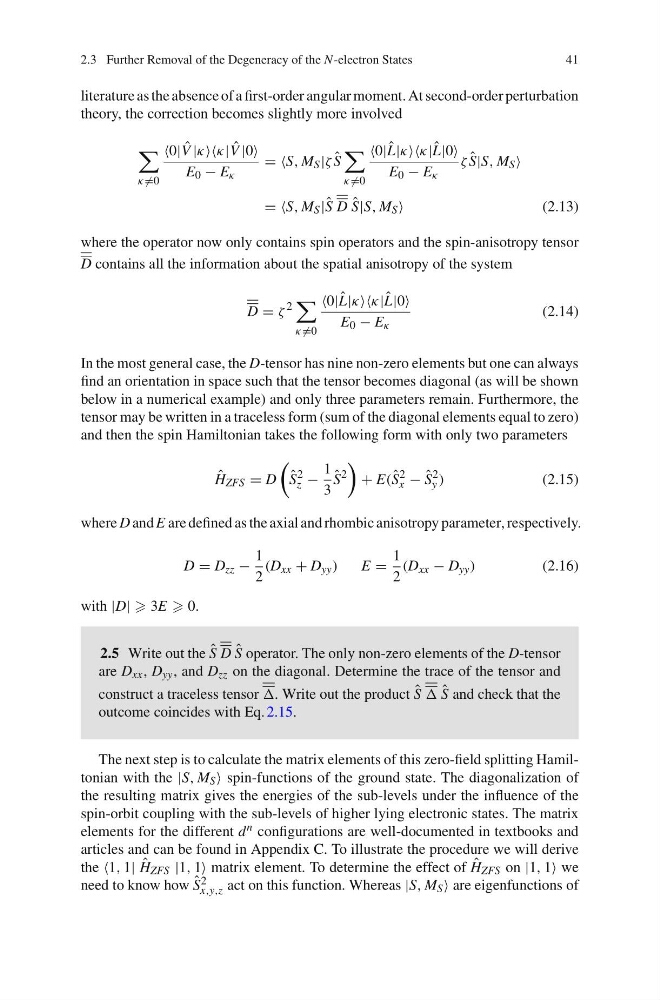
where the operator now only contains spin operators and the spin-anisotropy tensor
D contains all the information about the spatial anisotropy of the system
D = ζ
2
κ =0
0| ˆ
L|κκ| ˆ
L|0
E 0 − E κ
(2.14)
In the most general case, the D-tensor has nine non-zero elements but one can always
find an orientation in space such that the tensor becomes diagonal (as will be shown
below in a numerical example) and only three parameters remain. Furthermore, the
tensor may be written in a traceless form (sum of the diagonal elements equal to zero)
and then the spin Hamiltonian takes the following form with only two parameters
ˆ
H ZFS = D
ˆ
S
2
z −
1
3
ˆ
S
2
+ E( ˆ
S
2
x − ˆ
S
2
y )
(2.15)
where D and E are defined as the axial and rhombic anisotropy parameter, respectively.
D = D zz −
1
2
(D xx + D yy )
E =
1
2
(D xx − D yy )
(2.16)
with |D| 3E 0.
2.5 Write out the ˆ
S D ˆ
S operator. The only non-zero elements of the D-tensor
are D xx , D yy , and D zz on the diagonal. Determine the trace of the tensor and
construct a traceless tensor . Write out the product ˆ
S ˆ
S and check that the
outcome coincides with Eq. 2.15.
The next step is to calculate the matrix elements of this zero-field splitting Hamiltonian with the |S, M S spin-functions of the ground state. The diagonalization of
the resulting matrix gives the energies of the sub-levels under the influence of the
spin-orbit coupling with the sub-levels of higher lying electronic states. The matrix
elements for the different d n configurations are well-documented in textbooks and
articles and can be found in Appendix C. To illustrate the procedure we will derive
the 1, 1| ˆ
H ZFS |1, 1 matrix element. To determine the effect of ˆ
H ZFS on |1, 1 we
need to know how ˆ
S 2
x,y,z act on this function. Whereas |S, M S are eigenfunctions of
41
literature as the absence of a first-order angular moment. At second-order perturbation
theory, the correction becomes slightly more involved
κ =0
0| ˆ
V |κκ| ˆ
V |0
E 0 − E κ
==S, M S |ζ ˆ
S
κ =0
0| ˆ
L|κκ| ˆ
L|0
E 0 − E κ
ζ ˆ
S|S, M S
==S, M S | ˆ
S D ˆ
S|S, M S
(2.13)
where the operator now only contains spin operators and the spin-anisotropy tensor
D contains all the information about the spatial anisotropy of the system
D = ζ
2
κ =0
0| ˆ
L|κκ| ˆ
L|0
E 0 − E κ
(2.14)
In the most general case, the D-tensor has nine non-zero elements but one can always
find an orientation in space such that the tensor becomes diagonal (as will be shown
below in a numerical example) and only three parameters remain. Furthermore, the
tensor may be written in a traceless form (sum of the diagonal elements equal to zero)
and then the spin Hamiltonian takes the following form with only two parameters
ˆ
H ZFS = D
ˆ
S
2
z −
1
3
ˆ
S
2
+ E( ˆ
S
2
x − ˆ
S
2
y )
(2.15)
where D and E are defined as the axial and rhombic anisotropy parameter, respectively.
D = D zz −
1
2
(D xx + D yy )
E =
1
2
(D xx − D yy )
(2.16)
with |D| 3E 0.
2.5 Write out the ˆ
S D ˆ
S operator. The only non-zero elements of the D-tensor
are D xx , D yy , and D zz on the diagonal. Determine the trace of the tensor and
construct a traceless tensor . Write out the product ˆ
S ˆ
S and check that the
outcome coincides with Eq. 2.15.
The next step is to calculate the matrix elements of this zero-field splitting Hamiltonian with the |S, M S spin-functions of the ground state. The diagonalization of
the resulting matrix gives the energies of the sub-levels under the influence of the
spin-orbit coupling with the sub-levels of higher lying electronic states. The matrix
elements for the different d n configurations are well-documented in textbooks and
articles and can be found in Appendix C. To illustrate the procedure we will derive
the 1, 1| ˆ
H ZFS |1, 1 matrix element. To determine the effect of ˆ
H ZFS on |1, 1 we
need to know how ˆ
S 2
x,y,z act on this function. Whereas |S, M S are eigenfunctions of