

40
2 One Magnetic Center
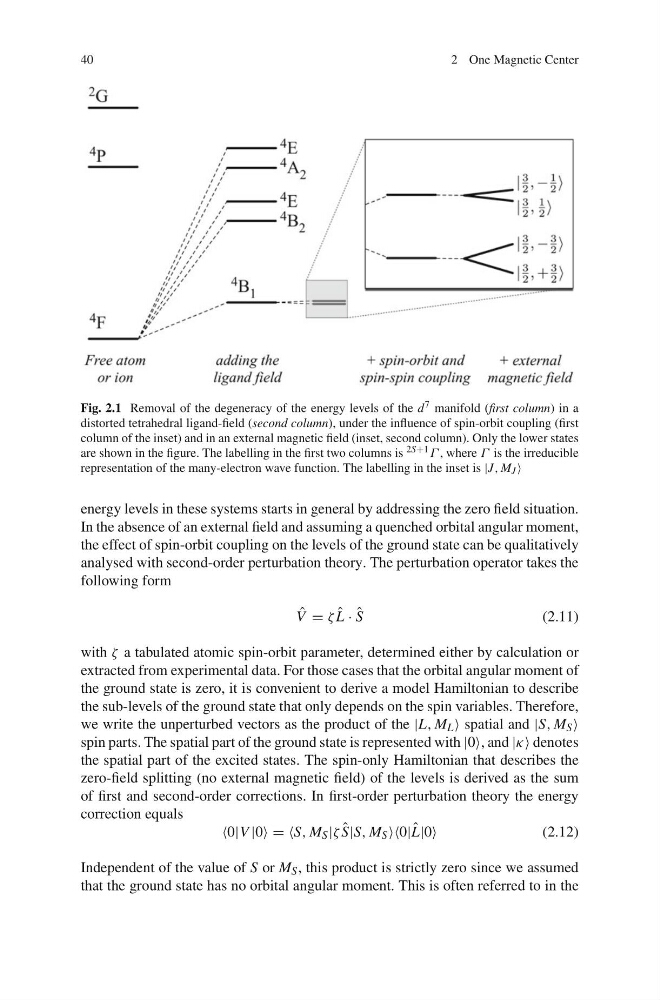
Fig. 2.1 Removal of the degeneracy of the energy levels of the d 7 manifold (first column)i na
distorted tetrahedral ligand-field (second column), under the influence of spin-orbit coupling (first
column of the inset) and in an external magnetic field (inset, second column). Only the lower states
are shown in the figure. The labelling in the first two columns is 2S+1 Γ ,whereΓ is the irreducible
representation of the many-electron wave function. The labelling in the inset is |J, M J
energy levels in these systems starts in general by addressing the zero field situation.
In the absence of an external field and assuming a quenched orbital angular moment,
the effect of spin-orbit coupling on the levels of the ground state can be qualitatively
analysed with second-order perturbation theory. The perturbation operator takes the
following form
ˆ
V = ζ ˆ
L · ˆ
S
(2.11)
with ζ a tabulated atomic spin-orbit parameter, determined either by calculation or
extracted from experimental data. For those cases that the orbital angular moment of
the ground state is zero, it is convenient to derive a model Hamiltonian to describe
the sub-levels of the ground state that only depends on the spin variables. Therefore,
we write the unperturbed vectors as the product of the |L, M L spatial and |S, M S
spin parts. The spatial part of the ground state is represented with |0, and |κ denotes
the spatial part of the excited states. The spin-only Hamiltonian that describes the
zero-field splitting (no external magnetic field) of the levels is derived as the sum
of first and second-order corrections. In first-order perturbation theory the energy
correction equals
0|V |0==S, M S |ζ ˆ
S|S, M S 0| ˆ
L|0
(2.12)
Independent of the value of S or M S , this product is strictly zero since we assumed
that the ground state has no orbital angular moment. This is often referred to in the
2 One Magnetic Center
Fig. 2.1 Removal of the degeneracy of the energy levels of the d 7 manifold (first column)i na
distorted tetrahedral ligand-field (second column), under the influence of spin-orbit coupling (first
column of the inset) and in an external magnetic field (inset, second column). Only the lower states
are shown in the figure. The labelling in the first two columns is 2S+1 Γ ,whereΓ is the irreducible
representation of the many-electron wave function. The labelling in the inset is |J, M J
energy levels in these systems starts in general by addressing the zero field situation.
In the absence of an external field and assuming a quenched orbital angular moment,
the effect of spin-orbit coupling on the levels of the ground state can be qualitatively
analysed with second-order perturbation theory. The perturbation operator takes the
following form
ˆ
V = ζ ˆ
L · ˆ
S
(2.11)
with ζ a tabulated atomic spin-orbit parameter, determined either by calculation or
extracted from experimental data. For those cases that the orbital angular moment of
the ground state is zero, it is convenient to derive a model Hamiltonian to describe
the sub-levels of the ground state that only depends on the spin variables. Therefore,
we write the unperturbed vectors as the product of the |L, M L spatial and |S, M S
spin parts. The spatial part of the ground state is represented with |0, and |κ denotes
the spatial part of the excited states. The spin-only Hamiltonian that describes the
zero-field splitting (no external magnetic field) of the levels is derived as the sum
of first and second-order corrections. In first-order perturbation theory the energy
correction equals
0|V |0==S, M S |ζ ˆ
S|S, M S 0| ˆ
L|0
(2.12)
Independent of the value of S or M S , this product is strictly zero since we assumed
that the ground state has no orbital angular moment. This is often referred to in the