

28
1 Basic Concepts
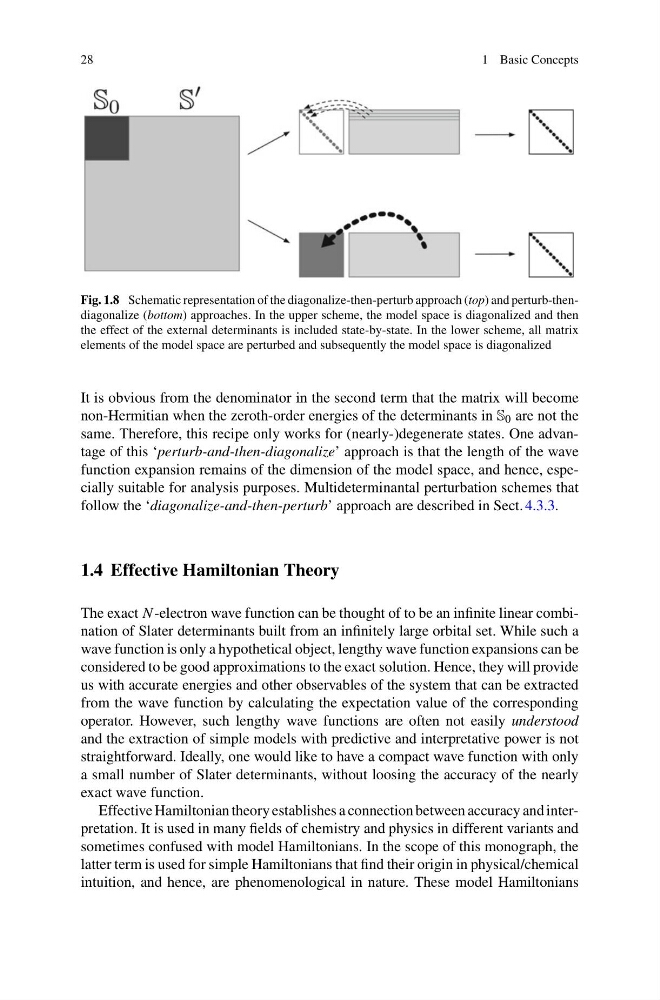
Fig. 1.8 Schematic representation of the diagonalize-then-perturb approach (top) and perturb-thendiagonalize (bottom) approaches. In the upper scheme, the model space is diagonalized and then
the effect of the external determinants is included state-by-state. In the lower scheme, all matrix
elements of the model space are perturbed and subsequently the model space is diagonalized
It is obvious from the denominator in the second term that the matrix will become
non-Hermitian when the zeroth-order energies of the determinants in S 0 are not the
same. Therefore, this recipe only works for (nearly-)degenerate states. One advantage of this ‘perturb-and-then-diagonalize’ approach is that the length of the wave
function expansion remains of the dimension of the model space, and hence, especially suitable for analysis purposes. Multideterminantal perturbation schemes that
follow the ‘diagonalize-and-then-perturb’ approach are described in Sect. 4.3.3.
1.4 Effective Hamiltonian Theory
The exact N -electron wave function can be thought of to be an infinite linear combination of Slater determinants built from an infinitely large orbital set. While such a
wave function is only a hypothetical object, lengthy wave function expansions can be
considered to be good approximations to the exact solution. Hence, they will provide
us with accurate energies and other observables of the system that can be extracted
from the wave function by calculating the expectation value of the corresponding
operator. However, such lengthy wave functions are often not easily understood
and the extraction of simple models with predictive and interpretative power is not
straightforward. Ideally, one would like to have a compact wave function with only
a small number of Slater determinants, without loosing the accuracy of the nearly
exact wave function.
Effective Hamiltonian theory establishes a connection between accuracy and interpretation. It is used in many fields of chemistry and physics in different variants and
sometimes confused with model Hamiltonians. In the scope of this monograph, the
latter term is used for simple Hamiltonians that find their origin in physical/chemical
intuition, and hence, are phenomenological in nature. These model Hamiltonians
1 Basic Concepts
Fig. 1.8 Schematic representation of the diagonalize-then-perturb approach (top) and perturb-thendiagonalize (bottom) approaches. In the upper scheme, the model space is diagonalized and then
the effect of the external determinants is included state-by-state. In the lower scheme, all matrix
elements of the model space are perturbed and subsequently the model space is diagonalized
It is obvious from the denominator in the second term that the matrix will become
non-Hermitian when the zeroth-order energies of the determinants in S 0 are not the
same. Therefore, this recipe only works for (nearly-)degenerate states. One advantage of this ‘perturb-and-then-diagonalize’ approach is that the length of the wave
function expansion remains of the dimension of the model space, and hence, especially suitable for analysis purposes. Multideterminantal perturbation schemes that
follow the ‘diagonalize-and-then-perturb’ approach are described in Sect. 4.3.3.
1.4 Effective Hamiltonian Theory
The exact N -electron wave function can be thought of to be an infinite linear combination of Slater determinants built from an infinitely large orbital set. While such a
wave function is only a hypothetical object, lengthy wave function expansions can be
considered to be good approximations to the exact solution. Hence, they will provide
us with accurate energies and other observables of the system that can be extracted
from the wave function by calculating the expectation value of the corresponding
operator. However, such lengthy wave functions are often not easily understood
and the extraction of simple models with predictive and interpretative power is not
straightforward. Ideally, one would like to have a compact wave function with only
a small number of Slater determinants, without loosing the accuracy of the nearly
exact wave function.
Effective Hamiltonian theory establishes a connection between accuracy and interpretation. It is used in many fields of chemistry and physics in different variants and
sometimes confused with model Hamiltonians. In the scope of this monograph, the
latter term is used for simple Hamiltonians that find their origin in physical/chemical
intuition, and hence, are phenomenological in nature. These model Hamiltonians