

1.3 Perturbation Theory
27
E
(3)
0 =
a
c
(0)
0 | ˆ
H |Φ ab
ij Φ ab
ij | ˆ
H |Φ cd
kl Φ cd
kl | ˆ
H |Ψ
(0)
0
(ε i + ε j − ε a − ε b )(ε k + ε l − ε c − ε d )
− E
(1)
0
a
||Ψ
(0)
0 | ˆ
H |Φ ab
ij | 2
(ε i + ε j − ε a − ε b ) 2
(1.84)
1.3.3 Quasi-Degenerate Perturbation Theory
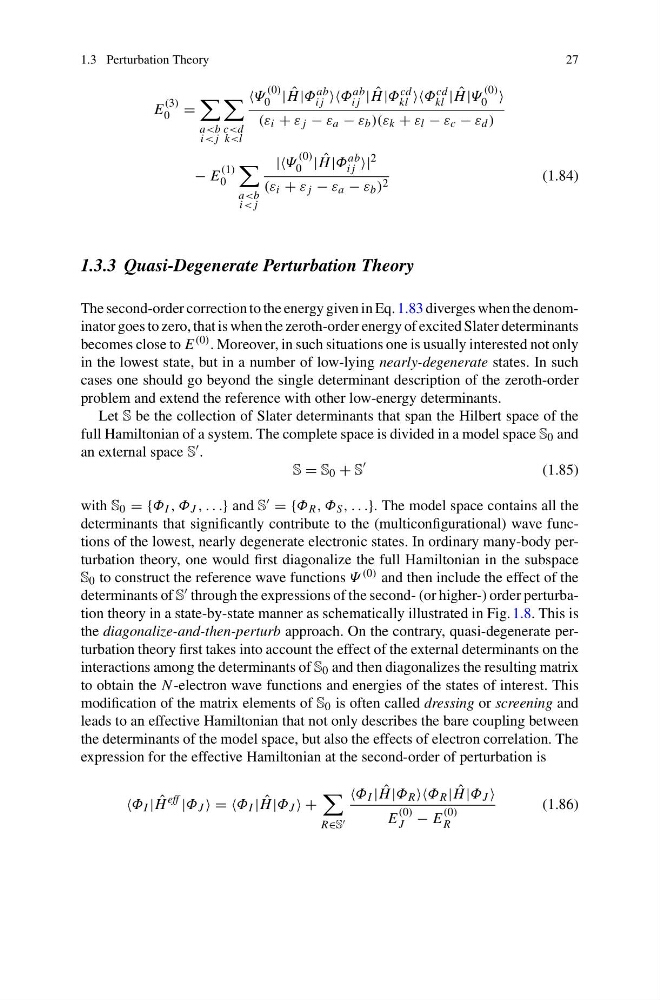
The second-order correction to the energy given in Eq. 1.83 diverges when the denominator goes to zero, that is when the zeroth-order energy of excited Slater determinants
becomes close to E (0) . Moreover, in such situations one is usually interested not only
in the lowest state, but in a number of low-lying nearly-degenerate states. In such
cases one should go beyond the single determinant description of the zeroth-order
problem and extend the reference with other low-energy determinants.
Let S be the collection of Slater determinants that span the Hilbert space of the
full Hamiltonian of a system. The complete space is divided in a model space S 0 and
an external space S ′ .
S = S 0 + S
′
(1.85)
with S 0 ={ Φ I ,Φ J ,...} and S ′ ={ Φ R ,Φ S ,...}. The model space contains all the
determinants that significantly contribute to the (multiconfigurational) wave functions of the lowest, nearly degenerate electronic states. In ordinary many-body perturbation theory, one would first diagonalize the full Hamiltonian in the subspace
S 0 to construct the reference wave functions Ψ (0) and then include the effect of the
determinants of S ′ through the expressions of the second- (or higher-) order perturbation theory in a state-by-state manner as schematically illustrated in Fig. 1.8.Thisis
the diagonalize-and-then-perturb approach. On the contrary, quasi-degenerate perturbation theory first takes into account the effect of the external determinants on the
interactions among the determinants of S 0 and then diagonalizes the resulting matrix
to obtain the N -electron wave functions and energies of the states of interest. This
modification of the matrix elements of S 0 is often called dressing or screening and
leads to an effective Hamiltonian that not only describes the bare coupling between
the determinants of the model space, but also the effects of electron correlation. The
expression for the effective Hamiltonian at the second-order of perturbation is
Φ I | ˆ
H
eff |Φ J ==Φ I | ˆ
H |Φ J +
R∈S ′
Φ I | ˆ
H |Φ R Φ R | ˆ
H |Φ J
E
(0)
J − E
(0)
R
(1.86)
27
E
(3)
0 =
a
c
(0)
0 | ˆ
H |Φ ab
ij Φ ab
ij | ˆ
H |Φ cd
kl Φ cd
kl | ˆ
H |Ψ
(0)
0
(ε i + ε j − ε a − ε b )(ε k + ε l − ε c − ε d )
− E
(1)
0
a
||Ψ
(0)
0 | ˆ
H |Φ ab
ij | 2
(ε i + ε j − ε a − ε b ) 2
(1.84)
1.3.3 Quasi-Degenerate Perturbation Theory
The second-order correction to the energy given in Eq. 1.83 diverges when the denominator goes to zero, that is when the zeroth-order energy of excited Slater determinants
becomes close to E (0) . Moreover, in such situations one is usually interested not only
in the lowest state, but in a number of low-lying nearly-degenerate states. In such
cases one should go beyond the single determinant description of the zeroth-order
problem and extend the reference with other low-energy determinants.
Let S be the collection of Slater determinants that span the Hilbert space of the
full Hamiltonian of a system. The complete space is divided in a model space S 0 and
an external space S ′ .
S = S 0 + S
′
(1.85)
with S 0 ={ Φ I ,Φ J ,...} and S ′ ={ Φ R ,Φ S ,...}. The model space contains all the
determinants that significantly contribute to the (multiconfigurational) wave functions of the lowest, nearly degenerate electronic states. In ordinary many-body perturbation theory, one would first diagonalize the full Hamiltonian in the subspace
S 0 to construct the reference wave functions Ψ (0) and then include the effect of the
determinants of S ′ through the expressions of the second- (or higher-) order perturbation theory in a state-by-state manner as schematically illustrated in Fig. 1.8.Thisis
the diagonalize-and-then-perturb approach. On the contrary, quasi-degenerate perturbation theory first takes into account the effect of the external determinants on the
interactions among the determinants of S 0 and then diagonalizes the resulting matrix
to obtain the N -electron wave functions and energies of the states of interest. This
modification of the matrix elements of S 0 is often called dressing or screening and
leads to an effective Hamiltonian that not only describes the bare coupling between
the determinants of the model space, but also the effects of electron correlation. The
expression for the effective Hamiltonian at the second-order of perturbation is
Φ I | ˆ
H
eff |Φ J ==Φ I | ˆ
H |Φ J +
R∈S ′
Φ I | ˆ
H |Φ R Φ R | ˆ
H |Φ J
E
(0)
J − E
(0)
R
(1.86)