

26
1 Basic Concepts
E
(1)
0 == Ψ
(0) | ˆ
V |Ψ
(0) ==Φ HF |
i
i> j
1
r ij
|Φ HF −−Φ HF |−
i
ˆ
g(i)|Φ HF
=
1
2
i
φ i |
j
ˆ
J j − ˆ
K j |φ i −
i
φ i |
j
ˆ
J j − ˆ
K j |φ i
=−
1
2
i
φ i |
j
ˆ
J j − ˆ
K j |φ i
(1.79)
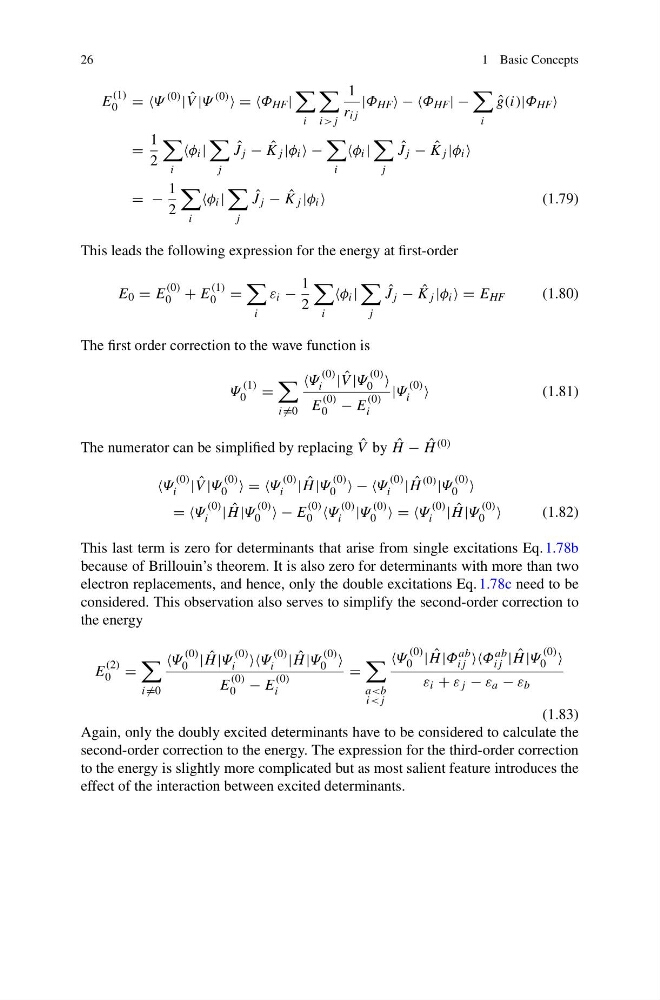
This leads the following expression for the energy at first-order
E 0 = E
(0)
0 + E
(1)
0 =
i
ε i −
1
2
i
φ i |
j
ˆ
J j − ˆ
K j |φ i =E HF
(1.80)
The first order correction to the wave function is
Ψ
(1)
0 =
i =0
Ψ
(0)
i | ˆ
V |Ψ
(0)
0
E
(0)
0 − E
(0)
i
|Ψ
(0)
i
(1.81)
The numerator can be simplified by replacing ˆ
V by ˆ
H − ˆ
H (0)
Ψ
(0)
i | ˆ
V |Ψ
(0)
0 ==Ψ
(0)
i | ˆ
H |Ψ
(0)
0 −−Ψ
(0)
i | ˆ
H
(0) |Ψ
(0)
0
==Ψ
(0)
i | ˆ
H |Ψ
(0)
0 −E
(0)
0 Ψ
(0)
i |Ψ
(0)
0 ==Ψ
(0)
i | ˆ
H |Ψ
(0)
0
(1.82)
This last term is zero for determinants that arise from single excitations Eq. 1.78b
because of Brillouin’s theorem. It is also zero for determinants with more than two
electron replacements, and hence, only the double excitations Eq. 1.78c need to be
considered. This observation also serves to simplify the second-order correction to
the energy
E
(2)
0 =
i =0
Ψ
(0)
0 | ˆ
H |Ψ
(0)
i Ψ
(0)
i | ˆ
H |Ψ
(0)
0
E
(0)
0 − E
(0)
i
=
a
Ψ
(0)
0 | ˆ
H |Φ ab
ij Φ ab
ij | ˆ
H |Ψ
(0)
0
ε i + ε j − ε a − ε b
(1.83)
Again, only the doubly excited determinants have to be considered to calculate the
second-order correction to the energy. The expression for the third-order correction
to the energy is slightly more complicated but as most salient feature introduces the
effect of the interaction between excited determinants.
1 Basic Concepts
E
(1)
0 == Ψ
(0) | ˆ
V |Ψ
(0) ==Φ HF |
i
i> j
1
r ij
|Φ HF −−Φ HF |−
i
ˆ
g(i)|Φ HF
=
1
2
i
φ i |
j
ˆ
J j − ˆ
K j |φ i −
i
φ i |
j
ˆ
J j − ˆ
K j |φ i
=−
1
2
i
φ i |
j
ˆ
J j − ˆ
K j |φ i
(1.79)
This leads the following expression for the energy at first-order
E 0 = E
(0)
0 + E
(1)
0 =
i
ε i −
1
2
i
φ i |
j
ˆ
J j − ˆ
K j |φ i =E HF
(1.80)
The first order correction to the wave function is
Ψ
(1)
0 =
i =0
Ψ
(0)
i | ˆ
V |Ψ
(0)
0
E
(0)
0 − E
(0)
i
|Ψ
(0)
i
(1.81)
The numerator can be simplified by replacing ˆ
V by ˆ
H − ˆ
H (0)
Ψ
(0)
i | ˆ
V |Ψ
(0)
0 ==Ψ
(0)
i | ˆ
H |Ψ
(0)
0 −−Ψ
(0)
i | ˆ
H
(0) |Ψ
(0)
0
==Ψ
(0)
i | ˆ
H |Ψ
(0)
0 −E
(0)
0 Ψ
(0)
i |Ψ
(0)
0 ==Ψ
(0)
i | ˆ
H |Ψ
(0)
0
(1.82)
This last term is zero for determinants that arise from single excitations Eq. 1.78b
because of Brillouin’s theorem. It is also zero for determinants with more than two
electron replacements, and hence, only the double excitations Eq. 1.78c need to be
considered. This observation also serves to simplify the second-order correction to
the energy
E
(2)
0 =
i =0
Ψ
(0)
0 | ˆ
H |Ψ
(0)
i Ψ
(0)
i | ˆ
H |Ψ
(0)
0
E
(0)
0 − E
(0)
i
=
a
Ψ
(0)
0 | ˆ
H |Φ ab
ij Φ ab
ij | ˆ
H |Ψ
(0)
0
ε i + ε j − ε a − ε b
(1.83)
Again, only the doubly excited determinants have to be considered to calculate the
second-order correction to the energy. The expression for the third-order correction
to the energy is slightly more complicated but as most salient feature introduces the
effect of the interaction between excited determinants.