

1.2 Generation of Many Electron Spin Functions
15
1
1
0
2
234
1
2
3
2
1
1
1
2
3
2
1
1
1
1
0
2
234
1
2
3
2
1
1
1
2
3
2
1
1
1
1
0
2
234
1
2
3
2
1
1
1
2
3
2
1
1
(a)
(b)
(a)
(b)
(c)
(d)
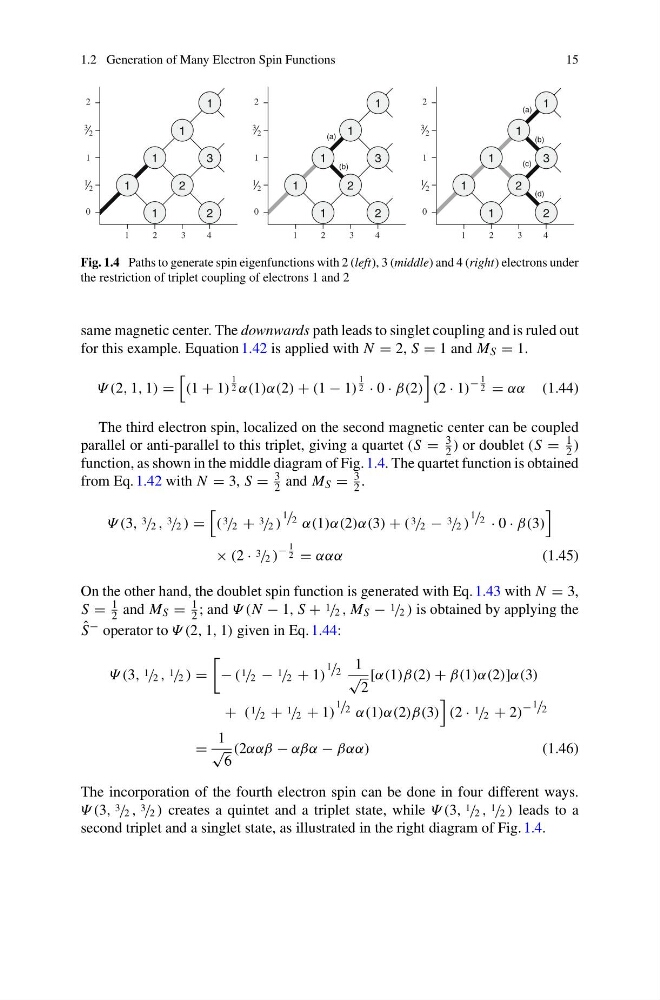
Fig. 1.4 Paths to generate spin eigenfunctions with 2 (left), 3 (middle)and4(right) electrons under
the restriction of triplet coupling of electrons 1 and 2
same magnetic center. The downwards path leads to singlet coupling and is ruled out
for this example. Equation 1.42 is applied with N = 2, S = 1 and M S = 1.
Ψ(2, 1, 1) =
(1 + 1)
1
2 α(1)α(2) + (1 − 1)
1
2 · 0 · β(2)
(2 · 1)
−
1
2 = αα (1.44)
The third electron spin, localized on the second magnetic center can be coupled
parallel or anti-parallel to this triplet, giving a quartet (S =
3
2 ) or doublet (S =
1
2 )
function, as shown in the middle diagram of Fig. 1.4. The quartet function is obtained
from Eq. 1.42 with N = 3, S =
3
2 and M S =
3
2 .
Ψ(3, 3 / 2 , 3 / 2 ) =
( 3 / 2 + 3 / 2 )
1 / 2 α(1)α(2)α(3) + ( 3 / 2 − 3 / 2 )
1 / 2 · 0 · β(3)
× (2 · 3 / 2 )
−
1
2 = ααα
(1.45)
On the other hand, the doublet spin function is generated with Eq. 1.43 with N = 3,
S =
1
2 and M S =
1
2 ; and Ψ(N − 1, S + 1 / 2 , M S − 1 / 2 ) is obtained by applying the
ˆ
S − operator to Ψ(2, 1, 1) given in Eq. 1.44:
Ψ(3, 1 / 2 , 1 / 2 ) =
− ( 1 / 2 − 1 / 2 + 1)
1 / 2 1
√
2
[α(1)β(2) + β(1)α(2)]α(3)
+ ( 1 / 2 + 1 / 2 + 1)
1 / 2 α(1)α(2)β(3)
(2 · 1 / 2 + 2)
− 1 / 2
=
1
√
6
(2ααβ − αβα − βαα)
(1.46)
The incorporation of the fourth electron spin can be done in four different ways.
Ψ(3, 3 / 2 , 3 / 2 ) creates a quintet and a triplet state, while Ψ(3, 1 / 2 , 1 / 2 ) leads to a
second triplet and a singlet state, as illustrated in the right diagram of Fig. 1.4.
15
1
1
0
2
234
1
2
3
2
1
1
1
2
3
2
1
1
1
1
0
2
234
1
2
3
2
1
1
1
2
3
2
1
1
1
1
0
2
234
1
2
3
2
1
1
1
2
3
2
1
1
(a)
(b)
(a)
(b)
(c)
(d)
Fig. 1.4 Paths to generate spin eigenfunctions with 2 (left), 3 (middle)and4(right) electrons under
the restriction of triplet coupling of electrons 1 and 2
same magnetic center. The downwards path leads to singlet coupling and is ruled out
for this example. Equation 1.42 is applied with N = 2, S = 1 and M S = 1.
Ψ(2, 1, 1) =
(1 + 1)
1
2 α(1)α(2) + (1 − 1)
1
2 · 0 · β(2)
(2 · 1)
−
1
2 = αα (1.44)
The third electron spin, localized on the second magnetic center can be coupled
parallel or anti-parallel to this triplet, giving a quartet (S =
3
2 ) or doublet (S =
1
2 )
function, as shown in the middle diagram of Fig. 1.4. The quartet function is obtained
from Eq. 1.42 with N = 3, S =
3
2 and M S =
3
2 .
Ψ(3, 3 / 2 , 3 / 2 ) =
( 3 / 2 + 3 / 2 )
1 / 2 α(1)α(2)α(3) + ( 3 / 2 − 3 / 2 )
1 / 2 · 0 · β(3)
× (2 · 3 / 2 )
−
1
2 = ααα
(1.45)
On the other hand, the doublet spin function is generated with Eq. 1.43 with N = 3,
S =
1
2 and M S =
1
2 ; and Ψ(N − 1, S + 1 / 2 , M S − 1 / 2 ) is obtained by applying the
ˆ
S − operator to Ψ(2, 1, 1) given in Eq. 1.44:
Ψ(3, 1 / 2 , 1 / 2 ) =
− ( 1 / 2 − 1 / 2 + 1)
1 / 2 1
√
2
[α(1)β(2) + β(1)α(2)]α(3)
+ ( 1 / 2 + 1 / 2 + 1)
1 / 2 α(1)α(2)β(3)
(2 · 1 / 2 + 2)
− 1 / 2
=
1
√
6
(2ααβ − αβα − βαα)
(1.46)
The incorporation of the fourth electron spin can be done in four different ways.
Ψ(3, 3 / 2 , 3 / 2 ) creates a quintet and a triplet state, while Ψ(3, 1 / 2 , 1 / 2 ) leads to a
second triplet and a singlet state, as illustrated in the right diagram of Fig. 1.4.