

14
1 Basic Concepts
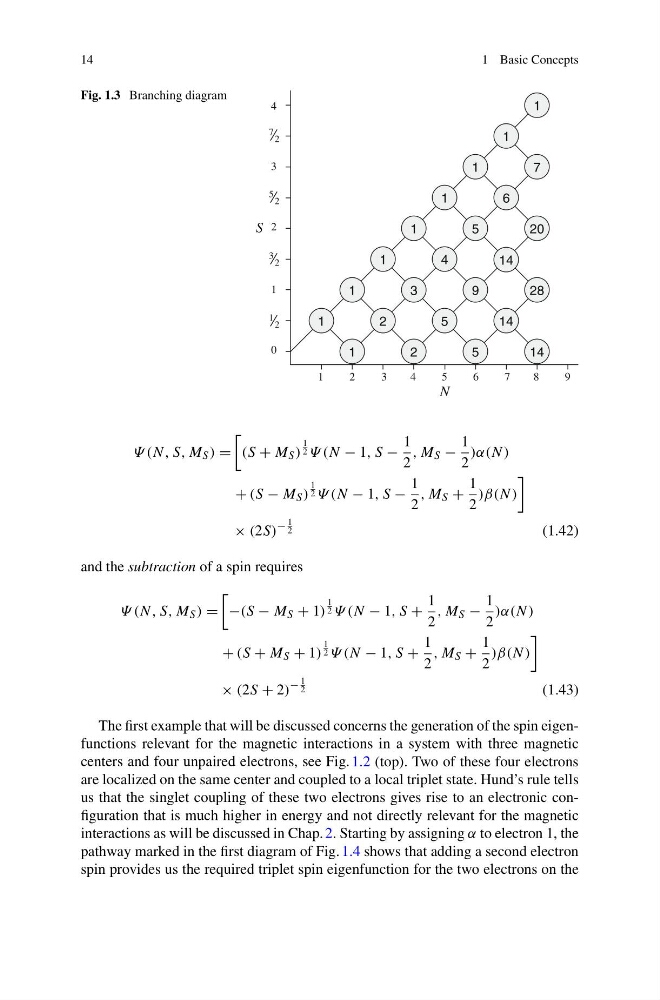
Fig. 1.3 Branching diagram
1
1
1
2
3
4
9
5
5
5
6
7
2
1
1
1
1
1
1
14
14
14
20
28
1
1
0
2
3
4
2345678
N
S
9
1
2
3
2
5
2
7
2
Ψ(N , S, M S ) =
(S + M S )
1
2 Ψ(N − 1, S −
1
2
, M S −
1
2
)α(N )
+ (S − M S )
1
2 Ψ(N − 1, S −
1
2
, M S +
1
2
)β(N )
× (2S)
−
1
2
(1.42)
and the subtraction of a spin requires
Ψ(N , S, M S ) =
−(S − M S + 1)
1
2 Ψ(N − 1, S +
1
2
, M S −
1
2
)α(N )
+ (S + M S + 1)
1
2 Ψ(N − 1, S +
1
2
, M S +
1
2
)β(N )
× (2S + 2)
−
1
2
(1.43)
The first example that will be discussed concerns the generation of the spin eigenfunctions relevant for the magnetic interactions in a system with three magnetic
centers and four unpaired electrons, see Fig. 1.2 (top). Two of these four electrons
are localized on the same center and coupled to a local triplet state. Hund’s rule tells
us that the singlet coupling of these two electrons gives rise to an electronic configuration that is much higher in energy and not directly relevant for the magnetic
interactions as will be discussed in Chap. 2. Starting by assigning α to electron 1, the
pathway marked in the first diagram of Fig. 1.4 shows that adding a second electron
spin provides us the required triplet spin eigenfunction for the two electrons on the
1 Basic Concepts
Fig. 1.3 Branching diagram
1
1
1
2
3
4
9
5
5
5
6
7
2
1
1
1
1
1
1
14
14
14
20
28
1
1
0
2
3
4
2345678
N
S
9
1
2
3
2
5
2
7
2
Ψ(N , S, M S ) =
(S + M S )
1
2 Ψ(N − 1, S −
1
2
, M S −
1
2
)α(N )
+ (S − M S )
1
2 Ψ(N − 1, S −
1
2
, M S +
1
2
)β(N )
× (2S)
−
1
2
(1.42)
and the subtraction of a spin requires
Ψ(N , S, M S ) =
−(S − M S + 1)
1
2 Ψ(N − 1, S +
1
2
, M S −
1
2
)α(N )
+ (S + M S + 1)
1
2 Ψ(N − 1, S +
1
2
, M S +
1
2
)β(N )
× (2S + 2)
−
1
2
(1.43)
The first example that will be discussed concerns the generation of the spin eigenfunctions relevant for the magnetic interactions in a system with three magnetic
centers and four unpaired electrons, see Fig. 1.2 (top). Two of these four electrons
are localized on the same center and coupled to a local triplet state. Hund’s rule tells
us that the singlet coupling of these two electrons gives rise to an electronic configuration that is much higher in energy and not directly relevant for the magnetic
interactions as will be discussed in Chap. 2. Starting by assigning α to electron 1, the
pathway marked in the first diagram of Fig. 1.4 shows that adding a second electron
spin provides us the required triplet spin eigenfunction for the two electrons on the