

16
1 Basic Concepts
Ψ(4, 2, 2) =
(2 + 2)
1
2 α(1)α(2)α(3)α(4) + (2 − 2)
1
2 · 0 · β(4)
(2 · 2)
−
1
2
= αααα
(1.47)
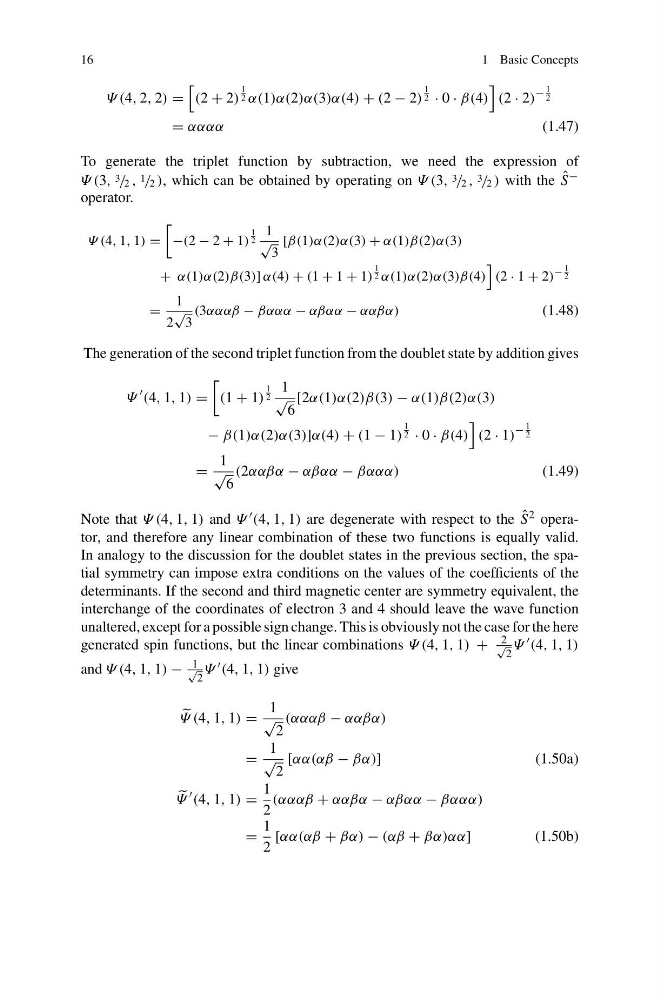
To generate the triplet function by subtraction, we need the expression of
Ψ(3, 3 / 2 , 1 / 2 ), which can be obtained by operating on Ψ(3, 3 / 2 , 3 / 2 ) with the ˆ
S −
operator.
Ψ(4, 1, 1) =
−(2 − 2 + 1)
1
2
1
√
3
[β(1)α(2)α(3) + α(1)β(2)α(3)
+ α(1)α(2)β(3)] α(4) + (1 + 1 + 1)
1
2 α(1)α(2)α(3)β(4)
(2 · 1 + 2)
−
1
2
=
1
2
√
3
(3αααβ − βααα − αβ αα − ααβα)
(1.48)
The generation of the second triplet function from the doublet state by addition gives
Ψ
′ (4, 1, 1) =
(1 + 1)
1
2
1
√
6
[2α(1)α(2)β(3) − α(1)β(2)α(3)
− β(1)α(2)α(3)]α(4) + (1 − 1)
1
2 · 0 · β(4)
(2 · 1)
−
1
2
=
1
√
6
(2ααβα − αβαα − βααα)
(1.49)
Note that Ψ(4, 1, 1) and Ψ ′ (4, 1, 1) are degenerate with respect to the ˆ
S 2 operator, and therefore any linear combination of these two functions is equally valid.
In analogy to the discussion for the doublet states in the previous section, the spatial symmetry can impose extra conditions on the values of the coefficients of the
determinants. If the second and third magnetic center are symmetry equivalent, the
interchange of the coordinates of electron 3 and 4 should leave the wave function
unaltered, except for a possible sign change. This is obviously not the case for the here
generated spin functions, but the linear combinations Ψ(4, 1, 1) +
2
√
2
Ψ ′ (4, 1, 1)
and Ψ(4, 1, 1) −
1
√
2
Ψ ′ (4, 1, 1) give
Ψ(4, 1, 1) =
1
√
2
(αααβ − ααβα)
=
1
√
2
[αα(αβ − βα)]
(1.50a)
Ψ
′ (4, 1, 1) =
1
2
(αααβ + ααβα − αβαα − βααα)
=
1
2
[αα(αβ + βα) − (αβ + βα)αα]
(1.50b)
1 Basic Concepts
Ψ(4, 2, 2) =
(2 + 2)
1
2 α(1)α(2)α(3)α(4) + (2 − 2)
1
2 · 0 · β(4)
(2 · 2)
−
1
2
= αααα
(1.47)
To generate the triplet function by subtraction, we need the expression of
Ψ(3, 3 / 2 , 1 / 2 ), which can be obtained by operating on Ψ(3, 3 / 2 , 3 / 2 ) with the ˆ
S −
operator.
Ψ(4, 1, 1) =
−(2 − 2 + 1)
1
2
1
√
3
[β(1)α(2)α(3) + α(1)β(2)α(3)
+ α(1)α(2)β(3)] α(4) + (1 + 1 + 1)
1
2 α(1)α(2)α(3)β(4)
(2 · 1 + 2)
−
1
2
=
1
2
√
3
(3αααβ − βααα − αβ αα − ααβα)
(1.48)
The generation of the second triplet function from the doublet state by addition gives
Ψ
′ (4, 1, 1) =
(1 + 1)
1
2
1
√
6
[2α(1)α(2)β(3) − α(1)β(2)α(3)
− β(1)α(2)α(3)]α(4) + (1 − 1)
1
2 · 0 · β(4)
(2 · 1)
−
1
2
=
1
√
6
(2ααβα − αβαα − βααα)
(1.49)
Note that Ψ(4, 1, 1) and Ψ ′ (4, 1, 1) are degenerate with respect to the ˆ
S 2 operator, and therefore any linear combination of these two functions is equally valid.
In analogy to the discussion for the doublet states in the previous section, the spatial symmetry can impose extra conditions on the values of the coefficients of the
determinants. If the second and third magnetic center are symmetry equivalent, the
interchange of the coordinates of electron 3 and 4 should leave the wave function
unaltered, except for a possible sign change. This is obviously not the case for the here
generated spin functions, but the linear combinations Ψ(4, 1, 1) +
2
√
2
Ψ ′ (4, 1, 1)
and Ψ(4, 1, 1) −
1
√
2
Ψ ′ (4, 1, 1) give
Ψ(4, 1, 1) =
1
√
2
(αααβ − ααβα)
=
1
√
2
[αα(αβ − βα)]
(1.50a)
Ψ
′ (4, 1, 1) =
1
2
(αααβ + ααβα − αβαα − βααα)
=
1
2
[αα(αβ + βα) − (αβ + βα)αα]
(1.50b)