

12
1 Basic Concepts
⎛
⎝
7
4 11
1
7
4 1
11
7
4
⎞
⎠
⎛
⎝
c 1
c 2
c 3
⎞
⎠ = x
⎛
⎝
c 1
c 2
c 3
⎞
⎠
(1.39)
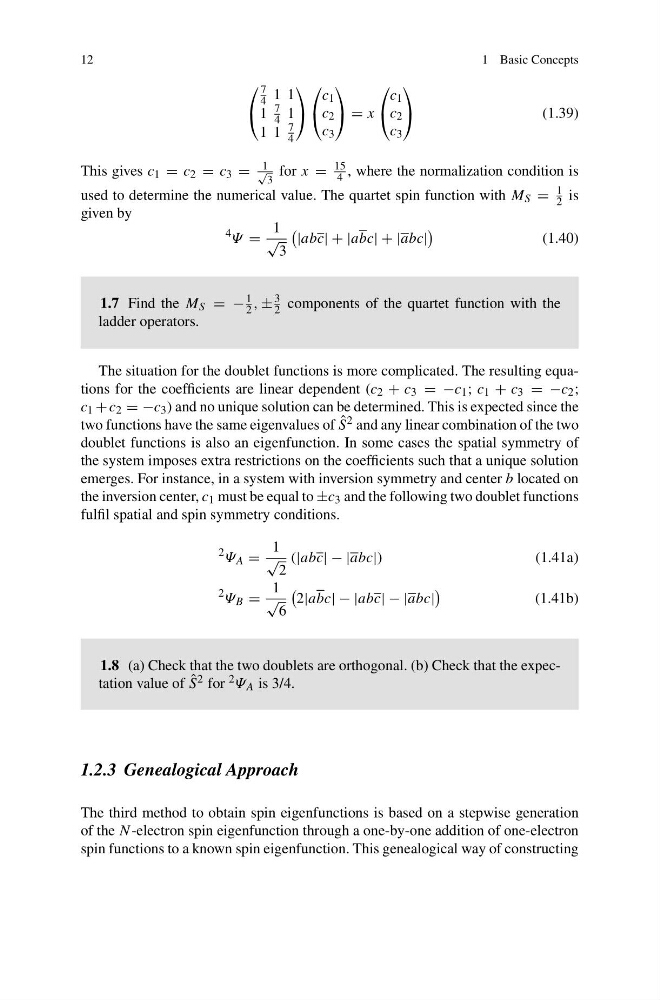
This gives c 1 = c 2 = c 3 =
1
√
3
for x =
15
4 , where the normalization condition is
used to determine the numerical value. The quartet spin function with M S =
1
2 is
given by
4 Ψ =
1
√
3
|abc|+|abc|+|abc|
(1.40)
1.7 Find the M S =−
1
2 , ±
3
2 components of the quartet function with the
ladder operators.
The situation for the doublet functions is more complicated. The resulting equations for the coefficients are linear dependent (c 2 + c 3 =− c 1 ; c 1 + c 3 =− c 2 ;
c 1 + c 2 =−c 3 ) and no unique solution can be determined. This is expected since the
two functions have the same eigenvalues of ˆ
S 2 and any linear combination of the two
doublet functions is also an eigenfunction. In some cases the spatial symmetry of
the system imposes extra restrictions on the coefficients such that a unique solution
emerges. For instance, in a system with inversion symmetry and center b located on
the inversion center, c 1 must be equal to ±c 3 and the following two doublet functions
fulfil spatial and spin symmetry conditions.
2 Ψ A =
1
√
2
(|abc|−|abc|)
(1.41a)
2 Ψ B =
1
√
6
2|abc|−|abc|−|abc|
(1.41b)
1.8 (a) Check that the two doublets are orthogonal. (b) Check that the expectation value of ˆ
S 2 for 2 Ψ A is 3/4.
1.2.3 Genealogical Approach
The third method to obtain spin eigenfunctions is based on a stepwise generation
of the N -electron spin eigenfunction through a one-by-one addition of one-electron
spin functions to a known spin eigenfunction. This genealogical way of constructing
1 Basic Concepts
⎛
⎝
7
4 11
1
7
4 1
11
7
4
⎞
⎠
⎛
⎝
c 1
c 2
c 3
⎞
⎠ = x
⎛
⎝
c 1
c 2
c 3
⎞
⎠
(1.39)
This gives c 1 = c 2 = c 3 =
1
√
3
for x =
15
4 , where the normalization condition is
used to determine the numerical value. The quartet spin function with M S =
1
2 is
given by
4 Ψ =
1
√
3
|abc|+|abc|+|abc|
(1.40)
1.7 Find the M S =−
1
2 , ±
3
2 components of the quartet function with the
ladder operators.
The situation for the doublet functions is more complicated. The resulting equations for the coefficients are linear dependent (c 2 + c 3 =− c 1 ; c 1 + c 3 =− c 2 ;
c 1 + c 2 =−c 3 ) and no unique solution can be determined. This is expected since the
two functions have the same eigenvalues of ˆ
S 2 and any linear combination of the two
doublet functions is also an eigenfunction. In some cases the spatial symmetry of
the system imposes extra restrictions on the coefficients such that a unique solution
emerges. For instance, in a system with inversion symmetry and center b located on
the inversion center, c 1 must be equal to ±c 3 and the following two doublet functions
fulfil spatial and spin symmetry conditions.
2 Ψ A =
1
√
2
(|abc|−|abc|)
(1.41a)
2 Ψ B =
1
√
6
2|abc|−|abc|−|abc|
(1.41b)
1.8 (a) Check that the two doublets are orthogonal. (b) Check that the expectation value of ˆ
S 2 for 2 Ψ A is 3/4.
1.2.3 Genealogical Approach
The third method to obtain spin eigenfunctions is based on a stepwise generation
of the N -electron spin eigenfunction through a one-by-one addition of one-electron
spin functions to a known spin eigenfunction. This genealogical way of constructing