

1.2 Generation of Many Electron Spin Functions
11
with three electrons in three distinct orbitals. The basis set spanned in the M S =
1
2
space contains three determinants
Φ 1 =|abc|
Φ 2 =|abc|
Φ 3 =|abc|
(1.34)
The matrix representation of ˆ
S 2 can be constructed by analyzing the effect of ˆ
S + ˆ
S − ,
ˆ
S z and ˆ
S 2
z (cf. Eq. 1.21) on the three basis functions.
ˆ
S
+ ˆ
S
− |abc|= ˆ
S
+
|abc|+|abc|+0
=|abc|+|abc|+|abc|+|abc| (1.35a)
ˆ
S z |abc|=
1
2
+
1
2
−
1
2
|abc|=
1
2
|abc|
(1.35b)
ˆ
S
2
z |abc|=
1
4
|abc|
(1.35c)
The other two determinants give analogous results and from this we evaluate the
action of ˆ
S 2 on the three basis functions:
ˆ
S
2 |abc|= 7 / 4 |abc|+|abc|+|abc|
(1.36a)
ˆ
S
2 |abc|=|abc|+ 7 / 4 |abc|+|abc|
(1.36b)
ˆ
S
2 |abc|=|abc|+|abc|+ 7 / 4 |abc|
(1.36c)
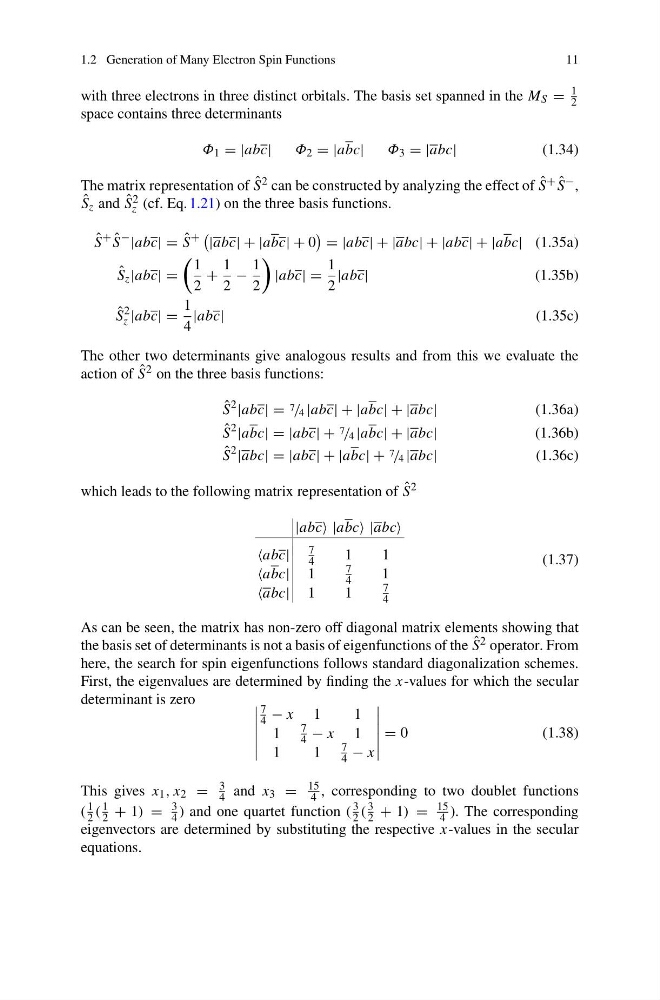
which leads to the following matrix representation of ˆ
S 2
|abc| abc| abc
abc|
7
4
11
abc| 1
7
4
1
abc| 11
7
4
(1.37)
As can be seen, the matrix has non-zero off diagonal matrix elements showing that
the basis set of determinants is not a basis of eigenfunctions of the ˆ
S 2 operator. From
here, the search for spin eigenfunctions follows standard diagonalization schemes.
First, the eigenvalues are determined by finding the x-values for which the secular
determinant is zero
7
4 − x 11
1
7
4 − x 1
11
7
4 − x
= 0
(1.38)
This gives x 1 , x 2 =
3
4 and x 3 =
15
4 , corresponding to two doublet functions
(
1
2 (
1
2 + 1) =
3
4 ) and one quartet function (
3
2 (
3
2 + 1) =
15
4 ). The corresponding
eigenvectors are determined by substituting the respective x-values in the secular
equations.
11
with three electrons in three distinct orbitals. The basis set spanned in the M S =
1
2
space contains three determinants
Φ 1 =|abc|
Φ 2 =|abc|
Φ 3 =|abc|
(1.34)
The matrix representation of ˆ
S 2 can be constructed by analyzing the effect of ˆ
S + ˆ
S − ,
ˆ
S z and ˆ
S 2
z (cf. Eq. 1.21) on the three basis functions.
ˆ
S
+ ˆ
S
− |abc|= ˆ
S
+
|abc|+|abc|+0
=|abc|+|abc|+|abc|+|abc| (1.35a)
ˆ
S z |abc|=
1
2
+
1
2
−
1
2
|abc|=
1
2
|abc|
(1.35b)
ˆ
S
2
z |abc|=
1
4
|abc|
(1.35c)
The other two determinants give analogous results and from this we evaluate the
action of ˆ
S 2 on the three basis functions:
ˆ
S
2 |abc|= 7 / 4 |abc|+|abc|+|abc|
(1.36a)
ˆ
S
2 |abc|=|abc|+ 7 / 4 |abc|+|abc|
(1.36b)
ˆ
S
2 |abc|=|abc|+|abc|+ 7 / 4 |abc|
(1.36c)
which leads to the following matrix representation of ˆ
S 2
|abc| abc| abc
abc|
7
4
11
abc| 1
7
4
1
abc| 11
7
4
(1.37)
As can be seen, the matrix has non-zero off diagonal matrix elements showing that
the basis set of determinants is not a basis of eigenfunctions of the ˆ
S 2 operator. From
here, the search for spin eigenfunctions follows standard diagonalization schemes.
First, the eigenvalues are determined by finding the x-values for which the secular
determinant is zero
7
4 − x 11
1
7
4 − x 1
11
7
4 − x
= 0
(1.38)
This gives x 1 , x 2 =
3
4 and x 3 =
15
4 , corresponding to two doublet functions
(
1
2 (
1
2 + 1) =
3
4 ) and one quartet function (
3
2 (
3
2 + 1) =
15
4 ). The corresponding
eigenvectors are determined by substituting the respective x-values in the secular
equations.