

208
6 Magnetism and Conduction
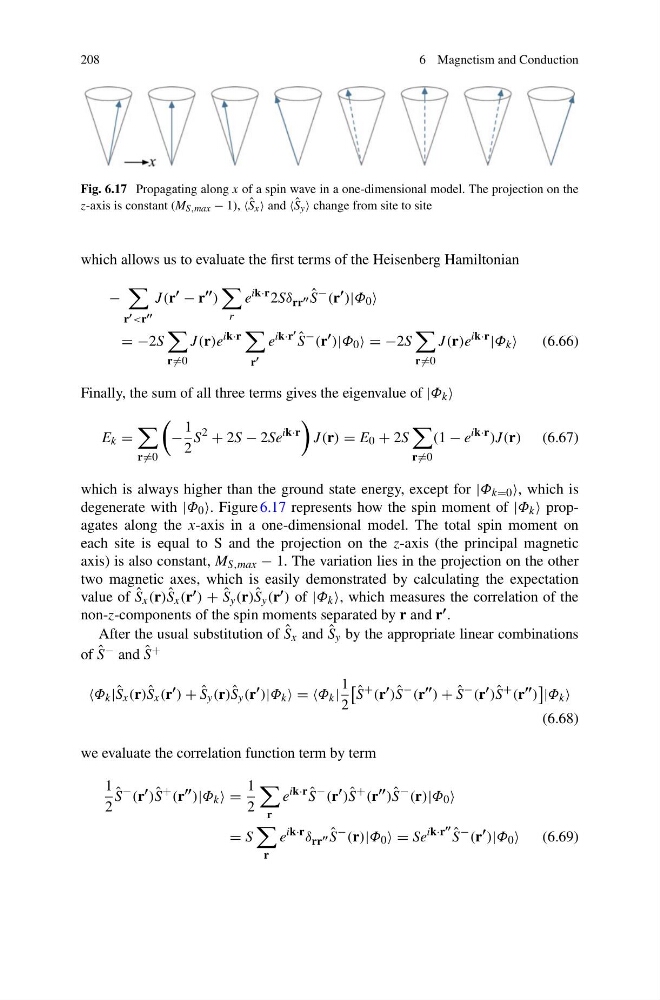
Fig. 6.17 Propagating along x of a spin wave in a one-dimensional model. The projection on the
z-axis is constant (M S,max − 1), ˆ
S x and ˆ
S y change from site to site
which allows us to evaluate the first terms of the Heisenberg Hamiltonian
−
r ′
′ − r
′′ )
r
e
ik·r 2Sδ rr ′′ ˆ
S
− (r
′ )|Φ 0
=−2S
r =0
J(r)e
ik·r
r ′
e
ik·r ′ ˆ
S
− (r
′ )|Φ 0 =−2S
r =0
J(r)e
ik·r |Φ k
(6.66)
Finally, the sum of all three terms gives the eigenvalue of |Φ k
E k =
r =0
−
1
2
S
2 + 2S − 2Se
ik·r
J(r) = E 0 + 2S
r =0
(1 − e
ik·r )J(r) (6.67)
which is always higher than the ground state energy, except for |Φ k=0 , which is
degenerate with |Φ 0 . Figure 6.17 represents how the spin moment of |Φ k propagates along the x-axis in a one-dimensional model. The total spin moment on
each site is equal to S and the projection on the z-axis (the principal magnetic
axis) is also constant, M S,max − 1. The variation lies in the projection on the other
two magnetic axes, which is easily demonstrated by calculating the expectation
value of ˆ
S x (r) ˆ
S x (r ′ ) + ˆ
S y (r) ˆ
S y (r ′ ) of |Φ k , which measures the correlation of the
non-z-components of the spin moments separated by r and r ′ .
After the usual substitution of ˆ
S x and ˆ
S y by the appropriate linear combinations
of ˆ
S − and ˆ
S +
Φ k | ˆ
S x (r) ˆ
S x (r
′ ) + ˆ
S y (r) ˆ
S y (r
′ )|Φ k ==Φ k |
1
2
ˆ
S
+ (r
′ ) ˆ
S
− (r
′′ ) + ˆ
S
− (r
′ ) ˆ
S
+ (r
′′ )
|Φ k
(6.68)
we evaluate the correlation function term by term
1
2
ˆ
S
− (r
′ ) ˆ
S
+ (r
′′ )|Φ k =
1
2
r
e
ik·r ˆ
S
− (r
′ ) ˆ
S
+ (r
′′ ) ˆ
S
− (r)|Φ 0
= S
r
e
ik·r δ rr ′′ ˆ
S
− (r)|Φ 0 =Se
ik·r ′′ ˆ
S
− (r
′ )|Φ 0
(6.69)
6 Magnetism and Conduction
Fig. 6.17 Propagating along x of a spin wave in a one-dimensional model. The projection on the
z-axis is constant (M S,max − 1), ˆ
S x and ˆ
S y change from site to site
which allows us to evaluate the first terms of the Heisenberg Hamiltonian
−
r ′
′ − r
′′ )
r
e
ik·r 2Sδ rr ′′ ˆ
S
− (r
′ )|Φ 0
=−2S
r =0
J(r)e
ik·r
r ′
e
ik·r ′ ˆ
S
− (r
′ )|Φ 0 =−2S
r =0
J(r)e
ik·r |Φ k
(6.66)
Finally, the sum of all three terms gives the eigenvalue of |Φ k
E k =
r =0
−
1
2
S
2 + 2S − 2Se
ik·r
J(r) = E 0 + 2S
r =0
(1 − e
ik·r )J(r) (6.67)
which is always higher than the ground state energy, except for |Φ k=0 , which is
degenerate with |Φ 0 . Figure 6.17 represents how the spin moment of |Φ k propagates along the x-axis in a one-dimensional model. The total spin moment on
each site is equal to S and the projection on the z-axis (the principal magnetic
axis) is also constant, M S,max − 1. The variation lies in the projection on the other
two magnetic axes, which is easily demonstrated by calculating the expectation
value of ˆ
S x (r) ˆ
S x (r ′ ) + ˆ
S y (r) ˆ
S y (r ′ ) of |Φ k , which measures the correlation of the
non-z-components of the spin moments separated by r and r ′ .
After the usual substitution of ˆ
S x and ˆ
S y by the appropriate linear combinations
of ˆ
S − and ˆ
S +
Φ k | ˆ
S x (r) ˆ
S x (r
′ ) + ˆ
S y (r) ˆ
S y (r
′ )|Φ k ==Φ k |
1
2
ˆ
S
+ (r
′ ) ˆ
S
− (r
′′ ) + ˆ
S
− (r
′ ) ˆ
S
+ (r
′′ )
|Φ k
(6.68)
we evaluate the correlation function term by term
1
2
ˆ
S
− (r
′ ) ˆ
S
+ (r
′′ )|Φ k =
1
2
r
e
ik·r ˆ
S
− (r
′ ) ˆ
S
+ (r
′′ ) ˆ
S
− (r)|Φ 0
= S
r
e
ik·r δ rr ′′ ˆ
S
− (r)|Φ 0 =Se
ik·r ′′ ˆ
S
− (r
′ )|Φ 0
(6.69)