

6.5 Spin Waves for Ferromagnets
207
ˆ
H =−
r ′
′ − r
′′ )
1
2
ˆ
S
+ (r
′ ) · ˆ
S
− (r
′′ ) + ˆ
S
− (r
′ ) · ˆ
S
+ (r
′′ )
+ ˆ
S z (r
′ ) ˆ
S z (r
′′ )
(6.60)
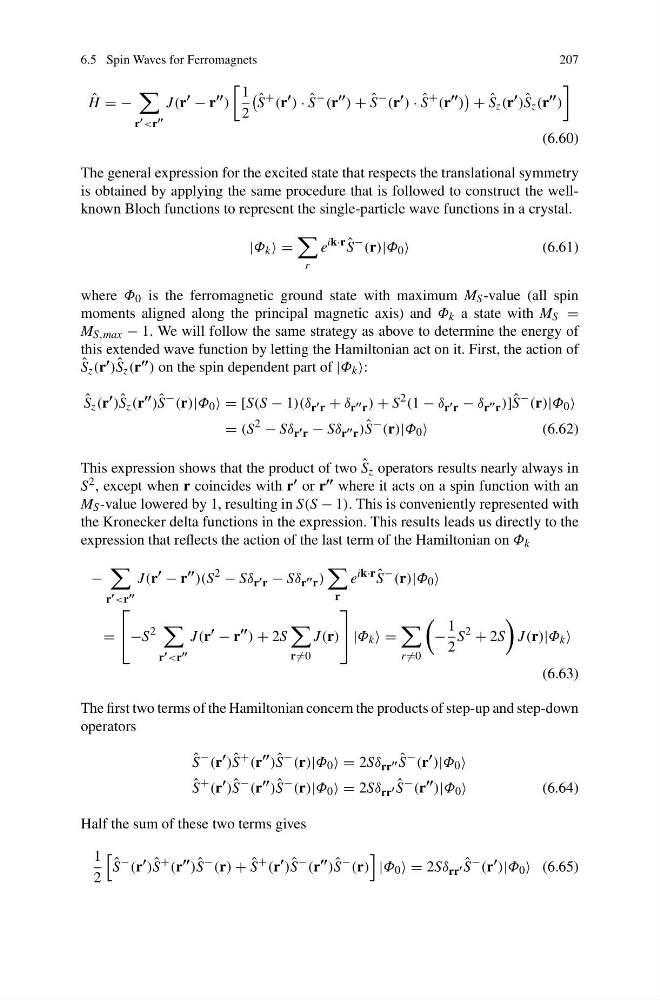
The general expression for the excited state that respects the translational symmetry
is obtained by applying the same procedure that is followed to construct the wellknown Bloch functions to represent the single-particle wave functions in a crystal.
|Φ k =
r
e
ik·r ˆ
S
− (r)|Φ 0
(6.61)
where Φ 0 is the ferromagnetic ground state with maximum M S -value (all spin
moments aligned along the principal magnetic axis) and Φ k a state with M S =
M S,max − 1. We will follow the same strategy as above to determine the energy of
this extended wave function by letting the Hamiltonian act on it. First, the action of
ˆ
S z (r ′ ) ˆ
S z (r ′′ ) on the spin dependent part of |Φ k :
ˆ
S z (r
′ ) ˆ
S z (r
′′ ) ˆ
S
− (r)|Φ 0 =[S(S − 1)(δ r ′ r + δ r ′′ r ) + S
2 (1 − δ r ′ r − δ r ′′ r )] ˆ
S
− (r)|Φ 0
= (S
2 − Sδ r ′ r − Sδ r ′′ r ) ˆ
S
− (r)|Φ 0
(6.62)
This expression shows that the product of two ˆ
S z operators results nearly always in
S 2 , except when r coincides with r ′ or r ′′ where it acts on a spin function with an
M S -value lowered by 1, resulting in S(S − 1). This is conveniently represented with
the Kronecker delta functions in the expression. This results leads us directly to the
expression that reflects the action of the last term of the Hamiltonian on Φ k
−
r ′
′ − r
′′ )(S
2 − Sδ r ′ r − Sδ r ′′ r )
r
e
ik·r ˆ
S
− (r)|Φ 0
=
⎡
⎣ −S
2
r ′
′ − r
′′ ) + 2S
r =0
J(r)
⎤
⎦ |Φ k =
r =0
−
1
2
S
2 + 2S
J(r)|Φ k
(6.63)
The first two terms of the Hamiltonian concern the products of step-up and step-down
operators
ˆ
S
− (r
′ ) ˆ
S
+ (r
′′ ) ˆ
S
− (r)|Φ 0 =2Sδ rr ′′ ˆ
S
− (r
′ )|Φ 0
ˆ
S
+ (r
′ ) ˆ
S
− (r
′′ ) ˆ
S
− (r)|Φ 0 =2Sδ rr ′ ˆ
S
− (r
′′ )|Φ 0
(6.64)
Half the sum of these two terms gives
1
2
ˆ
S
− (r
′ ) ˆ
S
+ (r
′′ ) ˆ
S
− (r) + ˆ
S
+ (r
′ ) ˆ
S
− (r
′′ ) ˆ
S
− (r)
|Φ 0 =2Sδ rr ′ ˆ
S
− (r
′ )|Φ 0 (6.65)
207
ˆ
H =−
r ′
′ − r
′′ )
1
2
ˆ
S
+ (r
′ ) · ˆ
S
− (r
′′ ) + ˆ
S
− (r
′ ) · ˆ
S
+ (r
′′ )
+ ˆ
S z (r
′ ) ˆ
S z (r
′′ )
(6.60)
The general expression for the excited state that respects the translational symmetry
is obtained by applying the same procedure that is followed to construct the wellknown Bloch functions to represent the single-particle wave functions in a crystal.
|Φ k =
r
e
ik·r ˆ
S
− (r)|Φ 0
(6.61)
where Φ 0 is the ferromagnetic ground state with maximum M S -value (all spin
moments aligned along the principal magnetic axis) and Φ k a state with M S =
M S,max − 1. We will follow the same strategy as above to determine the energy of
this extended wave function by letting the Hamiltonian act on it. First, the action of
ˆ
S z (r ′ ) ˆ
S z (r ′′ ) on the spin dependent part of |Φ k :
ˆ
S z (r
′ ) ˆ
S z (r
′′ ) ˆ
S
− (r)|Φ 0 =[S(S − 1)(δ r ′ r + δ r ′′ r ) + S
2 (1 − δ r ′ r − δ r ′′ r )] ˆ
S
− (r)|Φ 0
= (S
2 − Sδ r ′ r − Sδ r ′′ r ) ˆ
S
− (r)|Φ 0
(6.62)
This expression shows that the product of two ˆ
S z operators results nearly always in
S 2 , except when r coincides with r ′ or r ′′ where it acts on a spin function with an
M S -value lowered by 1, resulting in S(S − 1). This is conveniently represented with
the Kronecker delta functions in the expression. This results leads us directly to the
expression that reflects the action of the last term of the Hamiltonian on Φ k
−
r ′
′ − r
′′ )(S
2 − Sδ r ′ r − Sδ r ′′ r )
r
e
ik·r ˆ
S
− (r)|Φ 0
=
⎡
⎣ −S
2
r ′
′ − r
′′ ) + 2S
r =0
J(r)
⎤
⎦ |Φ k =
r =0
−
1
2
S
2 + 2S
J(r)|Φ k
(6.63)
The first two terms of the Hamiltonian concern the products of step-up and step-down
operators
ˆ
S
− (r
′ ) ˆ
S
+ (r
′′ ) ˆ
S
− (r)|Φ 0 =2Sδ rr ′′ ˆ
S
− (r
′ )|Φ 0
ˆ
S
+ (r
′ ) ˆ
S
− (r
′′ ) ˆ
S
− (r)|Φ 0 =2Sδ rr ′ ˆ
S
− (r
′′ )|Φ 0
(6.64)
Half the sum of these two terms gives
1
2
ˆ
S
− (r
′ ) ˆ
S
+ (r
′′ ) ˆ
S
− (r) + ˆ
S
+ (r
′ ) ˆ
S
− (r
′′ ) ˆ
S
− (r)
|Φ 0 =2Sδ rr ′ ˆ
S
− (r
′ )|Φ 0 (6.65)