

206
6 Magnetism and Conduction
Ψ − : ˆ
H(Φ 1 − Φ 2 )/
√
2 =−
i
− SΦ 1 + SΦ 2 + (S − 1)S(Φ 1 − Φ 2 )
/
√
2
=−
i
2 − S)(Φ 1 − Φ 2 )/
√
2 =−
i
2 − 2S)Ψ −
(6.59)
E + is identical to the ground state value and the corresponding wave function has the
same spin multiplicity as Φ 0 but the total M S value is lowered by one. The second
energy, E − , is higher than E 0 (remember that the J ij are positive for a ferromagnetic
system) and describes a state where the total spin moment is no longer equal to the
maximum value.
6.6 Consider a system with two S = 1 magnetic sites. The ferromagnetic
solution is Φ 0 = αααα. Check that Ψ ± = (M S,max , M S,max −1)± (M S,max −1,
M S,max ) are indeed eigenfunctions of the Heisenberg Hamiltonian and that the
plus combination corresponds to a quintet and the minus combination to a
triplet.
This description of the excited state does however not respect the translational
symmetry of the crystal and an extra step has to be taken to obtain a more complete
description. First, we change from discrete point indexation (1, 2,...i, j,...,N) to
a more convenient representation based on the distance between two lattice sites.
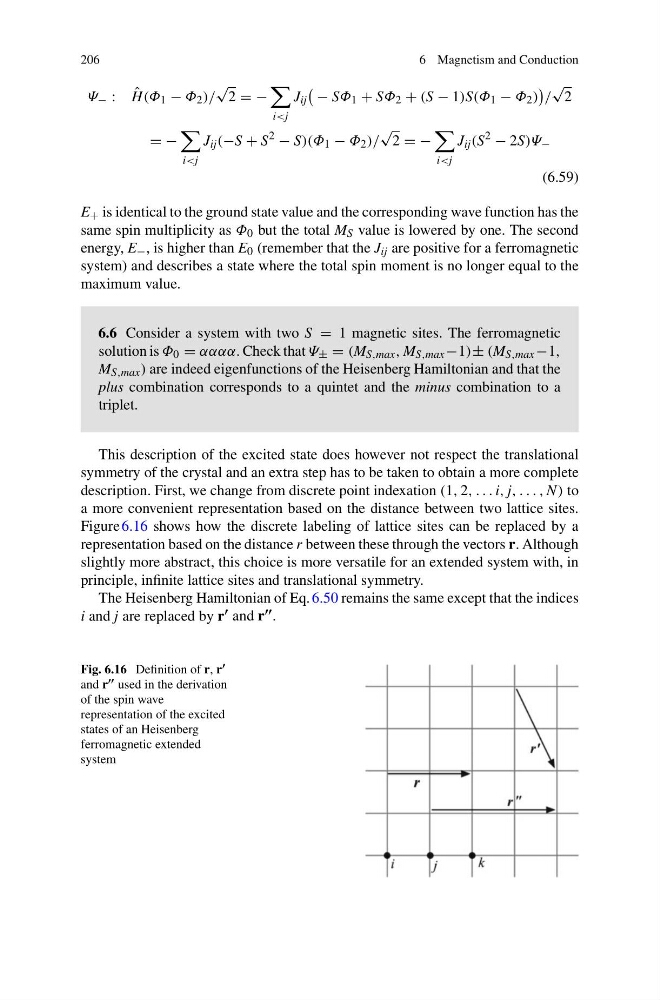
Figure 6.16 shows how the discrete labeling of lattice sites can be replaced by a
representation based on the distance r between these through the vectors r. Although
slightly more abstract, this choice is more versatile for an extended system with, in
principle, infinite lattice sites and translational symmetry.
The Heisenberg Hamiltonian of Eq. 6.50 remains the same except that the indices
i and j are replaced by r ′ and r ′′ .
Fig. 6.16 Definition of r, r ′
and r ′′ used in the derivation
of the spin wave
representation of the excited
states of an Heisenberg
ferromagnetic extended
system
6 Magnetism and Conduction
Ψ − : ˆ
H(Φ 1 − Φ 2 )/
√
2 =−
i
− SΦ 1 + SΦ 2 + (S − 1)S(Φ 1 − Φ 2 )
/
√
2
=−
i
2 − S)(Φ 1 − Φ 2 )/
√
2 =−
i
2 − 2S)Ψ −
(6.59)
E + is identical to the ground state value and the corresponding wave function has the
same spin multiplicity as Φ 0 but the total M S value is lowered by one. The second
energy, E − , is higher than E 0 (remember that the J ij are positive for a ferromagnetic
system) and describes a state where the total spin moment is no longer equal to the
maximum value.
6.6 Consider a system with two S = 1 magnetic sites. The ferromagnetic
solution is Φ 0 = αααα. Check that Ψ ± = (M S,max , M S,max −1)± (M S,max −1,
M S,max ) are indeed eigenfunctions of the Heisenberg Hamiltonian and that the
plus combination corresponds to a quintet and the minus combination to a
triplet.
This description of the excited state does however not respect the translational
symmetry of the crystal and an extra step has to be taken to obtain a more complete
description. First, we change from discrete point indexation (1, 2,...i, j,...,N) to
a more convenient representation based on the distance between two lattice sites.
Figure 6.16 shows how the discrete labeling of lattice sites can be replaced by a
representation based on the distance r between these through the vectors r. Although
slightly more abstract, this choice is more versatile for an extended system with, in
principle, infinite lattice sites and translational symmetry.
The Heisenberg Hamiltonian of Eq. 6.50 remains the same except that the indices
i and j are replaced by r ′ and r ′′ .
Fig. 6.16 Definition of r, r ′
and r ′′ used in the derivation
of the spin wave
representation of the excited
states of an Heisenberg
ferromagnetic extended
system