

6.5 Spin Waves for Ferromagnets
205
The zero’s in the first two contributions are due to the fact that a spin with maximum
M S -value cannot climb further on the ladder by ˆ
S + . From this, we confirm that Φ 0
is an eigenfunction with eigenvalue
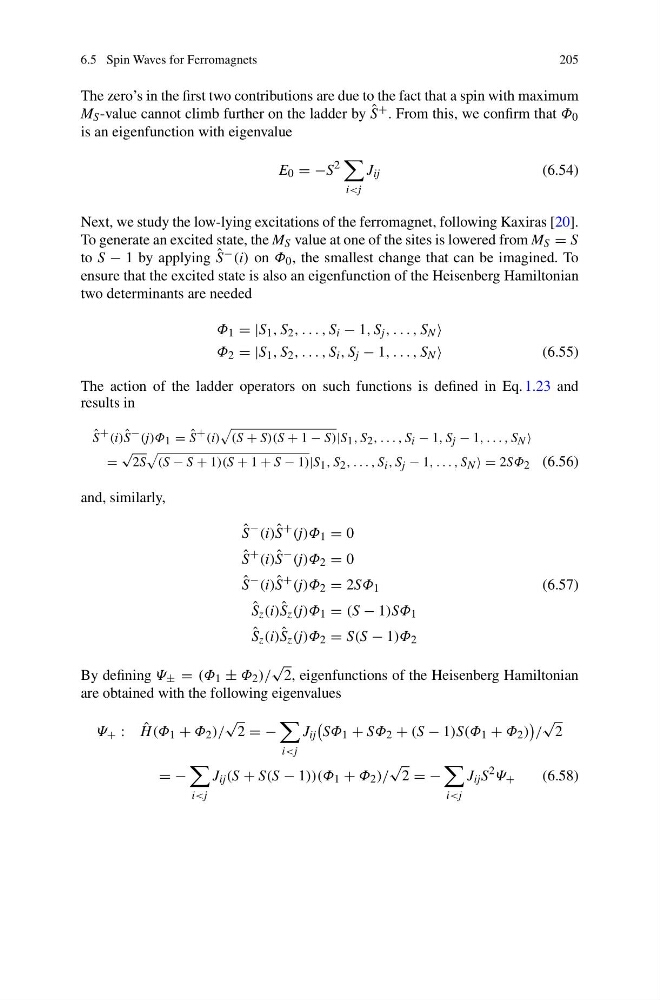
E 0 =−S
2
i
(6.54)
Next, we study the low-lying excitations of the ferromagnet, following Kaxiras [20].
To generate an excited state, the M S value at one of the sites is lowered from M S = S
to S − 1 by applying ˆ
S − (i) on Φ 0 , the smallest change that can be imagined. To
ensure that the excited state is also an eigenfunction of the Heisenberg Hamiltonian
two determinants are needed
Φ 1 =|S 1 , S 2 ,...,S i − 1, S j ,...,S N
Φ 2 =|S 1 , S 2 ,...,S i , S j − 1,...,S N
(6.55)
The action of the ladder operators on such functions is defined in Eq. 1.23 and
results in
ˆ
S + (i) ˆ
S − (j)Φ 1 = ˆ
S + (i)
(S + S)(S + 1 − S)|S 1 , S 2 ,...,S i − 1, S j − 1,...,S N
=
√
2S
(S − S + 1)(S + 1 + S − 1)|S 1 , S 2 ,...,S i , S j − 1,...,S N =2SΦ 2 (6.56)
and, similarly,
ˆ
S
− (i) ˆ
S
+ (j)Φ 1 = 0
ˆ
S
+ (i) ˆ
S
− (j)Φ 2 = 0
ˆ
S
− (i) ˆ
S
+ (j)Φ 2 = 2SΦ 1
(6.57)
ˆ
S z (i) ˆ
S z (j)Φ 1 = (S − 1)SΦ 1
ˆ
S z (i) ˆ
S z (j)Φ 2 = S(S − 1)Φ 2
By defining Ψ ± = (Φ 1 ± Φ 2 )/
√
2, eigenfunctions of the Heisenberg Hamiltonian
are obtained with the following eigenvalues
Ψ + : ˆ
H(Φ 1 + Φ 2 )/
√
2 =−
i
SΦ 1 + SΦ 2 + (S − 1)S(Φ 1 + Φ 2 )
/
√
2
=−
i
√
2 =−
i
2 Ψ +
(6.58)
205
The zero’s in the first two contributions are due to the fact that a spin with maximum
M S -value cannot climb further on the ladder by ˆ
S + . From this, we confirm that Φ 0
is an eigenfunction with eigenvalue
E 0 =−S
2
i
(6.54)
Next, we study the low-lying excitations of the ferromagnet, following Kaxiras [20].
To generate an excited state, the M S value at one of the sites is lowered from M S = S
to S − 1 by applying ˆ
S − (i) on Φ 0 , the smallest change that can be imagined. To
ensure that the excited state is also an eigenfunction of the Heisenberg Hamiltonian
two determinants are needed
Φ 1 =|S 1 , S 2 ,...,S i − 1, S j ,...,S N
Φ 2 =|S 1 , S 2 ,...,S i , S j − 1,...,S N
(6.55)
The action of the ladder operators on such functions is defined in Eq. 1.23 and
results in
ˆ
S + (i) ˆ
S − (j)Φ 1 = ˆ
S + (i)
(S + S)(S + 1 − S)|S 1 , S 2 ,...,S i − 1, S j − 1,...,S N
=
√
2S
(S − S + 1)(S + 1 + S − 1)|S 1 , S 2 ,...,S i , S j − 1,...,S N =2SΦ 2 (6.56)
and, similarly,
ˆ
S
− (i) ˆ
S
+ (j)Φ 1 = 0
ˆ
S
+ (i) ˆ
S
− (j)Φ 2 = 0
ˆ
S
− (i) ˆ
S
+ (j)Φ 2 = 2SΦ 1
(6.57)
ˆ
S z (i) ˆ
S z (j)Φ 1 = (S − 1)SΦ 1
ˆ
S z (i) ˆ
S z (j)Φ 2 = S(S − 1)Φ 2
By defining Ψ ± = (Φ 1 ± Φ 2 )/
√
2, eigenfunctions of the Heisenberg Hamiltonian
are obtained with the following eigenvalues
Ψ + : ˆ
H(Φ 1 + Φ 2 )/
√
2 =−
i
SΦ 1 + SΦ 2 + (S − 1)S(Φ 1 + Φ 2 )
/
√
2
=−
i
√
2 =−
i
2 Ψ +
(6.58)