

204
6 Magnetism and Conduction
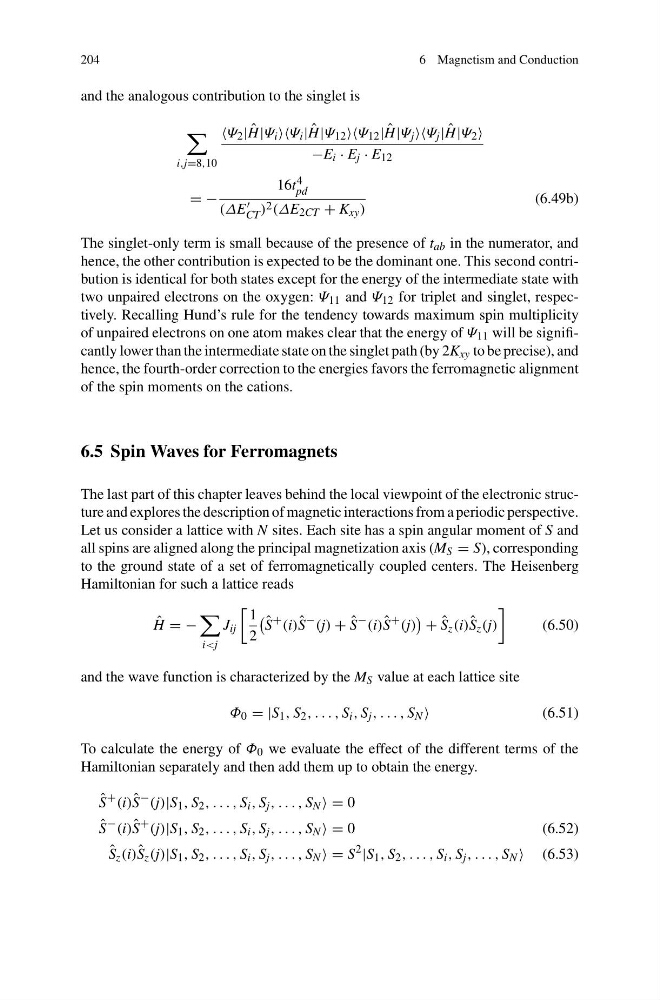
and the analogous contribution to the singlet is
i,j=8,10
Ψ 2 | ˆ
H|Ψ i Ψ i | ˆ
H|Ψ 12 Ψ 12 | ˆ
H|Ψ j Ψ j | ˆ
H|Ψ 2
−E i · E j · E 12
=−
16t 4
pd
(∆E ′
CT ) 2 (∆E 2CT + K xy )
(6.49b)
The singlet-only term is small because of the presence of t ab in the numerator, and
hence, the other contribution is expected to be the dominant one. This second contribution is identical for both states except for the energy of the intermediate state with
two unpaired electrons on the oxygen: Ψ 11 and Ψ 12 for triplet and singlet, respectively. Recalling Hund’s rule for the tendency towards maximum spin multiplicity
of unpaired electrons on one atom makes clear that the energy of Ψ 11 will be significantly lower than the intermediate state on the singlet path (by 2K xy to be precise), and
hence, the fourth-order correction to the energies favors the ferromagnetic alignment
of the spin moments on the cations.
6.5 Spin Waves for Ferromagnets
The last part of this chapter leaves behind the local viewpoint of the electronic structure and explores the description of magnetic interactions from a periodic perspective.
Let us consider a lattice with N sites. Each site has a spin angular moment of S and
all spins are aligned along the principal magnetization axis (M S = S), corresponding
to the ground state of a set of ferromagnetically coupled centers. The Heisenberg
Hamiltonian for such a lattice reads
ˆ
H =−
i
1
2
ˆ
S
+ (i) ˆ
S
− (j) + ˆ
S
− (i) ˆ
S
+ (j)
+ ˆ
S z (i) ˆ
S z (j)
(6.50)
and the wave function is characterized by the M S value at each lattice site
Φ 0 =|S 1 , S 2 ,...,S i , S j ,...,S N
(6.51)
To calculate the energy of Φ 0 we evaluate the effect of the different terms of the
Hamiltonian separately and then add them up to obtain the energy.
ˆ
S
+ (i) ˆ
S
− (j)|S 1 , S 2 ,...,S i , S j ,...,S N =0
ˆ
S
− (i) ˆ
S
+ (j)|S 1 , S 2 ,...,S i , S j ,...,S N =0
(6.52)
ˆ
S z (i) ˆ
S z (j)|S 1 , S 2 ,...,S i , S j ,...,S N =S
2 |S 1 , S 2 ,...,S i , S j ,...,S N (6.53)
6 Magnetism and Conduction
and the analogous contribution to the singlet is
i,j=8,10
Ψ 2 | ˆ
H|Ψ i Ψ i | ˆ
H|Ψ 12 Ψ 12 | ˆ
H|Ψ j Ψ j | ˆ
H|Ψ 2
−E i · E j · E 12
=−
16t 4
pd
(∆E ′
CT ) 2 (∆E 2CT + K xy )
(6.49b)
The singlet-only term is small because of the presence of t ab in the numerator, and
hence, the other contribution is expected to be the dominant one. This second contribution is identical for both states except for the energy of the intermediate state with
two unpaired electrons on the oxygen: Ψ 11 and Ψ 12 for triplet and singlet, respectively. Recalling Hund’s rule for the tendency towards maximum spin multiplicity
of unpaired electrons on one atom makes clear that the energy of Ψ 11 will be significantly lower than the intermediate state on the singlet path (by 2K xy to be precise), and
hence, the fourth-order correction to the energies favors the ferromagnetic alignment
of the spin moments on the cations.
6.5 Spin Waves for Ferromagnets
The last part of this chapter leaves behind the local viewpoint of the electronic structure and explores the description of magnetic interactions from a periodic perspective.
Let us consider a lattice with N sites. Each site has a spin angular moment of S and
all spins are aligned along the principal magnetization axis (M S = S), corresponding
to the ground state of a set of ferromagnetically coupled centers. The Heisenberg
Hamiltonian for such a lattice reads
ˆ
H =−
i
1
2
ˆ
S
+ (i) ˆ
S
− (j) + ˆ
S
− (i) ˆ
S
+ (j)
+ ˆ
S z (i) ˆ
S z (j)
(6.50)
and the wave function is characterized by the M S value at each lattice site
Φ 0 =|S 1 , S 2 ,...,S i , S j ,...,S N
(6.51)
To calculate the energy of Φ 0 we evaluate the effect of the different terms of the
Hamiltonian separately and then add them up to obtain the energy.
ˆ
S
+ (i) ˆ
S
− (j)|S 1 , S 2 ,...,S i , S j ,...,S N =0
ˆ
S
− (i) ˆ
S
+ (j)|S 1 , S 2 ,...,S i , S j ,...,S N =0
(6.52)
ˆ
S z (i) ˆ
S z (j)|S 1 , S 2 ,...,S i , S j ,...,S N =S
2 |S 1 , S 2 ,...,S i , S j ,...,S N (6.53)