

6.4 Goodenough–Kanamori Rules
203
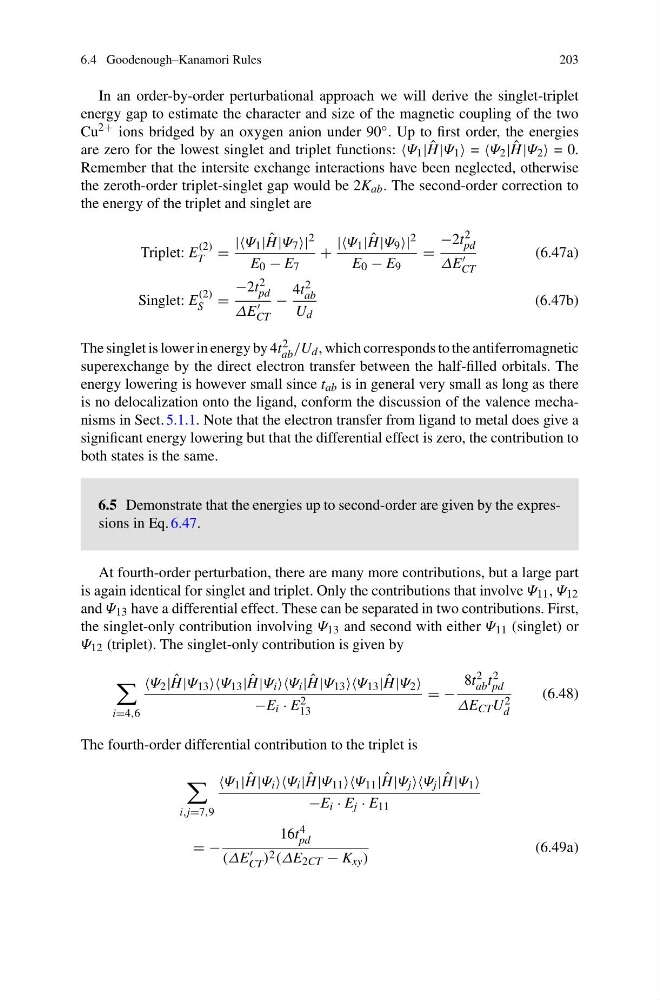
In an order-by-order perturbational approach we will derive the singlet-triplet
energy gap to estimate the character and size of the magnetic coupling of the two
Cu 2+ ions bridged by an oxygen anion under 90 ◦ . Up to first order, the energies
are zero for the lowest singlet and triplet functions: Ψ 1 | ˆ
H|Ψ 1 = Ψ 2 | ˆ
H|Ψ 2 =0 .
Remember that the intersite exchange interactions have been neglected, otherwise
the zeroth-order triplet-singlet gap would be 2K ab . The second-order correction to
the energy of the triplet and singlet are
Triplet: E
(2)
T =
||Ψ 1 | ˆ
H|Ψ 7 | 2
E 0 − E 7
+
||Ψ 1 | ˆ
H|Ψ 9 | 2
E 0 − E 9
=
−2t 2
pd
∆E ′
CT
(6.47a)
Singlet: E
(2)
S =
−2t 2
pd
∆E ′
CT
−
4t 2
ab
U d
(6.47b)
The singlet is lower in energy by 4t 2
ab /U d , which corresponds to the antiferromagnetic
superexchange by the direct electron transfer between the half-filled orbitals. The
energy lowering is however small since t ab is in general very small as long as there
is no delocalization onto the ligand, conform the discussion of the valence mechanisms in Sect. 5.1.1. Note that the electron transfer from ligand to metal does give a
significant energy lowering but that the differential effect is zero, the contribution to
both states is the same.
6.5 Demonstrate that the energies up to second-order are given by the expressions in Eq. 6.47.
At fourth-order perturbation, there are many more contributions, but a large part
is again identical for singlet and triplet. Only the contributions that involve Ψ 11 , Ψ 12
and Ψ 13 have a differential effect. These can be separated in two contributions. First,
the singlet-only contribution involving Ψ 13 and second with either Ψ 11 (singlet) or
Ψ 12 (triplet). The singlet-only contribution is given by
i=4,6
Ψ 2 | ˆ
H|Ψ 13 Ψ 13 | ˆ
H|Ψ i Ψ i | ˆ
H|Ψ 13 Ψ 13 | ˆ
H|Ψ 2
−E i · E 2
13
=−
8t 2
ab t 2
pd
∆E CT U 2
d
(6.48)
The fourth-order differential contribution to the triplet is
i,j=7,9
Ψ 1 | ˆ
H|Ψ i Ψ i | ˆ
H|Ψ 11 Ψ 11 | ˆ
H|Ψ j Ψ j | ˆ
H|Ψ 1
−E i · E j · E 11
=−
16t 4
pd
(∆E ′
CT ) 2 (∆E 2CT − K xy )
(6.49a)
203
In an order-by-order perturbational approach we will derive the singlet-triplet
energy gap to estimate the character and size of the magnetic coupling of the two
Cu 2+ ions bridged by an oxygen anion under 90 ◦ . Up to first order, the energies
are zero for the lowest singlet and triplet functions: Ψ 1 | ˆ
H|Ψ 1 = Ψ 2 | ˆ
H|Ψ 2 =0 .
Remember that the intersite exchange interactions have been neglected, otherwise
the zeroth-order triplet-singlet gap would be 2K ab . The second-order correction to
the energy of the triplet and singlet are
Triplet: E
(2)
T =
||Ψ 1 | ˆ
H|Ψ 7 | 2
E 0 − E 7
+
||Ψ 1 | ˆ
H|Ψ 9 | 2
E 0 − E 9
=
−2t 2
pd
∆E ′
CT
(6.47a)
Singlet: E
(2)
S =
−2t 2
pd
∆E ′
CT
−
4t 2
ab
U d
(6.47b)
The singlet is lower in energy by 4t 2
ab /U d , which corresponds to the antiferromagnetic
superexchange by the direct electron transfer between the half-filled orbitals. The
energy lowering is however small since t ab is in general very small as long as there
is no delocalization onto the ligand, conform the discussion of the valence mechanisms in Sect. 5.1.1. Note that the electron transfer from ligand to metal does give a
significant energy lowering but that the differential effect is zero, the contribution to
both states is the same.
6.5 Demonstrate that the energies up to second-order are given by the expressions in Eq. 6.47.
At fourth-order perturbation, there are many more contributions, but a large part
is again identical for singlet and triplet. Only the contributions that involve Ψ 11 , Ψ 12
and Ψ 13 have a differential effect. These can be separated in two contributions. First,
the singlet-only contribution involving Ψ 13 and second with either Ψ 11 (singlet) or
Ψ 12 (triplet). The singlet-only contribution is given by
i=4,6
Ψ 2 | ˆ
H|Ψ 13 Ψ 13 | ˆ
H|Ψ i Ψ i | ˆ
H|Ψ 13 Ψ 13 | ˆ
H|Ψ 2
−E i · E 2
13
=−
8t 2
ab t 2
pd
∆E CT U 2
d
(6.48)
The fourth-order differential contribution to the triplet is
i,j=7,9
Ψ 1 | ˆ
H|Ψ i Ψ i | ˆ
H|Ψ 11 Ψ 11 | ˆ
H|Ψ j Ψ j | ˆ
H|Ψ 1
−E i · E j · E 11
=−
16t 4
pd
(∆E ′
CT ) 2 (∆E 2CT − K xy )
(6.49a)