

202
6 Magnetism and Conduction
To simplify the derivation of the singlet and triplet energy, we first construct
spin-symmetry adapted CSFs by forming linear combination of the above-listed
determinants with unpaired electrons:
Ψ 1,2 =
1
√
2
(Φ 1 ± Φ 2 )Ψ 3,4 =
1
√
2
(Φ 1 ± Φ 2 )Ψ 5,6 =
1
√
2
(Φ 5 ± Φ 6 )
Ψ 7,8 =
1
√
2
(Φ 7 ± Φ 8 )Ψ 9,10 =
1
√
2
(Φ 9 ± Φ 10 )Ψ 11,12 =
1
√
2
(Φ 11 ± Φ 12 )
Ψ 13,14 =
1
√
2
(Φ 13 ± Φ 14 )
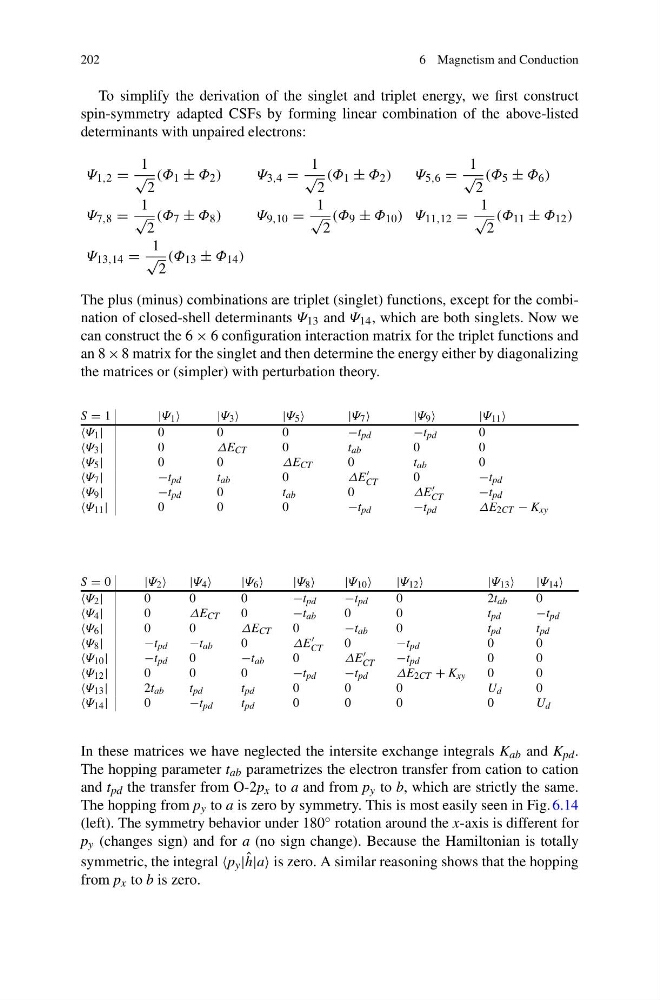
The plus (minus) combinations are triplet (singlet) functions, except for the combination of closed-shell determinants Ψ 13 and Ψ 14 , which are both singlets. Now we
can construct the 6 × 6 configuration interaction matrix for the triplet functions and
an 8 × 8 matrix for the singlet and then determine the energy either by diagonalizing
the matrices or (simpler) with perturbation theory.
S = 1
|Ψ 1 | Ψ 3 | Ψ 5 | Ψ 7 | Ψ 9 | Ψ 11
Ψ 1 |
00
0
−t pd
−t pd
0
Ψ 3 |
0
∆E CT
0
t ab
00
Ψ 5 |
00
∆E CT
0
t ab
0
Ψ 7 |
−t pd
t ab
0
∆E ′
CT
0
−t pd
Ψ 9 |
−t pd
0
t ab
0
∆E ′
CT
−t pd
Ψ 11 |
00
0
−t pd
−t pd
∆E 2CT − K xy
S = 0
|Ψ 2 | Ψ 4 | Ψ 6 | Ψ 8 | Ψ 10 | Ψ 12 | Ψ 13 | Ψ 14
Ψ 2 |
00
0
−t pd
−t pd
02 t ab
0
Ψ 4 |
0
∆E CT
0
−t ab
00
t pd
−t pd
Ψ 6 |
00
∆E CT
0
−t ab
0
t pd
t pd
Ψ 8 |
−t pd
−t ab
0
∆E ′
CT
0
−t pd
00
Ψ 10 |
−t pd
0
−t ab
0
∆E ′
CT
−t pd
00
Ψ 12 |
00
0
−t pd
−t pd
∆E 2CT + K xy
00
Ψ 13 |
2t ab
t pd
t pd
000
U d
0
Ψ 14 |
0
−t pd
t pd
000
0U d
In these matrices we have neglected the intersite exchange integrals K ab and K pd .
The hopping parameter t ab parametrizes the electron transfer from cation to cation
and t pd the transfer from O-2p x to a and from p y to b, which are strictly the same.
The hopping from p y to a is zero by symmetry. This is most easily seen in Fig. 6.14
(left). The symmetry behavior under 180 ◦ rotation around the x-axis is different for
p y (changes sign) and for a (no sign change). Because the Hamiltonian is totally
symmetric, the integral p y | ˆ
h|a is zero. A similar reasoning shows that the hopping
from p x to b is zero.
6 Magnetism and Conduction
To simplify the derivation of the singlet and triplet energy, we first construct
spin-symmetry adapted CSFs by forming linear combination of the above-listed
determinants with unpaired electrons:
Ψ 1,2 =
1
√
2
(Φ 1 ± Φ 2 )Ψ 3,4 =
1
√
2
(Φ 1 ± Φ 2 )Ψ 5,6 =
1
√
2
(Φ 5 ± Φ 6 )
Ψ 7,8 =
1
√
2
(Φ 7 ± Φ 8 )Ψ 9,10 =
1
√
2
(Φ 9 ± Φ 10 )Ψ 11,12 =
1
√
2
(Φ 11 ± Φ 12 )
Ψ 13,14 =
1
√
2
(Φ 13 ± Φ 14 )
The plus (minus) combinations are triplet (singlet) functions, except for the combination of closed-shell determinants Ψ 13 and Ψ 14 , which are both singlets. Now we
can construct the 6 × 6 configuration interaction matrix for the triplet functions and
an 8 × 8 matrix for the singlet and then determine the energy either by diagonalizing
the matrices or (simpler) with perturbation theory.
S = 1
|Ψ 1 | Ψ 3 | Ψ 5 | Ψ 7 | Ψ 9 | Ψ 11
Ψ 1 |
00
0
−t pd
−t pd
0
Ψ 3 |
0
∆E CT
0
t ab
00
Ψ 5 |
00
∆E CT
0
t ab
0
Ψ 7 |
−t pd
t ab
0
∆E ′
CT
0
−t pd
Ψ 9 |
−t pd
0
t ab
0
∆E ′
CT
−t pd
Ψ 11 |
00
0
−t pd
−t pd
∆E 2CT − K xy
S = 0
|Ψ 2 | Ψ 4 | Ψ 6 | Ψ 8 | Ψ 10 | Ψ 12 | Ψ 13 | Ψ 14
Ψ 2 |
00
0
−t pd
−t pd
02 t ab
0
Ψ 4 |
0
∆E CT
0
−t ab
00
t pd
−t pd
Ψ 6 |
00
∆E CT
0
−t ab
0
t pd
t pd
Ψ 8 |
−t pd
−t ab
0
∆E ′
CT
0
−t pd
00
Ψ 10 |
−t pd
0
−t ab
0
∆E ′
CT
−t pd
00
Ψ 12 |
00
0
−t pd
−t pd
∆E 2CT + K xy
00
Ψ 13 |
2t ab
t pd
t pd
000
U d
0
Ψ 14 |
0
−t pd
t pd
000
0U d
In these matrices we have neglected the intersite exchange integrals K ab and K pd .
The hopping parameter t ab parametrizes the electron transfer from cation to cation
and t pd the transfer from O-2p x to a and from p y to b, which are strictly the same.
The hopping from p y to a is zero by symmetry. This is most easily seen in Fig. 6.14
(left). The symmetry behavior under 180 ◦ rotation around the x-axis is different for
p y (changes sign) and for a (no sign change). Because the Hamiltonian is totally
symmetric, the integral p y | ˆ
h|a is zero. A similar reasoning shows that the hopping
from p x to b is zero.