

6.5 Spin Waves for Ferromagnets
209
Φ k |
1
2
ˆ
S
+ (r
′ ) ˆ
S
− (r
′′ ) =
1
2
ˆ
S
− (r
′′ ) ˆ
S
+ (r
′ )
r
e
−ik·r ˆ
S
− |Φ 0
= S
r
e
−ik·r δ rr ′ ˆ
S
− (r
′′ )|Φ 0 =Se
−ik·r ′ ˆ
S
− (r
′′ )|Φ 0 (6.70)
The sum of these two terms gives
Φ k | ˆ
S x (r) ˆ
S x (r
′ ) + ˆ
S y (r) ˆ
S y (r
′ )|Φ k =S(e
−ik·r ′ + e
ik·r ′′
) = 2S cos
(r
′ − r
′′ ) · k
(6.71)
showing that the orientation of the projection of the spin moment on the plane perpendicular to the principal magnetic axis varies as a cosine that depends on the separation
of the spins and the lattice vector k, exactly as the spin wave shown in Fig. 6.17.
Antiferromagnetic lattices: The description of an ‘infinite’ lattice with antiferromagnetic interactions is much more complicated and in fact there is no exact ground
state solution for such case. The first necessary simplification towards an (approximate) description is to limit the interactions to nearest neighbours. Imagine a twodimensional regular lattice of magnetic centers. Taking into account only nearest
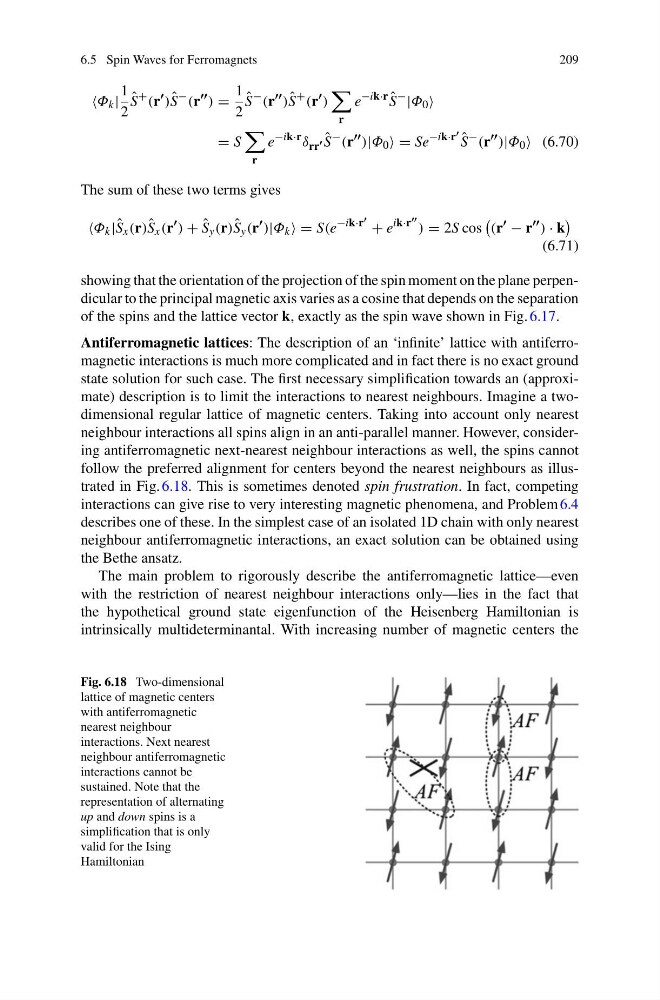
neighbour interactions all spins align in an anti-parallel manner. However, considering antiferromagnetic next-nearest neighbour interactions as well, the spins cannot
follow the preferred alignment for centers beyond the nearest neighbours as illustrated in Fig. 6.18. This is sometimes denoted spin frustration. In fact, competing
interactions can give rise to very interesting magnetic phenomena, and Problem 6.4
describes one of these. In the simplest case of an isolated 1D chain with only nearest
neighbour antiferromagnetic interactions, an exact solution can be obtained using
the Bethe ansatz.
The main problem to rigorously describe the antiferromagnetic lattice—even
with the restriction of nearest neighbour interactions only—lies in the fact that
the hypothetical ground state eigenfunction of the Heisenberg Hamiltonian is
intrinsically multideterminantal. With increasing number of magnetic centers the
Fig. 6.18 Two-dimensional
lattice of magnetic centers
with antiferromagnetic
nearest neighbour
interactions. Next nearest
neighbour antiferromagnetic
interactions cannot be
sustained. Note that the
representation of alternating
up and down spinsisa
simplification that is only
valid for the Ising
Hamiltonian
209
Φ k |
1
2
ˆ
S
+ (r
′ ) ˆ
S
− (r
′′ ) =
1
2
ˆ
S
− (r
′′ ) ˆ
S
+ (r
′ )
r
e
−ik·r ˆ
S
− |Φ 0
= S
r
e
−ik·r δ rr ′ ˆ
S
− (r
′′ )|Φ 0 =Se
−ik·r ′ ˆ
S
− (r
′′ )|Φ 0 (6.70)
The sum of these two terms gives
Φ k | ˆ
S x (r) ˆ
S x (r
′ ) + ˆ
S y (r) ˆ
S y (r
′ )|Φ k =S(e
−ik·r ′ + e
ik·r ′′
) = 2S cos
(r
′ − r
′′ ) · k
(6.71)
showing that the orientation of the projection of the spin moment on the plane perpendicular to the principal magnetic axis varies as a cosine that depends on the separation
of the spins and the lattice vector k, exactly as the spin wave shown in Fig. 6.17.
Antiferromagnetic lattices: The description of an ‘infinite’ lattice with antiferromagnetic interactions is much more complicated and in fact there is no exact ground
state solution for such case. The first necessary simplification towards an (approximate) description is to limit the interactions to nearest neighbours. Imagine a twodimensional regular lattice of magnetic centers. Taking into account only nearest
neighbour interactions all spins align in an anti-parallel manner. However, considering antiferromagnetic next-nearest neighbour interactions as well, the spins cannot
follow the preferred alignment for centers beyond the nearest neighbours as illustrated in Fig. 6.18. This is sometimes denoted spin frustration. In fact, competing
interactions can give rise to very interesting magnetic phenomena, and Problem 6.4
describes one of these. In the simplest case of an isolated 1D chain with only nearest
neighbour antiferromagnetic interactions, an exact solution can be obtained using
the Bethe ansatz.
The main problem to rigorously describe the antiferromagnetic lattice—even
with the restriction of nearest neighbour interactions only—lies in the fact that
the hypothetical ground state eigenfunction of the Heisenberg Hamiltonian is
intrinsically multideterminantal. With increasing number of magnetic centers the
Fig. 6.18 Two-dimensional
lattice of magnetic centers
with antiferromagnetic
nearest neighbour
interactions. Next nearest
neighbour antiferromagnetic
interactions cannot be
sustained. Note that the
representation of alternating
up and down spinsisa
simplification that is only
valid for the Ising
Hamiltonian