

6.4 Goodenough–Kanamori Rules
199
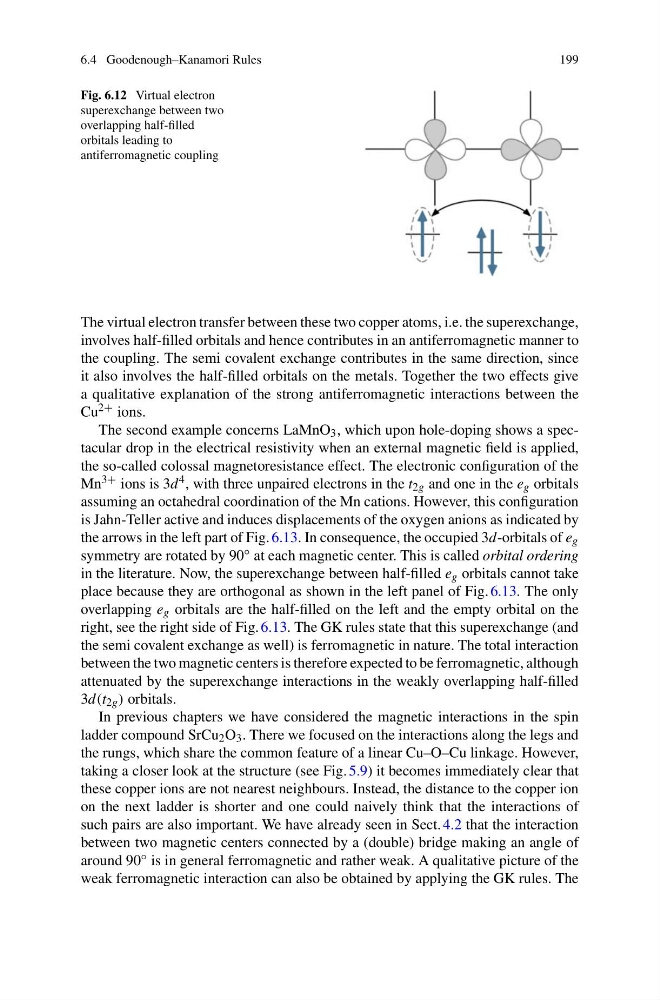
Fig. 6.12 Virtual electron
superexchange between two
overlapping half-filled
orbitals leading to
antiferromagnetic coupling
The virtual electron transfer between these two copper atoms, i.e. the superexchange,
involves half-filled orbitals and hence contributes in an antiferromagnetic manner to
the coupling. The semi covalent exchange contributes in the same direction, since
it also involves the half-filled orbitals on the metals. Together the two effects give
a qualitative explanation of the strong antiferromagnetic interactions between the
Cu 2+ ions.
The second example concerns LaMnO 3 , which upon hole-doping shows a spectacular drop in the electrical resistivity when an external magnetic field is applied,
the so-called colossal magnetoresistance effect. The electronic configuration of the
Mn 3+ ions is 3d 4 , with three unpaired electrons in the t 2g and one in the e g orbitals
assuming an octahedral coordination of the Mn cations. However, this configuration
is Jahn-Teller active and induces displacements of the oxygen anions as indicated by
the arrows in the left part of Fig. 6.13. In consequence, the occupied 3d-orbitals of e g
symmetry are rotated by 90 ◦ at each magnetic center. This is called orbital ordering
in the literature. Now, the superexchange between half-filled e g orbitals cannot take
place because they are orthogonal as shown in the left panel of Fig. 6.13. The only
overlapping e g orbitals are the half-filled on the left and the empty orbital on the
right, see the right side of Fig. 6.13. The GK rules state that this superexchange (and
the semi covalent exchange as well) is ferromagnetic in nature. The total interaction
between the two magnetic centers is therefore expected to be ferromagnetic, although
attenuated by the superexchange interactions in the weakly overlapping half-filled
3d(t 2g ) orbitals.
In previous chapters we have considered the magnetic interactions in the spin
ladder compound SrCu 2 O 3 . There we focused on the interactions along the legs and
the rungs, which share the common feature of a linear Cu–O–Cu linkage. However,
taking a closer look at the structure (see Fig. 5.9) it becomes immediately clear that
these copper ions are not nearest neighbours. Instead, the distance to the copper ion
on the next ladder is shorter and one could naively think that the interactions of
such pairs are also important. We have already seen in Sect. 4.2 that the interaction
between two magnetic centers connected by a (double) bridge making an angle of
around 90 ◦ is in general ferromagnetic and rather weak. A qualitative picture of the
weak ferromagnetic interaction can also be obtained by applying the GK rules. The
199
Fig. 6.12 Virtual electron
superexchange between two
overlapping half-filled
orbitals leading to
antiferromagnetic coupling
The virtual electron transfer between these two copper atoms, i.e. the superexchange,
involves half-filled orbitals and hence contributes in an antiferromagnetic manner to
the coupling. The semi covalent exchange contributes in the same direction, since
it also involves the half-filled orbitals on the metals. Together the two effects give
a qualitative explanation of the strong antiferromagnetic interactions between the
Cu 2+ ions.
The second example concerns LaMnO 3 , which upon hole-doping shows a spectacular drop in the electrical resistivity when an external magnetic field is applied,
the so-called colossal magnetoresistance effect. The electronic configuration of the
Mn 3+ ions is 3d 4 , with three unpaired electrons in the t 2g and one in the e g orbitals
assuming an octahedral coordination of the Mn cations. However, this configuration
is Jahn-Teller active and induces displacements of the oxygen anions as indicated by
the arrows in the left part of Fig. 6.13. In consequence, the occupied 3d-orbitals of e g
symmetry are rotated by 90 ◦ at each magnetic center. This is called orbital ordering
in the literature. Now, the superexchange between half-filled e g orbitals cannot take
place because they are orthogonal as shown in the left panel of Fig. 6.13. The only
overlapping e g orbitals are the half-filled on the left and the empty orbital on the
right, see the right side of Fig. 6.13. The GK rules state that this superexchange (and
the semi covalent exchange as well) is ferromagnetic in nature. The total interaction
between the two magnetic centers is therefore expected to be ferromagnetic, although
attenuated by the superexchange interactions in the weakly overlapping half-filled
3d(t 2g ) orbitals.
In previous chapters we have considered the magnetic interactions in the spin
ladder compound SrCu 2 O 3 . There we focused on the interactions along the legs and
the rungs, which share the common feature of a linear Cu–O–Cu linkage. However,
taking a closer look at the structure (see Fig. 5.9) it becomes immediately clear that
these copper ions are not nearest neighbours. Instead, the distance to the copper ion
on the next ladder is shorter and one could naively think that the interactions of
such pairs are also important. We have already seen in Sect. 4.2 that the interaction
between two magnetic centers connected by a (double) bridge making an angle of
around 90 ◦ is in general ferromagnetic and rather weak. A qualitative picture of the
weak ferromagnetic interaction can also be obtained by applying the GK rules. The