

198
6 Magnetism and Conduction
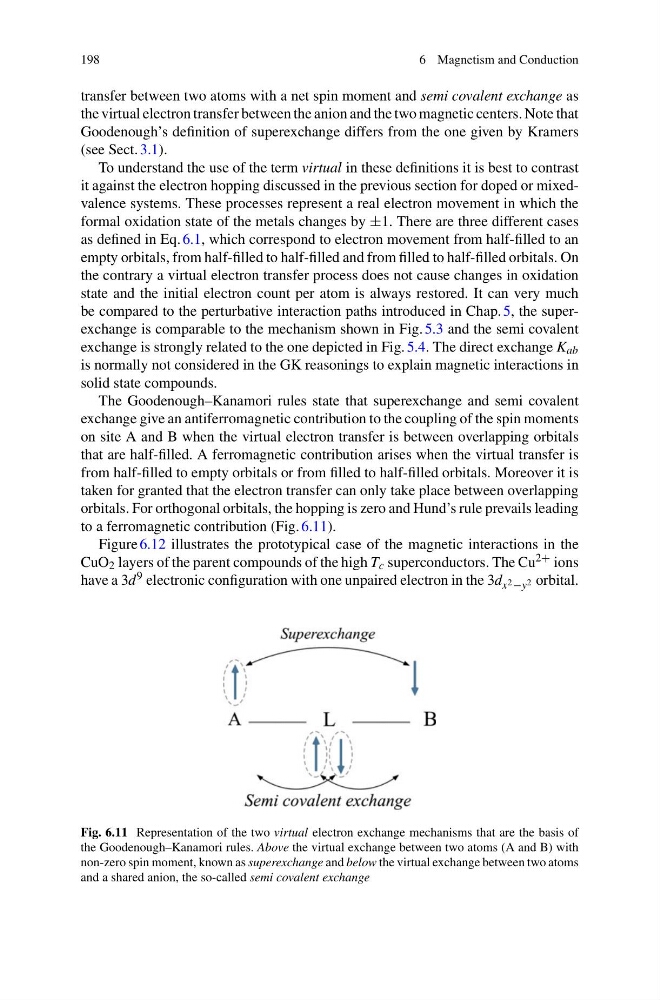
transfer between two atoms with a net spin moment and semi covalent exchange as
the virtual electron transfer between the anion and the two magnetic centers. Note that
Goodenough’s definition of superexchange differs from the one given by Kramers
(see Sect. 3.1).
To understand the use of the term virtual in these definitions it is best to contrast
it against the electron hopping discussed in the previous section for doped or mixedvalence systems. These processes represent a real electron movement in which the
formal oxidation state of the metals changes by ±1. There are three different cases
as defined in Eq. 6.1, which correspond to electron movement from half-filled to an
empty orbitals, from half-filled to half-filled and from filled to half-filled orbitals. On
the contrary a virtual electron transfer process does not cause changes in oxidation
state and the initial electron count per atom is always restored. It can very much
be compared to the perturbative interaction paths introduced in Chap. 5, the superexchange is comparable to the mechanism shown in Fig. 5.3 and the semi covalent
exchange is strongly related to the one depicted in Fig. 5.4. The direct exchange K ab
is normally not considered in the GK reasonings to explain magnetic interactions in
solid state compounds.
The Goodenough–Kanamori rules state that superexchange and semi covalent
exchange give an antiferromagnetic contribution to the coupling of the spin moments
on site A and B when the virtual electron transfer is between overlapping orbitals
that are half-filled. A ferromagnetic contribution arises when the virtual transfer is
from half-filled to empty orbitals or from filled to half-filled orbitals. Moreover it is
taken for granted that the electron transfer can only take place between overlapping
orbitals. For orthogonal orbitals, the hopping is zero and Hund’s rule prevails leading
to a ferromagnetic contribution (Fig. 6.11).
Figure 6.12 illustrates the prototypical case of the magnetic interactions in the
CuO 2 layers of the parent compounds of the high T c superconductors. The Cu 2+ ions
have a 3d 9 electronic configuration with one unpaired electron in the 3d x 2 −y 2 orbital.
Fig. 6.11 Representation of the two virtual electron exchange mechanisms that are the basis of
the Goodenough–Kanamori rules. Above the virtual exchange between two atoms (A and B) with
non-zero spin moment, known as superexchange and below the virtual exchange between two atoms
and a shared anion, the so-called semi covalent exchange
6 Magnetism and Conduction
transfer between two atoms with a net spin moment and semi covalent exchange as
the virtual electron transfer between the anion and the two magnetic centers. Note that
Goodenough’s definition of superexchange differs from the one given by Kramers
(see Sect. 3.1).
To understand the use of the term virtual in these definitions it is best to contrast
it against the electron hopping discussed in the previous section for doped or mixedvalence systems. These processes represent a real electron movement in which the
formal oxidation state of the metals changes by ±1. There are three different cases
as defined in Eq. 6.1, which correspond to electron movement from half-filled to an
empty orbitals, from half-filled to half-filled and from filled to half-filled orbitals. On
the contrary a virtual electron transfer process does not cause changes in oxidation
state and the initial electron count per atom is always restored. It can very much
be compared to the perturbative interaction paths introduced in Chap. 5, the superexchange is comparable to the mechanism shown in Fig. 5.3 and the semi covalent
exchange is strongly related to the one depicted in Fig. 5.4. The direct exchange K ab
is normally not considered in the GK reasonings to explain magnetic interactions in
solid state compounds.
The Goodenough–Kanamori rules state that superexchange and semi covalent
exchange give an antiferromagnetic contribution to the coupling of the spin moments
on site A and B when the virtual electron transfer is between overlapping orbitals
that are half-filled. A ferromagnetic contribution arises when the virtual transfer is
from half-filled to empty orbitals or from filled to half-filled orbitals. Moreover it is
taken for granted that the electron transfer can only take place between overlapping
orbitals. For orthogonal orbitals, the hopping is zero and Hund’s rule prevails leading
to a ferromagnetic contribution (Fig. 6.11).
Figure 6.12 illustrates the prototypical case of the magnetic interactions in the
CuO 2 layers of the parent compounds of the high T c superconductors. The Cu 2+ ions
have a 3d 9 electronic configuration with one unpaired electron in the 3d x 2 −y 2 orbital.
Fig. 6.11 Representation of the two virtual electron exchange mechanisms that are the basis of
the Goodenough–Kanamori rules. Above the virtual exchange between two atoms (A and B) with
non-zero spin moment, known as superexchange and below the virtual exchange between two atoms
and a shared anion, the so-called semi covalent exchange