

188
6 Magnetism and Conduction
and for θ = 0, slightly more elaborated expressions are obtained
aα| ˆ
H|bα
′ ==a
cos(θ/2)α
′ + sin(θ/2)β
′
| ˆ
H|bα
′ =τ cos(θ/2)
(6.28c)
aα| ˆ
H|bβ
′ =τ sin(θ/2)
(6.28d)
aβ| ˆ
H|bα
′ =−τ sin(θ/2)
(6.28e)
aβ| ˆ
H|bβ
′ =τ cos(θ/2)
(6.28f)
The spin moment of aα and bα ′ is parallel to S A and S B , respectively. In the simplest
description, the energy of these states with respect to the ones with antiparallel
alignment (aβ and bβ ′ ) is given by the number of exchange interactions between the
extra electron and the electrons that give rise to the background spin moments S A
and S B .
E 1,3 =−K · 2S A,B
E 2,4 = 0
(6.29)
However, in a formalism with correct spin eigenfunctions the energies become
E 1,3 =−K(S A,B + 1)
E 2,4 =+KS A,B
(6.30)
6.4 Consider a magnetic site with a S = 1 background spin moment (triplet
coupled electrons in ϕ 1 and ϕ 2 ) and an electron in ϕ 3 that can hop to neighboring
centers. Calculate the energies of |ϕ 1 ϕ 2 ϕ 3 |, |ϕ 1 ϕ 2 ϕ 3 | and the CSF for the
doublet with triplet coupling for ϕ 1 and ϕ 2 and compare to the Eqs. 6.29 and
6.30.
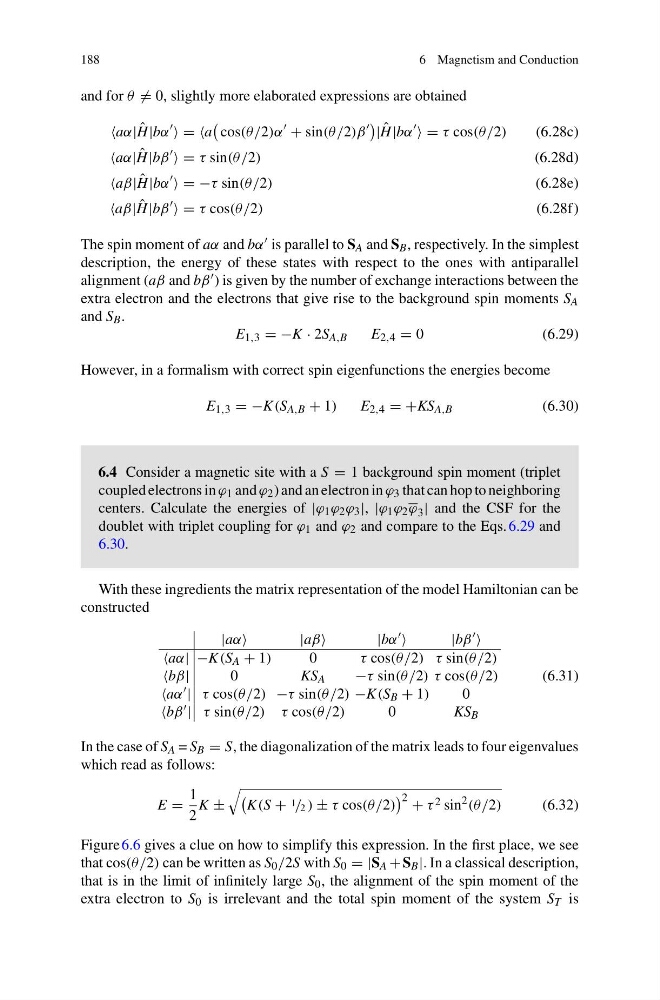
With these ingredients the matrix representation of the model Hamiltonian can be
constructed
|aα| aβ| bα ′ | bβ ′
aα| −K(S A + 1)
0
τ cos(θ/2)τ sin(θ/2)
bβ|
0
KS A
−τ sin(θ/2)τcos(θ/2)
aα ′ | τ cos(θ/2) −τ sin(θ/2) −K(S B + 1)
0
bβ ′ | τ sin(θ/2)τ cos(θ/2)
0
KS B
(6.31)
In the case of S A = S B = S, the diagonalization of the matrix leads to four eigenvalues
which read as follows:
E =
1
2
K ±
K(S + 1 / 2 ) ± τ cos(θ/2)
2 + τ 2 sin 2 (θ/2)
(6.32)
Figure 6.6 gives a clue on how to simplify this expression. In the first place, we see
that cos(θ/2) can be written as S 0 /2S with S 0 =|S A + S B |. In a classical description,
that is in the limit of infinitely large S 0 , the alignment of the spin moment of the
extra electron to S 0 is irrelevant and the total spin moment of the system S T is
6 Magnetism and Conduction
and for θ = 0, slightly more elaborated expressions are obtained
aα| ˆ
H|bα
′ ==a
cos(θ/2)α
′ + sin(θ/2)β
′
| ˆ
H|bα
′ =τ cos(θ/2)
(6.28c)
aα| ˆ
H|bβ
′ =τ sin(θ/2)
(6.28d)
aβ| ˆ
H|bα
′ =−τ sin(θ/2)
(6.28e)
aβ| ˆ
H|bβ
′ =τ cos(θ/2)
(6.28f)
The spin moment of aα and bα ′ is parallel to S A and S B , respectively. In the simplest
description, the energy of these states with respect to the ones with antiparallel
alignment (aβ and bβ ′ ) is given by the number of exchange interactions between the
extra electron and the electrons that give rise to the background spin moments S A
and S B .
E 1,3 =−K · 2S A,B
E 2,4 = 0
(6.29)
However, in a formalism with correct spin eigenfunctions the energies become
E 1,3 =−K(S A,B + 1)
E 2,4 =+KS A,B
(6.30)
6.4 Consider a magnetic site with a S = 1 background spin moment (triplet
coupled electrons in ϕ 1 and ϕ 2 ) and an electron in ϕ 3 that can hop to neighboring
centers. Calculate the energies of |ϕ 1 ϕ 2 ϕ 3 |, |ϕ 1 ϕ 2 ϕ 3 | and the CSF for the
doublet with triplet coupling for ϕ 1 and ϕ 2 and compare to the Eqs. 6.29 and
6.30.
With these ingredients the matrix representation of the model Hamiltonian can be
constructed
|aα| aβ| bα ′ | bβ ′
aα| −K(S A + 1)
0
τ cos(θ/2)τ sin(θ/2)
bβ|
0
KS A
−τ sin(θ/2)τcos(θ/2)
aα ′ | τ cos(θ/2) −τ sin(θ/2) −K(S B + 1)
0
bβ ′ | τ sin(θ/2)τ cos(θ/2)
0
KS B
(6.31)
In the case of S A = S B = S, the diagonalization of the matrix leads to four eigenvalues
which read as follows:
E =
1
2
K ±
K(S + 1 / 2 ) ± τ cos(θ/2)
2 + τ 2 sin 2 (θ/2)
(6.32)
Figure 6.6 gives a clue on how to simplify this expression. In the first place, we see
that cos(θ/2) can be written as S 0 /2S with S 0 =|S A + S B |. In a classical description,
that is in the limit of infinitely large S 0 , the alignment of the spin moment of the
extra electron to S 0 is irrelevant and the total spin moment of the system S T is