

6.2 Double Exchange
187
It is interesting to see that even when the intersite interaction is completely neglected
by putting J (or K ′ ) to zero, the hopping process forces the system into the ferromagnetic state. Only when J is very strongly antiferromagnetic and t relatively small,
one may expect a low-spin ground state. In the more common case that t dominates,
we see that the transfer integral is reduced by the factor (S + 1/2)/(S max + 1/2).
An important aspect of the physics of double exchange compounds is the interaction between the electron distribution and the movement of the nuclei by vibronic
coupling in complexes or electron-phonon interaction in extended systems. This goes
beyond the scope of this book and we refer the interested reader to Ref. [5] for further
reading.
Semi-classical description of the double exchange: The first description of the
double exchange by Zener [2] gave a simple (yet convincing) explanation of the
strong dependence of the electric resistivity on the strength of the external magnetic
field. The model only considers the hopping parameter t and assumes that the intraatomic exchange integral is infinitely large, which makes that the electron can only
move through the material when all spins at the magnetic sites are ferromagnetically
aligned. A more detailed description was given by Anderson and Hasegawa [6],
who derived the first right-hand-side term of Eq. 6.26. Here, we will review the
semi-classical description of these authors to illustrate the concept of spin dependent
hopping which is the basis of the Goodenough–Kanamori rules treated in the Sect. 6.4.
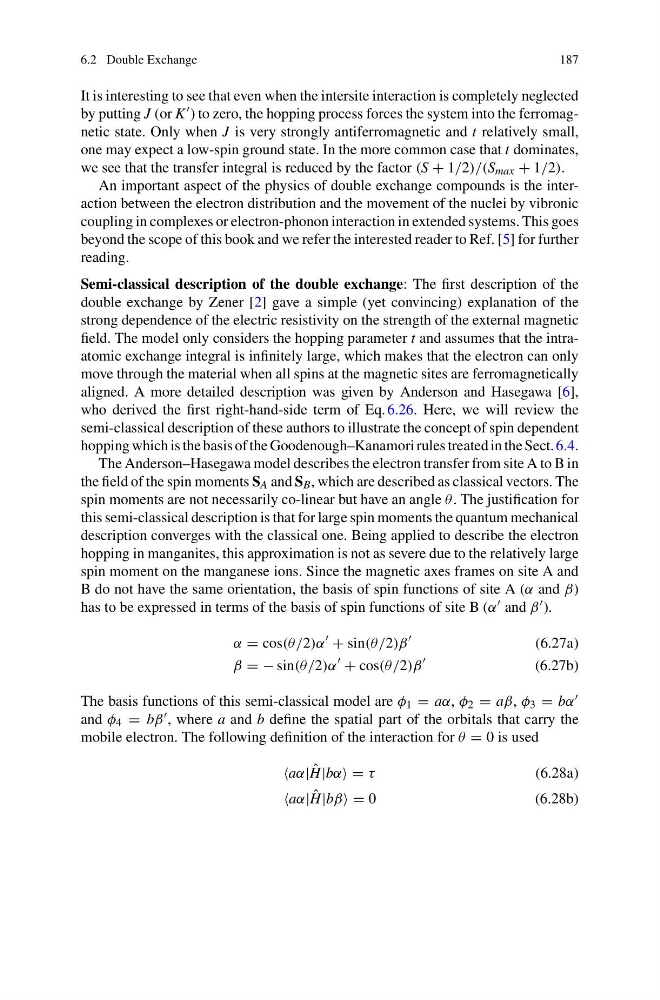
The Anderson–Hasegawa model describes the electron transfer from site A to B in
the field of the spin moments S A and S B , which are described as classical vectors. The
spin moments are not necessarily co-linear but have an angle θ . The justification for
this semi-classical description is that for large spin moments the quantum mechanical
description converges with the classical one. Being applied to describe the electron
hopping in manganites, this approximation is not as severe due to the relatively large
spin moment on the manganese ions. Since the magnetic axes frames on site A and
B do not have the same orientation, the basis of spin functions of site A (α and β)
has to be expressed in terms of the basis of spin functions of site B (α ′ and β ′ ).
α = cos(θ/2)α
′ + sin(θ/2)β
′
(6.27a)
β =−sin(θ/2)α
′ + cos(θ/2)β
′
(6.27b)
The basis functions of this semi-classical model are φ 1 = aα, φ 2 = aβ, φ 3 = bα ′
and φ 4 = bβ ′ , where a and b define the spatial part of the orbitals that carry the
mobile electron. The following definition of the interaction for θ = 0isused
aα| ˆ
H|bα=τ
(6.28a)
aα| ˆ
H|bβ=0
(6.28b)
187
It is interesting to see that even when the intersite interaction is completely neglected
by putting J (or K ′ ) to zero, the hopping process forces the system into the ferromagnetic state. Only when J is very strongly antiferromagnetic and t relatively small,
one may expect a low-spin ground state. In the more common case that t dominates,
we see that the transfer integral is reduced by the factor (S + 1/2)/(S max + 1/2).
An important aspect of the physics of double exchange compounds is the interaction between the electron distribution and the movement of the nuclei by vibronic
coupling in complexes or electron-phonon interaction in extended systems. This goes
beyond the scope of this book and we refer the interested reader to Ref. [5] for further
reading.
Semi-classical description of the double exchange: The first description of the
double exchange by Zener [2] gave a simple (yet convincing) explanation of the
strong dependence of the electric resistivity on the strength of the external magnetic
field. The model only considers the hopping parameter t and assumes that the intraatomic exchange integral is infinitely large, which makes that the electron can only
move through the material when all spins at the magnetic sites are ferromagnetically
aligned. A more detailed description was given by Anderson and Hasegawa [6],
who derived the first right-hand-side term of Eq. 6.26. Here, we will review the
semi-classical description of these authors to illustrate the concept of spin dependent
hopping which is the basis of the Goodenough–Kanamori rules treated in the Sect. 6.4.
The Anderson–Hasegawa model describes the electron transfer from site A to B in
the field of the spin moments S A and S B , which are described as classical vectors. The
spin moments are not necessarily co-linear but have an angle θ . The justification for
this semi-classical description is that for large spin moments the quantum mechanical
description converges with the classical one. Being applied to describe the electron
hopping in manganites, this approximation is not as severe due to the relatively large
spin moment on the manganese ions. Since the magnetic axes frames on site A and
B do not have the same orientation, the basis of spin functions of site A (α and β)
has to be expressed in terms of the basis of spin functions of site B (α ′ and β ′ ).
α = cos(θ/2)α
′ + sin(θ/2)β
′
(6.27a)
β =−sin(θ/2)α
′ + cos(θ/2)β
′
(6.27b)
The basis functions of this semi-classical model are φ 1 = aα, φ 2 = aβ, φ 3 = bα ′
and φ 4 = bβ ′ , where a and b define the spatial part of the orbitals that carry the
mobile electron. The following definition of the interaction for θ = 0isused
aα| ˆ
H|bα=τ
(6.28a)
aα| ˆ
H|bβ=0
(6.28b)