

186
6 Magnetism and Conduction
E(Q 1,2 ) =±t
(6.19)
E(D 1,2 ) = K + K
′ −
K 2 + t(t ± K) + K ′2 − K ′ (K ± 2t)
(6.20)
E(D 3,4 ) = K + K
′ +
K 2 + t(t ± K) + K ′2 − K ′ (K ± 2t)
(6.21)
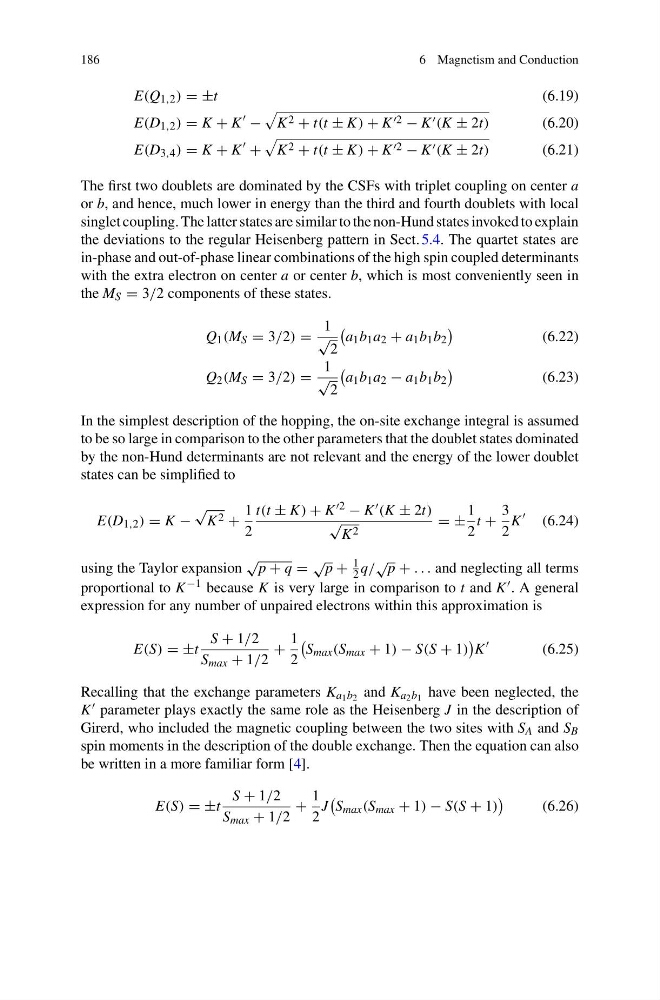
The first two doublets are dominated by the CSFs with triplet coupling on center a
or b, and hence, much lower in energy than the third and fourth doublets with local
singlet coupling. The latter states are similar to the non-Hund states invoked to explain
the deviations to the regular Heisenberg pattern in Sect. 5.4. The quartet states are
in-phase and out-of-phase linear combinations of the high spin coupled determinants
with the extra electron on center a or center b, which is most conveniently seen in
the M S = 3/2 components of these states.
Q 1 (M S = 3/2) =
1
√
2
a 1 b 1 a 2 + a 1 b 1 b 2
(6.22)
Q 2 (M S = 3/2) =
1
√
2
a 1 b 1 a 2 − a 1 b 1 b 2
(6.23)
In the simplest description of the hopping, the on-site exchange integral is assumed
to be so large in comparison to the other parameters that the doublet states dominated
by the non-Hund determinants are not relevant and the energy of the lower doublet
states can be simplified to
E(D 1,2 ) = K −
√
K 2 +
1
2
t(t ± K) + K ′2 − K ′ (K ± 2t)
√
K 2
=±
1
2
t +
3
2
K
′
(6.24)
using the Taylor expansion
√
p + q =
√
p +
1
2 q/
√ p + ...and neglecting all terms
proportional to K −1 because K is very large in comparison to t and K ′ . A general
expression for any number of unpaired electrons within this approximation is
E(S) =±t
S + 1/2
S max + 1/2
+
1
2
S max (S max + 1) − S(S + 1)
K
′
(6.25)
Recalling that the exchange parameters K a 1 b 2 and K a 2 b 1 have been neglected, the
K ′ parameter plays exactly the same role as the Heisenberg J in the description of
Girerd, who included the magnetic coupling between the two sites with S A and S B
spin moments in the description of the double exchange. Then the equation can also
be written in a more familiar form [4].
E(S) =±t
S + 1/2
S max + 1/2
+
1
2
J
S max (S max + 1) − S(S + 1)
(6.26)
6 Magnetism and Conduction
E(Q 1,2 ) =±t
(6.19)
E(D 1,2 ) = K + K
′ −
K 2 + t(t ± K) + K ′2 − K ′ (K ± 2t)
(6.20)
E(D 3,4 ) = K + K
′ +
K 2 + t(t ± K) + K ′2 − K ′ (K ± 2t)
(6.21)
The first two doublets are dominated by the CSFs with triplet coupling on center a
or b, and hence, much lower in energy than the third and fourth doublets with local
singlet coupling. The latter states are similar to the non-Hund states invoked to explain
the deviations to the regular Heisenberg pattern in Sect. 5.4. The quartet states are
in-phase and out-of-phase linear combinations of the high spin coupled determinants
with the extra electron on center a or center b, which is most conveniently seen in
the M S = 3/2 components of these states.
Q 1 (M S = 3/2) =
1
√
2
a 1 b 1 a 2 + a 1 b 1 b 2
(6.22)
Q 2 (M S = 3/2) =
1
√
2
a 1 b 1 a 2 − a 1 b 1 b 2
(6.23)
In the simplest description of the hopping, the on-site exchange integral is assumed
to be so large in comparison to the other parameters that the doublet states dominated
by the non-Hund determinants are not relevant and the energy of the lower doublet
states can be simplified to
E(D 1,2 ) = K −
√
K 2 +
1
2
t(t ± K) + K ′2 − K ′ (K ± 2t)
√
K 2
=±
1
2
t +
3
2
K
′
(6.24)
using the Taylor expansion
√
p + q =
√
p +
1
2 q/
√ p + ...and neglecting all terms
proportional to K −1 because K is very large in comparison to t and K ′ . A general
expression for any number of unpaired electrons within this approximation is
E(S) =±t
S + 1/2
S max + 1/2
+
1
2
S max (S max + 1) − S(S + 1)
K
′
(6.25)
Recalling that the exchange parameters K a 1 b 2 and K a 2 b 1 have been neglected, the
K ′ parameter plays exactly the same role as the Heisenberg J in the description of
Girerd, who included the magnetic coupling between the two sites with S A and S B
spin moments in the description of the double exchange. Then the equation can also
be written in a more familiar form [4].
E(S) =±t
S + 1/2
S max + 1/2
+
1
2
J
S max (S max + 1) − S(S + 1)
(6.26)