

6.2 Double Exchange
189
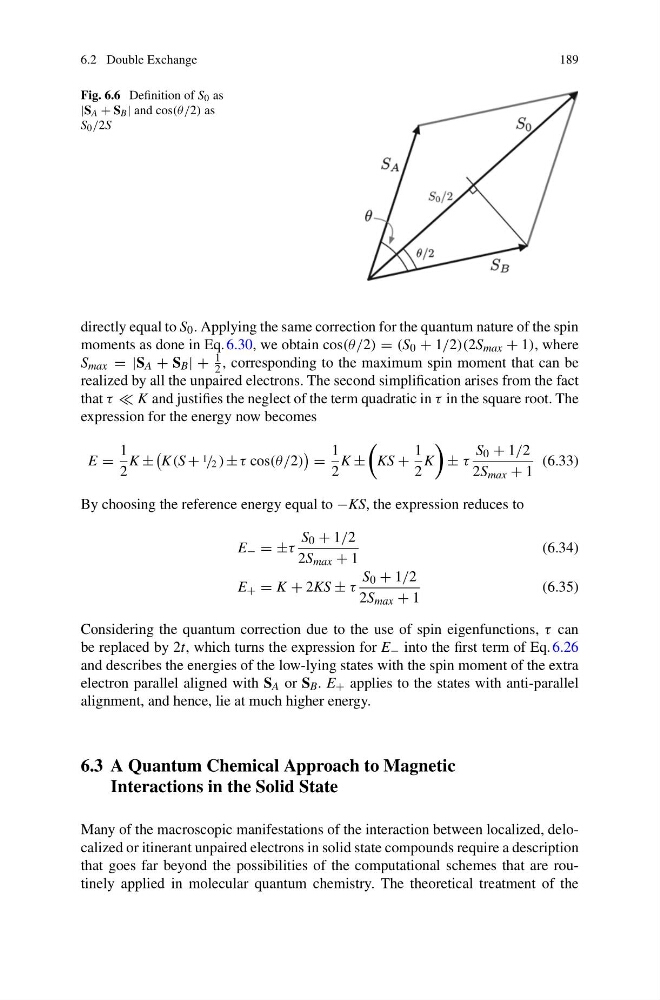
Fig. 6.6 Definition of S 0 as
|S A + S B | and cos(θ/2) as
S 0 /2S
directly equal to S 0 . Applying the same correction for the quantum nature of the spin
moments as done in Eq. 6.30, we obtain cos(θ/2) = (S 0 + 1/2)(2S max + 1), where
S max =| S A + S B |+
1
2 , corresponding to the maximum spin moment that can be
realized by all the unpaired electrons. The second simplification arises from the fact
that τ ≪ K and justifies the neglect of the term quadratic in τ in the square root. The
expression for the energy now becomes
E =
1
2
K ±
K(S + 1 / 2 ) ± τ cos(θ/2)
=
1
2
K ±
KS +
1
2
K
± τ
S 0 + 1/2
2S max + 1
(6.33)
By choosing the reference energy equal to −KS, the expression reduces to
E − =±τ
S 0 + 1/2
2S max + 1
(6.34)
E + = K + 2KS ± τ
S 0 + 1/2
2S max + 1
(6.35)
Considering the quantum correction due to the use of spin eigenfunctions, τ can
be replaced by 2t, which turns the expression for E − into the first term of Eq. 6.26
and describes the energies of the low-lying states with the spin moment of the extra
electron parallel aligned with S A or S B . E + applies to the states with anti-parallel
alignment, and hence, lie at much higher energy.
6.3 A Quantum Chemical Approach to Magnetic
Interactions in the Solid State
Many of the macroscopic manifestations of the interaction between localized, delocalized or itinerant unpaired electrons in solid state compounds require a description
that goes far beyond the possibilities of the computational schemes that are routinely applied in molecular quantum chemistry. The theoretical treatment of the
189
Fig. 6.6 Definition of S 0 as
|S A + S B | and cos(θ/2) as
S 0 /2S
directly equal to S 0 . Applying the same correction for the quantum nature of the spin
moments as done in Eq. 6.30, we obtain cos(θ/2) = (S 0 + 1/2)(2S max + 1), where
S max =| S A + S B |+
1
2 , corresponding to the maximum spin moment that can be
realized by all the unpaired electrons. The second simplification arises from the fact
that τ ≪ K and justifies the neglect of the term quadratic in τ in the square root. The
expression for the energy now becomes
E =
1
2
K ±
K(S + 1 / 2 ) ± τ cos(θ/2)
=
1
2
K ±
KS +
1
2
K
± τ
S 0 + 1/2
2S max + 1
(6.33)
By choosing the reference energy equal to −KS, the expression reduces to
E − =±τ
S 0 + 1/2
2S max + 1
(6.34)
E + = K + 2KS ± τ
S 0 + 1/2
2S max + 1
(6.35)
Considering the quantum correction due to the use of spin eigenfunctions, τ can
be replaced by 2t, which turns the expression for E − into the first term of Eq. 6.26
and describes the energies of the low-lying states with the spin moment of the extra
electron parallel aligned with S A or S B . E + applies to the states with anti-parallel
alignment, and hence, lie at much higher energy.
6.3 A Quantum Chemical Approach to Magnetic
Interactions in the Solid State
Many of the macroscopic manifestations of the interaction between localized, delocalized or itinerant unpaired electrons in solid state compounds require a description
that goes far beyond the possibilities of the computational schemes that are routinely applied in molecular quantum chemistry. The theoretical treatment of the