

166
5 Towards a Quantitative Understanding
In summary, biquadratic exchange interactions are only expected in complexes
with sizeable magnetic interaction, small on-site repulsion U , not too large on-site
exchange interaction K and different inter-site interactions for the pairs of electrons
on the different magnetic centers: K 13 = K 24 ; t 13 = t 24 .
5.4.2 Decomposition of the Four-Center Interactions
The four-spin interaction as discussed in Chap. 3 (Sect. 3.4.2) is the effective matrix
element between the determinants Φ I =|abcd| and Φ J =|abcd|. Since the direct
matrix element of the electronic Hamiltonian between them is zero (there are more
than two different columns in the determinants), there must be other, indirect interactions that account for the non-zero value of this interaction. In analogy to the normal
two-center magnetic interaction, we will review the role of the ionic determinants in
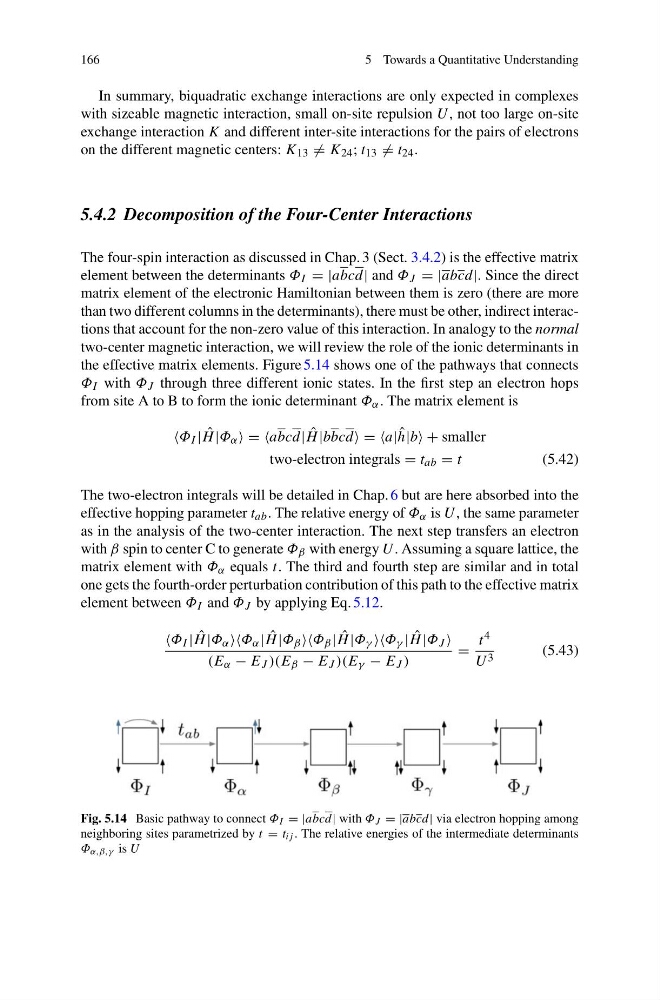
the effective matrix elements. Figure 5.14 shows one of the pathways that connects
Φ I with Φ J through three different ionic states. In the first step an electron hops
from site A to B to form the ionic determinant Φ α . The matrix element is
Φ I | ˆ
H |Φ α ==abcd| ˆ
H |bbcd==a| ˆ
h|b+smaller
two-electron integrals = t ab = t
(5.42)
The two-electron integrals will be detailed in Chap. 6 but are here absorbed into the
effective hopping parameter t ab . The relative energy of Φ α is U , the same parameter
as in the analysis of the two-center interaction. The next step transfers an electron
with β spin to center C to generate Φ β with energy U . Assuming a square lattice, the
matrix element with Φ α equals t. The third and fourth step are similar and in total
one gets the fourth-order perturbation contribution of this path to the effective matrix
element between Φ I and Φ J by applying Eq. 5.12.
Φ I | ˆ
H |Φ α Φ α | ˆ
H |Φ β Φ β | ˆ
H |Φ γ Φ γ | ˆ
H |Φ J
(E α − E J )(E β − E J )(E γ − E J )
=
t 4
U 3
(5.43)
Fig. 5.14 Basic pathway to connect Φ I =|abcd| with Φ J =|abcd| via electron hopping among
neighboring sites parametrized by t = t ij . The relative energies of the intermediate determinants
Φ α,β,γ is U
5 Towards a Quantitative Understanding
In summary, biquadratic exchange interactions are only expected in complexes
with sizeable magnetic interaction, small on-site repulsion U , not too large on-site
exchange interaction K and different inter-site interactions for the pairs of electrons
on the different magnetic centers: K 13 = K 24 ; t 13 = t 24 .
5.4.2 Decomposition of the Four-Center Interactions
The four-spin interaction as discussed in Chap. 3 (Sect. 3.4.2) is the effective matrix
element between the determinants Φ I =|abcd| and Φ J =|abcd|. Since the direct
matrix element of the electronic Hamiltonian between them is zero (there are more
than two different columns in the determinants), there must be other, indirect interactions that account for the non-zero value of this interaction. In analogy to the normal
two-center magnetic interaction, we will review the role of the ionic determinants in
the effective matrix elements. Figure 5.14 shows one of the pathways that connects
Φ I with Φ J through three different ionic states. In the first step an electron hops
from site A to B to form the ionic determinant Φ α . The matrix element is
Φ I | ˆ
H |Φ α ==abcd| ˆ
H |bbcd==a| ˆ
h|b+smaller
two-electron integrals = t ab = t
(5.42)
The two-electron integrals will be detailed in Chap. 6 but are here absorbed into the
effective hopping parameter t ab . The relative energy of Φ α is U , the same parameter
as in the analysis of the two-center interaction. The next step transfers an electron
with β spin to center C to generate Φ β with energy U . Assuming a square lattice, the
matrix element with Φ α equals t. The third and fourth step are similar and in total
one gets the fourth-order perturbation contribution of this path to the effective matrix
element between Φ I and Φ J by applying Eq. 5.12.
Φ I | ˆ
H |Φ α Φ α | ˆ
H |Φ β Φ β | ˆ
H |Φ γ Φ γ | ˆ
H |Φ J
(E α − E J )(E β − E J )(E γ − E J )
=
t 4
U 3
(5.43)
Fig. 5.14 Basic pathway to connect Φ I =|abcd| with Φ J =|abcd| via electron hopping among
neighboring sites parametrized by t = t ij . The relative energies of the intermediate determinants
Φ α,β,γ is U