

5.4 Analysis of Complex Interactions
167
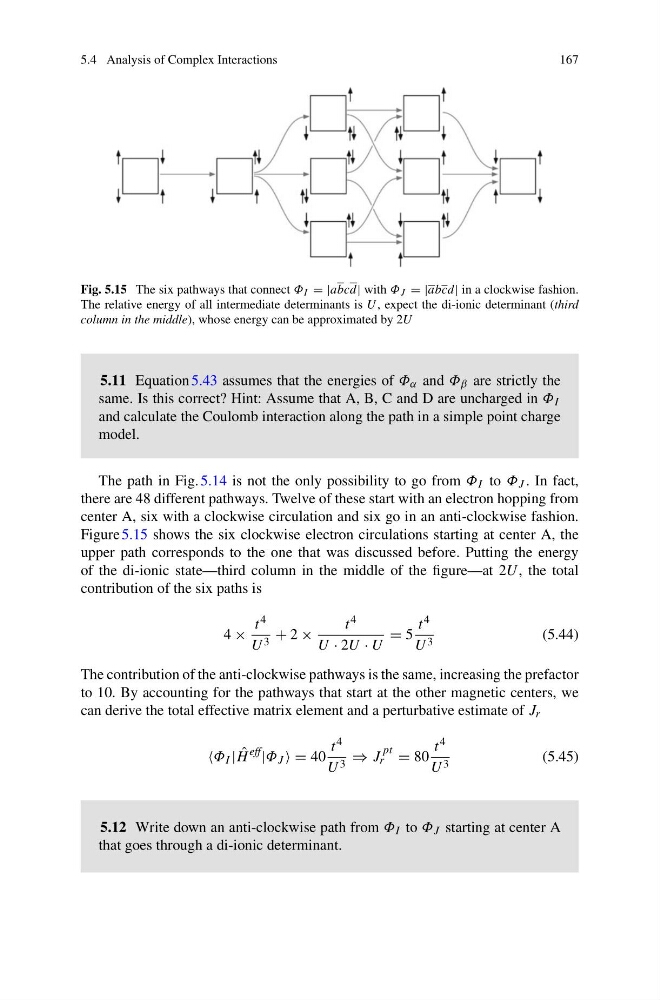
Fig. 5.15 The six pathways that connect Φ I =| abcd| with Φ J =| abcd| in a clockwise fashion.
The relative energy of all intermediate determinants is U , expect the di-ionic determinant (third
column in the middle), whose energy can be approximated by 2U
5.11 Equation 5.43 assumes that the energies of Φ α and Φ β are strictly the
same. Is this correct? Hint: Assume that A, B, C and D are uncharged in Φ I
and calculate the Coulomb interaction along the path in a simple point charge
model.
The path in Fig. 5.14 is not the only possibility to go from Φ I to Φ J . In fact,
there are 48 different pathways. Twelve of these start with an electron hopping from
center A, six with a clockwise circulation and six go in an anti-clockwise fashion.
Figure 5.15 shows the six clockwise electron circulations starting at center A, the
upper path corresponds to the one that was discussed before. Putting the energy
of the di-ionic state—third column in the middle of the figure—at 2U , the total
contribution of the six paths is
4 ×
t 4
U 3 + 2 ×
t 4
U · 2U · U
= 5
t 4
U 3
(5.44)
The contribution of the anti-clockwise pathways is the same, increasing the prefactor
to 10. By accounting for the pathways that start at the other magnetic centers, we
can derive the total effective matrix element and a perturbative estimate of J r
Φ I | ˆ
H
eff |Φ J =40
t 4
U 3 ⇒ J
pt
r = 80
t 4
U 3
(5.45)
5.12 Write down an anti-clockwise path from Φ I to Φ J starting at center A
that goes through a di-ionic determinant.
167
Fig. 5.15 The six pathways that connect Φ I =| abcd| with Φ J =| abcd| in a clockwise fashion.
The relative energy of all intermediate determinants is U , expect the di-ionic determinant (third
column in the middle), whose energy can be approximated by 2U
5.11 Equation 5.43 assumes that the energies of Φ α and Φ β are strictly the
same. Is this correct? Hint: Assume that A, B, C and D are uncharged in Φ I
and calculate the Coulomb interaction along the path in a simple point charge
model.
The path in Fig. 5.14 is not the only possibility to go from Φ I to Φ J . In fact,
there are 48 different pathways. Twelve of these start with an electron hopping from
center A, six with a clockwise circulation and six go in an anti-clockwise fashion.
Figure 5.15 shows the six clockwise electron circulations starting at center A, the
upper path corresponds to the one that was discussed before. Putting the energy
of the di-ionic state—third column in the middle of the figure—at 2U , the total
contribution of the six paths is
4 ×
t 4
U 3 + 2 ×
t 4
U · 2U · U
= 5
t 4
U 3
(5.44)
The contribution of the anti-clockwise pathways is the same, increasing the prefactor
to 10. By accounting for the pathways that start at the other magnetic centers, we
can derive the total effective matrix element and a perturbative estimate of J r
Φ I | ˆ
H
eff |Φ J =40
t 4
U 3 ⇒ J
pt
r = 80
t 4
U 3
(5.45)
5.12 Write down an anti-clockwise path from Φ I to Φ J starting at center A
that goes through a di-ionic determinant.