

5.4 Analysis of Complex Interactions
165
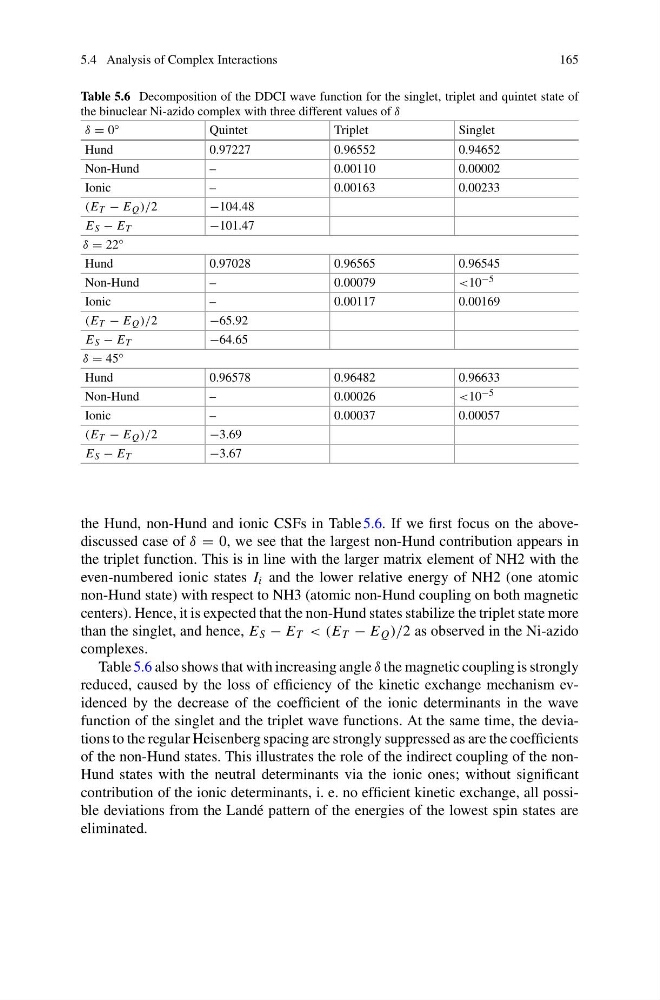
Table 5.6 Decomposition of the DDCI wave function for the singlet, triplet and quintet state of
the binuclear Ni-azido complex with three different values of δ
δ = 0 ◦
Quintet
Triplet
Singlet
Hund
0.97227
0.96552
0.94652
Non-Hund
–
0.00110
0.00002
Ionic
–
0.00163
0.00233
(E T − E Q )/2
−104.48
E S − E T
−101.47
δ = 22 ◦
Hund
0.97028
0.96565
0.96545
Non-Hund
–
0.00079
<10 −5
Ionic
–
0.00117
0.00169
(E T − E Q )/2
−65.92
E S − E T
−64.65
δ = 45 ◦
Hund
0.96578
0.96482
0.96633
Non-Hund
–
0.00026
<10 −5
Ionic
–
0.00037
0.00057
(E T − E Q )/2
−3.69
E S − E T
−3.67
the Hund, non-Hund and ionic CSFs in Table 5.6. If we first focus on the abovediscussed case of δ = 0, we see that the largest non-Hund contribution appears in
the triplet function. This is in line with the larger matrix element of NH2 with the
even-numbered ionic states I i and the lower relative energy of NH2 (one atomic
non-Hund state) with respect to NH3 (atomic non-Hund coupling on both magnetic
centers). Hence, it is expected that the non-Hund states stabilize the triplet state more
than the singlet, and hence, E S − E T <(E T − E Q )/2 as observed in the Ni-azido
complexes.
Table 5.6 also shows that with increasing angle δ the magnetic coupling is strongly
reduced, caused by the loss of efficiency of the kinetic exchange mechanism evidenced by the decrease of the coefficient of the ionic determinants in the wave
function of the singlet and the triplet wave functions. At the same time, the deviations to the regular Heisenberg spacing are strongly suppressed as are the coefficients
of the non-Hund states. This illustrates the role of the indirect coupling of the nonHund states with the neutral determinants via the ionic ones; without significant
contribution of the ionic determinants, i. e. no efficient kinetic exchange, all possible deviations from the Landé pattern of the energies of the lowest spin states are
eliminated.
165
Table 5.6 Decomposition of the DDCI wave function for the singlet, triplet and quintet state of
the binuclear Ni-azido complex with three different values of δ
δ = 0 ◦
Quintet
Triplet
Singlet
Hund
0.97227
0.96552
0.94652
Non-Hund
–
0.00110
0.00002
Ionic
–
0.00163
0.00233
(E T − E Q )/2
−104.48
E S − E T
−101.47
δ = 22 ◦
Hund
0.97028
0.96565
0.96545
Non-Hund
–
0.00079
<10 −5
Ionic
–
0.00117
0.00169
(E T − E Q )/2
−65.92
E S − E T
−64.65
δ = 45 ◦
Hund
0.96578
0.96482
0.96633
Non-Hund
–
0.00026
<10 −5
Ionic
–
0.00037
0.00057
(E T − E Q )/2
−3.69
E S − E T
−3.67
the Hund, non-Hund and ionic CSFs in Table 5.6. If we first focus on the abovediscussed case of δ = 0, we see that the largest non-Hund contribution appears in
the triplet function. This is in line with the larger matrix element of NH2 with the
even-numbered ionic states I i and the lower relative energy of NH2 (one atomic
non-Hund state) with respect to NH3 (atomic non-Hund coupling on both magnetic
centers). Hence, it is expected that the non-Hund states stabilize the triplet state more
than the singlet, and hence, E S − E T <(E T − E Q )/2 as observed in the Ni-azido
complexes.
Table 5.6 also shows that with increasing angle δ the magnetic coupling is strongly
reduced, caused by the loss of efficiency of the kinetic exchange mechanism evidenced by the decrease of the coefficient of the ionic determinants in the wave
function of the singlet and the triplet wave functions. At the same time, the deviations to the regular Heisenberg spacing are strongly suppressed as are the coefficients
of the non-Hund states. This illustrates the role of the indirect coupling of the nonHund states with the neutral determinants via the ionic ones; without significant
contribution of the ionic determinants, i. e. no efficient kinetic exchange, all possible deviations from the Landé pattern of the energies of the lowest spin states are
eliminated.