

164
5 Towards a Quantitative Understanding
E(S) =−
3
2
t 2
13
U
(5.41)
It is now trivial to see that E(T ) − E(Q) =2
E(S) − E(T )
. Note that taking into
account the interaction of all the CSFs with ionic character leads to more elaborate
expressions for the energies of S and T , but the principle is the same.
The simultaneous interaction of the ionic CSFs with S/T and NH3/NH2 makes
that the non-Hund states gain some weight in the wave function of the lowest triplet
and singlet states. This is exactly the same mechanism as in the configuration interaction of singles and doubles. The singles have no direct interaction with the
Hartree-Fock determinant due the Brillouin theorem, but they appear in the CI wave
function due to an indirect interaction via the doubles.
5.10 Rationalize the relative size for the estimates of J extracted from the
singlet-triplet and from the triplet-quintet energy difference. Hint: compare
the matrix elements of the ionic determinants with the non-Hund states and
take into consideration the relative energy of the non-Hund states involved in
the coupling.
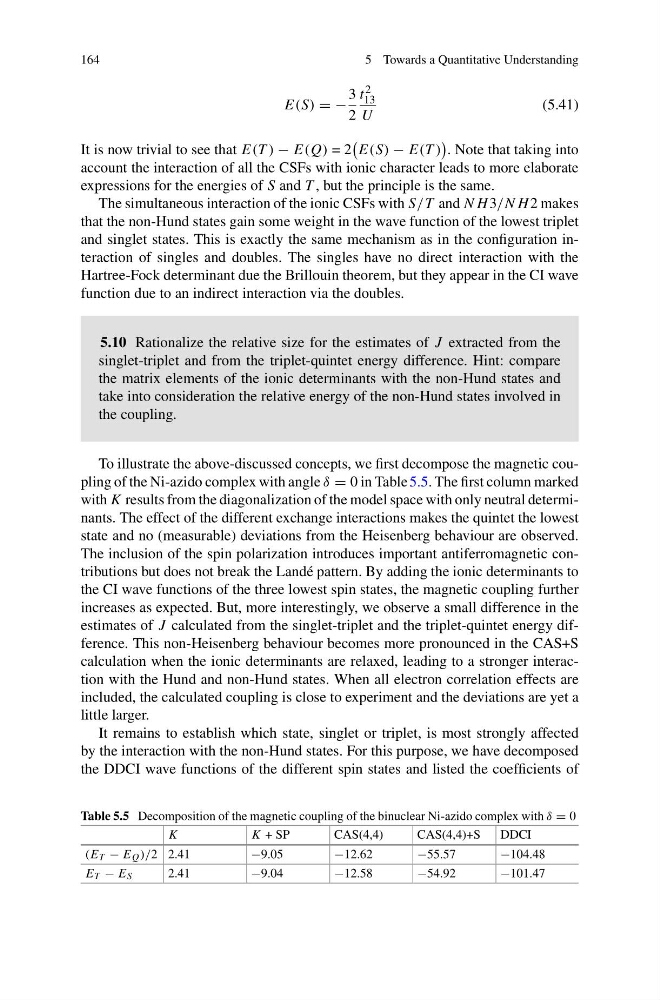
To illustrate the above-discussed concepts, we first decompose the magnetic coupling of the Ni-azido complex with angle δ = 0 in Table 5.5. The first column marked
with K results from the diagonalization of the model space with only neutral determinants. The effect of the different exchange interactions makes the quintet the lowest
state and no (measurable) deviations from the Heisenberg behaviour are observed.
The inclusion of the spin polarization introduces important antiferromagnetic contributions but does not break the Landé pattern. By adding the ionic determinants to
the CI wave functions of the three lowest spin states, the magnetic coupling further
increases as expected. But, more interestingly, we observe a small difference in the
estimates of J calculated from the singlet-triplet and the triplet-quintet energy difference. This non-Heisenberg behaviour becomes more pronounced in the CAS+S
calculation when the ionic determinants are relaxed, leading to a stronger interaction with the Hund and non-Hund states. When all electron correlation effects are
included, the calculated coupling is close to experiment and the deviations are yet a
little larger.
It remains to establish which state, singlet or triplet, is most strongly affected
by the interaction with the non-Hund states. For this purpose, we have decomposed
the DDCI wave functions of the different spin states and listed the coefficients of
Table 5.5 Decomposition of the magnetic coupling of the binuclear Ni-azido complex with δ = 0
K
K +SP
CAS(4,4)
CAS(4,4)+S
DDCI
(E T − E Q )/2 2.41
−9.05
−12.62
−55.57
−104.48
E T − E S
2.41
−9.04
−12.58
−54.92
−101.47
5 Towards a Quantitative Understanding
E(S) =−
3
2
t 2
13
U
(5.41)
It is now trivial to see that E(T ) − E(Q) =2
E(S) − E(T )
. Note that taking into
account the interaction of all the CSFs with ionic character leads to more elaborate
expressions for the energies of S and T , but the principle is the same.
The simultaneous interaction of the ionic CSFs with S/T and NH3/NH2 makes
that the non-Hund states gain some weight in the wave function of the lowest triplet
and singlet states. This is exactly the same mechanism as in the configuration interaction of singles and doubles. The singles have no direct interaction with the
Hartree-Fock determinant due the Brillouin theorem, but they appear in the CI wave
function due to an indirect interaction via the doubles.
5.10 Rationalize the relative size for the estimates of J extracted from the
singlet-triplet and from the triplet-quintet energy difference. Hint: compare
the matrix elements of the ionic determinants with the non-Hund states and
take into consideration the relative energy of the non-Hund states involved in
the coupling.
To illustrate the above-discussed concepts, we first decompose the magnetic coupling of the Ni-azido complex with angle δ = 0 in Table 5.5. The first column marked
with K results from the diagonalization of the model space with only neutral determinants. The effect of the different exchange interactions makes the quintet the lowest
state and no (measurable) deviations from the Heisenberg behaviour are observed.
The inclusion of the spin polarization introduces important antiferromagnetic contributions but does not break the Landé pattern. By adding the ionic determinants to
the CI wave functions of the three lowest spin states, the magnetic coupling further
increases as expected. But, more interestingly, we observe a small difference in the
estimates of J calculated from the singlet-triplet and the triplet-quintet energy difference. This non-Heisenberg behaviour becomes more pronounced in the CAS+S
calculation when the ionic determinants are relaxed, leading to a stronger interaction with the Hund and non-Hund states. When all electron correlation effects are
included, the calculated coupling is close to experiment and the deviations are yet a
little larger.
It remains to establish which state, singlet or triplet, is most strongly affected
by the interaction with the non-Hund states. For this purpose, we have decomposed
the DDCI wave functions of the different spin states and listed the coefficients of
Table 5.5 Decomposition of the magnetic coupling of the binuclear Ni-azido complex with δ = 0
K
K +SP
CAS(4,4)
CAS(4,4)+S
DDCI
(E T − E Q )/2 2.41
−9.05
−12.62
−55.57
−104.48
E T − E S
2.41
−9.04
−12.58
−54.92
−101.47