

5.4 Analysis of Complex Interactions
163
There are more ionic determinants, e.g. |φ 1 φ 1 φ 2 φ 3 |, but these do not interact with T
or S when φ 1 and φ 3 belong to a different irreducible representation than φ 2 and φ 4 .
The use of spin symmetry adapted configurations allows us to write the full 15 × 15
matrix representation of the model space in three separate blocks. The first one is
one-dimensional and only contains the neutral quintet CSF, the second one contains
all the triplet CSFs: T , NH2 and the even-numbered I i CSFs. The third sub-block
of the total reference space is formed by the singlets: S, NH3 and the odd-numbered
I i CSFs. NH1 does not interact with any of the other CSFs due to symmetry. The
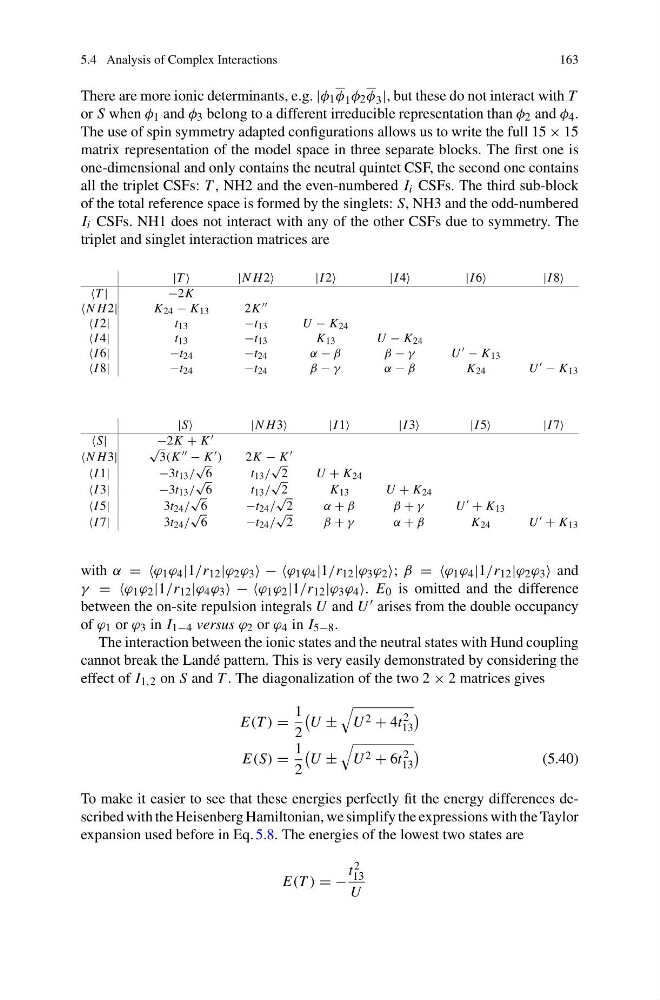
triplet and singlet interaction matrices are
|T | NH2| I 2| I 4| I 6| I 8
T |
−2K
NH2|
K 24 − K 13
2K ′′
I 2|
t 13
−t 13
U − K 24
I 4|
t 13
−t 13
K 13
U − K 24
I 6|
−t 24
−t 24
α − ββ − γ
U ′ − K 13
I 8|
−t 24
−t 24
β − γα − β
K 24
U ′ − K 13
|S| NH3| I 1| I 3| I 5| I 7
S|
−2K + K ′
NH3|
√
3(K ′′ − K ′ )
2K − K ′
I 1|
−3t 13 /
√
6
t 13 /
√
2
U + K 24
I 3|
−3t 13 /
√
6
t 13 /
√
2
K 13
U + K 24
I 5|
3t 24 /
√
6
−t 24 /
√
2
α + ββ + γ
U ′ + K 13
I 7|
3t 24 /
√
6
−t 24 /
√
2
β + γα + β
K 24
U ′ + K 13
with α == ϕ 1 ϕ 4 |1/r 12 |ϕ 2 ϕ 3 −− ϕ 1 ϕ 4 |1/r 12 |ϕ 3 ϕ 2 ; β == ϕ 1 ϕ 4 |1/r 12 |ϕ 2 ϕ 3 and
γ == ϕ 1 ϕ 2 |1/r 12 |ϕ 4 ϕ 3 −− ϕ 1 ϕ 2 |1/r 12 |ϕ 3 ϕ 4 . E 0 is omitted and the difference
between the on-site repulsion integrals U and U ′ arises from the double occupancy
of ϕ 1 or ϕ 3 in I 1−4 versus ϕ 2 or ϕ 4 in I 5−8 .
The interaction between the ionic states and the neutral states with Hund coupling
cannot break the Landé pattern. This is very easily demonstrated by considering the
effect of I 1,2 on S and T . The diagonalization of the two 2 × 2 matrices gives
E(T ) =
1
2
U ±
U 2 + 4t 2
13
E(S) =
1
2
U ±
U 2 + 6t 2
13
(5.40)
To make it easier to see that these energies perfectly fit the energy differences described with the Heisenberg Hamiltonian, we simplify the expressions with the Taylor
expansion used before in Eq. 5.8. The energies of the lowest two states are
E(T ) =−
t 2
13
U
163
There are more ionic determinants, e.g. |φ 1 φ 1 φ 2 φ 3 |, but these do not interact with T
or S when φ 1 and φ 3 belong to a different irreducible representation than φ 2 and φ 4 .
The use of spin symmetry adapted configurations allows us to write the full 15 × 15
matrix representation of the model space in three separate blocks. The first one is
one-dimensional and only contains the neutral quintet CSF, the second one contains
all the triplet CSFs: T , NH2 and the even-numbered I i CSFs. The third sub-block
of the total reference space is formed by the singlets: S, NH3 and the odd-numbered
I i CSFs. NH1 does not interact with any of the other CSFs due to symmetry. The
triplet and singlet interaction matrices are
|T | NH2| I 2| I 4| I 6| I 8
T |
−2K
NH2|
K 24 − K 13
2K ′′
I 2|
t 13
−t 13
U − K 24
I 4|
t 13
−t 13
K 13
U − K 24
I 6|
−t 24
−t 24
α − ββ − γ
U ′ − K 13
I 8|
−t 24
−t 24
β − γα − β
K 24
U ′ − K 13
|S| NH3| I 1| I 3| I 5| I 7
S|
−2K + K ′
NH3|
√
3(K ′′ − K ′ )
2K − K ′
I 1|
−3t 13 /
√
6
t 13 /
√
2
U + K 24
I 3|
−3t 13 /
√
6
t 13 /
√
2
K 13
U + K 24
I 5|
3t 24 /
√
6
−t 24 /
√
2
α + ββ + γ
U ′ + K 13
I 7|
3t 24 /
√
6
−t 24 /
√
2
β + γα + β
K 24
U ′ + K 13
with α == ϕ 1 ϕ 4 |1/r 12 |ϕ 2 ϕ 3 −− ϕ 1 ϕ 4 |1/r 12 |ϕ 3 ϕ 2 ; β == ϕ 1 ϕ 4 |1/r 12 |ϕ 2 ϕ 3 and
γ == ϕ 1 ϕ 2 |1/r 12 |ϕ 4 ϕ 3 −− ϕ 1 ϕ 2 |1/r 12 |ϕ 3 ϕ 4 . E 0 is omitted and the difference
between the on-site repulsion integrals U and U ′ arises from the double occupancy
of ϕ 1 or ϕ 3 in I 1−4 versus ϕ 2 or ϕ 4 in I 5−8 .
The interaction between the ionic states and the neutral states with Hund coupling
cannot break the Landé pattern. This is very easily demonstrated by considering the
effect of I 1,2 on S and T . The diagonalization of the two 2 × 2 matrices gives
E(T ) =
1
2
U ±
U 2 + 4t 2
13
E(S) =
1
2
U ±
U 2 + 6t 2
13
(5.40)
To make it easier to see that these energies perfectly fit the energy differences described with the Heisenberg Hamiltonian, we simplify the expressions with the Taylor
expansion used before in Eq. 5.8. The energies of the lowest two states are
E(T ) =−
t 2
13
U