

162
5 Towards a Quantitative Understanding
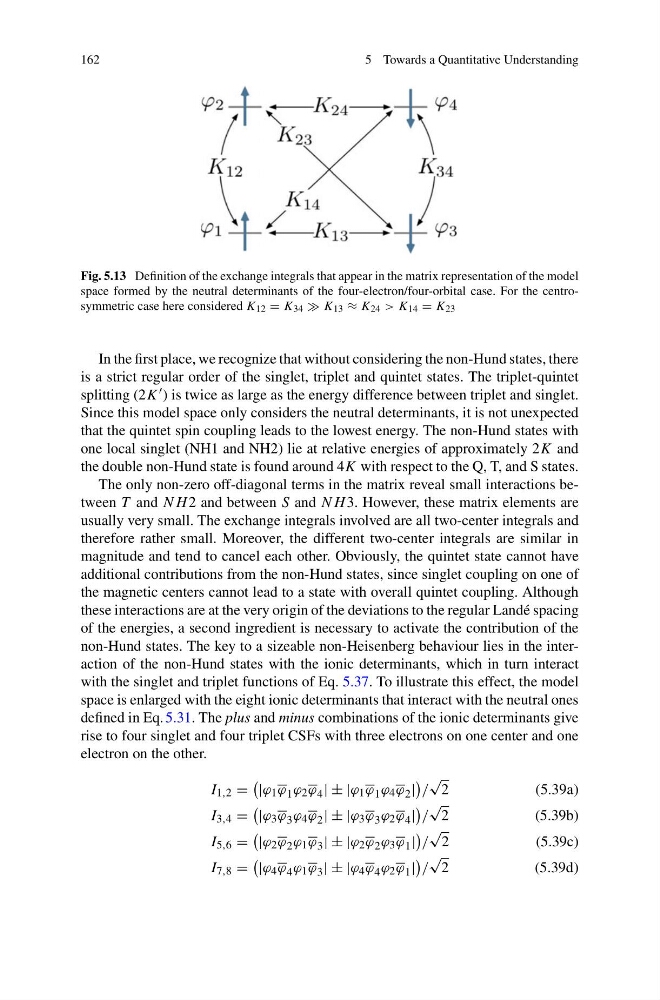
Fig. 5.13 Definition of the exchange integrals that appear in the matrix representation of the model
space formed by the neutral determinants of the four-electron/four-orbital case. For the centrosymmetric case here considered K 12 = K 34 ≫ K 13 ≈ K 24 > K 14 = K 23
In the first place, we recognize that without considering the non-Hund states, there
is a strict regular order of the singlet, triplet and quintet states. The triplet-quintet
splitting (2K ′ ) is twice as large as the energy difference between triplet and singlet.
Since this model space only considers the neutral determinants, it is not unexpected
that the quintet spin coupling leads to the lowest energy. The non-Hund states with
one local singlet (NH1 and NH2) lie at relative energies of approximately 2K and
the double non-Hund state is found around 4K with respect to the Q, T, and S states.
The only non-zero off-diagonal terms in the matrix reveal small interactions between T and NH2 and between S and NH3. However, these matrix elements are
usually very small. The exchange integrals involved are all two-center integrals and
therefore rather small. Moreover, the different two-center integrals are similar in
magnitude and tend to cancel each other. Obviously, the quintet state cannot have
additional contributions from the non-Hund states, since singlet coupling on one of
the magnetic centers cannot lead to a state with overall quintet coupling. Although
these interactions are at the very origin of the deviations to the regular Landé spacing
of the energies, a second ingredient is necessary to activate the contribution of the
non-Hund states. The key to a sizeable non-Heisenberg behaviour lies in the interaction of the non-Hund states with the ionic determinants, which in turn interact
with the singlet and triplet functions of Eq. 5.37. To illustrate this effect, the model
space is enlarged with the eight ionic determinants that interact with the neutral ones
defined in Eq. 5.31.Theplus and minus combinations of the ionic determinants give
rise to four singlet and four triplet CSFs with three electrons on one center and one
electron on the other.
I 1,2 =
|ϕ 1 ϕ 1 ϕ 2 ϕ 4 |±|ϕ 1 ϕ 1 ϕ 4 ϕ 2 |
/
√
2
(5.39a)
I 3,4 =
|ϕ 3 ϕ 3 ϕ 4 ϕ 2 |±|ϕ 3 ϕ 3 ϕ 2 ϕ 4 |
/
√
2
(5.39b)
I 5,6 =
|ϕ 2 ϕ 2 ϕ 1 ϕ 3 |±|ϕ 2 ϕ 2 ϕ 3 ϕ 1 |
/
√
2
(5.39c)
I 7,8 =
|ϕ 4 ϕ 4 ϕ 1 ϕ 3 |±|ϕ 4 ϕ 4 ϕ 2 ϕ 1 |
/
√
2
(5.39d)
5 Towards a Quantitative Understanding
Fig. 5.13 Definition of the exchange integrals that appear in the matrix representation of the model
space formed by the neutral determinants of the four-electron/four-orbital case. For the centrosymmetric case here considered K 12 = K 34 ≫ K 13 ≈ K 24 > K 14 = K 23
In the first place, we recognize that without considering the non-Hund states, there
is a strict regular order of the singlet, triplet and quintet states. The triplet-quintet
splitting (2K ′ ) is twice as large as the energy difference between triplet and singlet.
Since this model space only considers the neutral determinants, it is not unexpected
that the quintet spin coupling leads to the lowest energy. The non-Hund states with
one local singlet (NH1 and NH2) lie at relative energies of approximately 2K and
the double non-Hund state is found around 4K with respect to the Q, T, and S states.
The only non-zero off-diagonal terms in the matrix reveal small interactions between T and NH2 and between S and NH3. However, these matrix elements are
usually very small. The exchange integrals involved are all two-center integrals and
therefore rather small. Moreover, the different two-center integrals are similar in
magnitude and tend to cancel each other. Obviously, the quintet state cannot have
additional contributions from the non-Hund states, since singlet coupling on one of
the magnetic centers cannot lead to a state with overall quintet coupling. Although
these interactions are at the very origin of the deviations to the regular Landé spacing
of the energies, a second ingredient is necessary to activate the contribution of the
non-Hund states. The key to a sizeable non-Heisenberg behaviour lies in the interaction of the non-Hund states with the ionic determinants, which in turn interact
with the singlet and triplet functions of Eq. 5.37. To illustrate this effect, the model
space is enlarged with the eight ionic determinants that interact with the neutral ones
defined in Eq. 5.31.Theplus and minus combinations of the ionic determinants give
rise to four singlet and four triplet CSFs with three electrons on one center and one
electron on the other.
I 1,2 =
|ϕ 1 ϕ 1 ϕ 2 ϕ 4 |±|ϕ 1 ϕ 1 ϕ 4 ϕ 2 |
/
√
2
(5.39a)
I 3,4 =
|ϕ 3 ϕ 3 ϕ 4 ϕ 2 |±|ϕ 3 ϕ 3 ϕ 2 ϕ 4 |
/
√
2
(5.39b)
I 5,6 =
|ϕ 2 ϕ 2 ϕ 1 ϕ 3 |±|ϕ 2 ϕ 2 ϕ 3 ϕ 1 |
/
√
2
(5.39c)
I 7,8 =
|ϕ 4 ϕ 4 ϕ 1 ϕ 3 |±|ϕ 4 ϕ 4 ϕ 2 ϕ 1 |
/
√
2
(5.39d)