

1.1 Slater Determinants and Slater–Condon Rules
3
of Ψ | ˆ
H |Ψ . The variation theorem tells us that this lowest value is still above the
exact ground state energy E.
This variational procedure leads to a set of equations
ˆ
f φ i = ε i φ i
(1.6)
called the Hartree–Fock equations, which determine the spin orbitals in Ψ .Thesetof
equations (1.6) can be seen as effective one-electron Schrödinger equations, whose
eigenvalues ε are called one-electron energies or orbital energies. There is an operator
ˆ
f , called Fock operator, for each electron in the molecule, and they are all identical.
Much can be said about the Hartree–Fock equations, their eigenvalues ε and their
eigenfunctions, the spin orbitals φ but here we restrict ourselves to a few aspects
that are relevant later in this chapter. Firstly, ˆ
f depends on the spin orbitals to be
found, which has the consequence that the equations have to be solved iteratively
and secondly, the energy expectation value E is not equal to the sum of the one
electron energies. Summing the N individual Fock operators for the electrons of
the molecule gives an N -electron Hamiltonian, ˆ
H (0) , that is not equal to the true
N -electron Hamiltonian, but that we will use later as zeroth order Hamiltonian in a
perturbation expansion. All Slater determinants Φ k , k = 1, 2,... that can be built
from the spin orbitals of Eq. 1.6 are eigenfunctions of ˆ
H (0) , with eigenvalues E
(0)
k
equal to the sum of the orbital energies of the spin orbitals used in Ψ k .
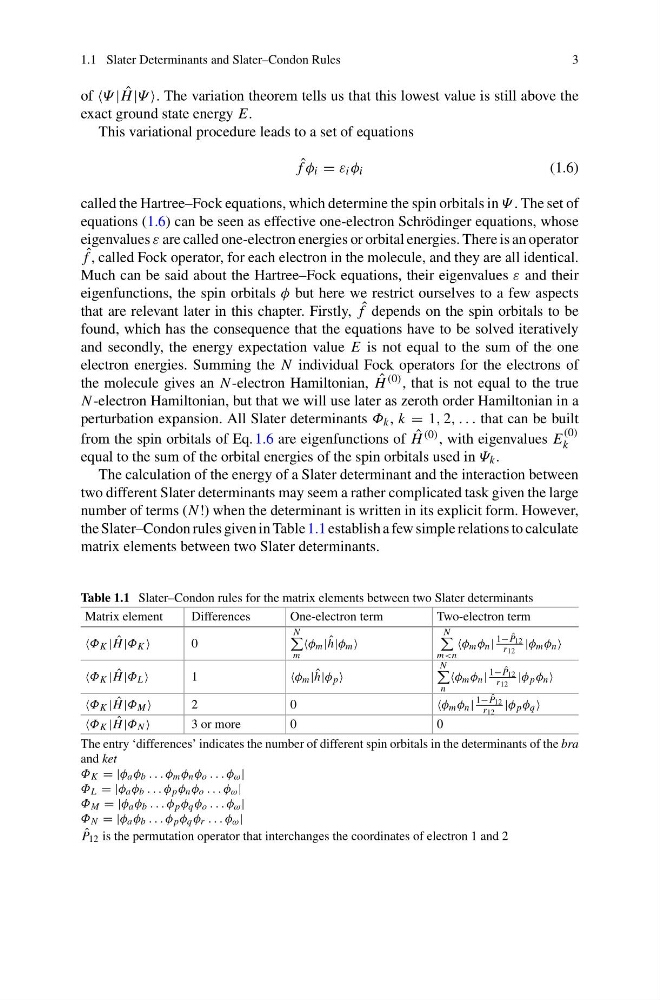
The calculation of the energy of a Slater determinant and the interaction between
two different Slater determinants may seem a rather complicated task given the large
number of terms (N !) when the determinant is written in its explicit form. However,
the Slater–Condon rules given in Table 1.1 establish a few simple relations to calculate
matrix elements between two Slater determinants.
Table 1.1 Slater–Condon rules for the matrix elements between two Slater determinants
Matrix element
Differences
One-electron term
Two-electron term
Φ K | ˆ
H |Φ K
0
N
m
φ m | ˆ
h|φ m
N
m
1− ˆ
P12
r12 |φ m φ n
Φ K | ˆ
H |Φ L
1
φ m | ˆ
h|φ p
N
n
φ m φ n |
1− ˆ
P12
r12 |φ p φ n
Φ K | ˆ
H |Φ M
2
0
φ m φ n |
1− ˆ
P12
r12 |φ p φ q
Φ K | ˆ
H |Φ N
3ormore
0
0
The entry ‘differences’ indicates the number of different spin orbitals in the determinants of the bra
and ket
Φ K =|φ a φ b ...φ m φ n φ o ...φ ω |
Φ L =|φ a φ b ...φ p φ n φ o ...φ ω |
Φ M =|φ a φ b ...φ p φ q φ o ...φ ω |
Φ N =|φ a φ b ...φ p φ q φ r ...φ ω |
ˆ
P 12 is the permutation operator that interchanges the coordinates of electron 1 and 2
3
of Ψ | ˆ
H |Ψ . The variation theorem tells us that this lowest value is still above the
exact ground state energy E.
This variational procedure leads to a set of equations
ˆ
f φ i = ε i φ i
(1.6)
called the Hartree–Fock equations, which determine the spin orbitals in Ψ .Thesetof
equations (1.6) can be seen as effective one-electron Schrödinger equations, whose
eigenvalues ε are called one-electron energies or orbital energies. There is an operator
ˆ
f , called Fock operator, for each electron in the molecule, and they are all identical.
Much can be said about the Hartree–Fock equations, their eigenvalues ε and their
eigenfunctions, the spin orbitals φ but here we restrict ourselves to a few aspects
that are relevant later in this chapter. Firstly, ˆ
f depends on the spin orbitals to be
found, which has the consequence that the equations have to be solved iteratively
and secondly, the energy expectation value E is not equal to the sum of the one
electron energies. Summing the N individual Fock operators for the electrons of
the molecule gives an N -electron Hamiltonian, ˆ
H (0) , that is not equal to the true
N -electron Hamiltonian, but that we will use later as zeroth order Hamiltonian in a
perturbation expansion. All Slater determinants Φ k , k = 1, 2,... that can be built
from the spin orbitals of Eq. 1.6 are eigenfunctions of ˆ
H (0) , with eigenvalues E
(0)
k
equal to the sum of the orbital energies of the spin orbitals used in Ψ k .
The calculation of the energy of a Slater determinant and the interaction between
two different Slater determinants may seem a rather complicated task given the large
number of terms (N !) when the determinant is written in its explicit form. However,
the Slater–Condon rules given in Table 1.1 establish a few simple relations to calculate
matrix elements between two Slater determinants.
Table 1.1 Slater–Condon rules for the matrix elements between two Slater determinants
Matrix element
Differences
One-electron term
Two-electron term
Φ K | ˆ
H |Φ K
0
N
m
φ m | ˆ
h|φ m
N
m
1− ˆ
P12
r12 |φ m φ n
Φ K | ˆ
H |Φ L
1
φ m | ˆ
h|φ p
N
n
φ m φ n |
1− ˆ
P12
r12 |φ p φ n
Φ K | ˆ
H |Φ M
2
0
φ m φ n |
1− ˆ
P12
r12 |φ p φ q
Φ K | ˆ
H |Φ N
3ormore
0
0
The entry ‘differences’ indicates the number of different spin orbitals in the determinants of the bra
and ket
Φ K =|φ a φ b ...φ m φ n φ o ...φ ω |
Φ L =|φ a φ b ...φ p φ n φ o ...φ ω |
Φ M =|φ a φ b ...φ p φ q φ o ...φ ω |
Φ N =|φ a φ b ...φ p φ q φ r ...φ ω |
ˆ
P 12 is the permutation operator that interchanges the coordinates of electron 1 and 2