

2
1 Basic Concepts
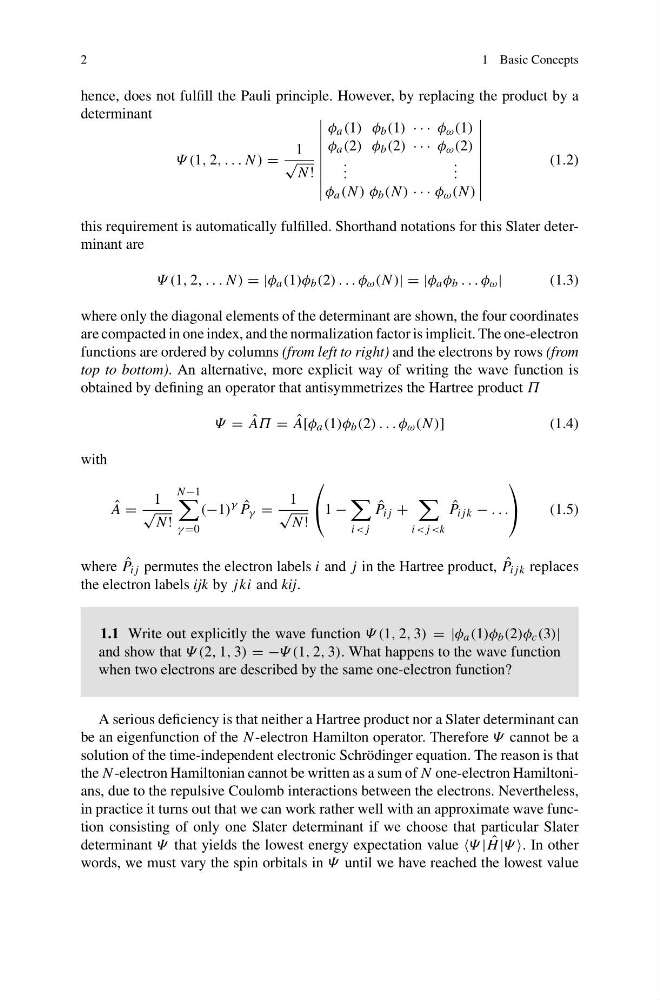
hence, does not fulfill the Pauli principle. However, by replacing the product by a
determinant
Ψ(1, 2,...N ) =
1
√
N !
φ a (1)φ b (1) ··· φ ω (1)
φ a (2)φ b (2) ··· φ ω (2)
. . .
. . .
φ a (N )φ b (N ) ··· φ ω (N )
(1.2)
this requirement is automatically fulfilled. Shorthand notations for this Slater determinant are
Ψ(1, 2,...N ) =|φ a (1)φ b (2)...φ ω (N )|=|φ a φ b ...φ ω |
(1.3)
where only the diagonal elements of the determinant are shown, the four coordinates
are compacted in one index, and the normalization factor is implicit. The one-electron
functions are ordered by columns (from left to right) and the electrons by rows (from
top to bottom). An alternative, more explicit way of writing the wave function is
obtained by defining an operator that antisymmetrizes the Hartree product Π
Ψ = ˆ
AΠ = ˆ
A[φ a (1)φ b (2)...φ ω (N )]
(1.4)
with
ˆ
A =
1
√
N !
N −1
γ =0
(−1)
γ ˆ
P γ =
1
√
N !
⎛
⎝ 1 −
i< j
ˆ
P ij +
i< j
P ijk − ...
⎞
⎠
(1.5)
where ˆ
P ij permutes the electron labels i and j in the Hartree product, ˆ
P ijk replaces
the electron labels ijk by jki and kij.
1.1 Write out explicitly the wave function Ψ(1, 2, 3) =| φ a (1)φ b (2)φ c (3)|
and show that Ψ(2, 1, 3) =− Ψ(1, 2, 3). What happens to the wave function
when two electrons are described by the same one-electron function?
A serious deficiency is that neither a Hartree product nor a Slater determinant can
be an eigenfunction of the N -electron Hamilton operator. Therefore Ψ cannot be a
solution of the time-independent electronic Schrödinger equation. The reason is that
the N -electron Hamiltonian cannot be written as a sum of N one-electron Hamiltonians, due to the repulsive Coulomb interactions between the electrons. Nevertheless,
in practice it turns out that we can work rather well with an approximate wave function consisting of only one Slater determinant if we choose that particular Slater
determinant Ψ that yields the lowest energy expectation value Ψ | ˆ
H |Ψ . In other
words, we must vary the spin orbitals in Ψ until we have reached the lowest value
1 Basic Concepts
hence, does not fulfill the Pauli principle. However, by replacing the product by a
determinant
Ψ(1, 2,...N ) =
1
√
N !
φ a (1)φ b (1) ··· φ ω (1)
φ a (2)φ b (2) ··· φ ω (2)
. . .
. . .
φ a (N )φ b (N ) ··· φ ω (N )
(1.2)
this requirement is automatically fulfilled. Shorthand notations for this Slater determinant are
Ψ(1, 2,...N ) =|φ a (1)φ b (2)...φ ω (N )|=|φ a φ b ...φ ω |
(1.3)
where only the diagonal elements of the determinant are shown, the four coordinates
are compacted in one index, and the normalization factor is implicit. The one-electron
functions are ordered by columns (from left to right) and the electrons by rows (from
top to bottom). An alternative, more explicit way of writing the wave function is
obtained by defining an operator that antisymmetrizes the Hartree product Π
Ψ = ˆ
AΠ = ˆ
A[φ a (1)φ b (2)...φ ω (N )]
(1.4)
with
ˆ
A =
1
√
N !
N −1
γ =0
(−1)
γ ˆ
P γ =
1
√
N !
⎛
⎝ 1 −
i< j
ˆ
P ij +
i< j
P ijk − ...
⎞
⎠
(1.5)
where ˆ
P ij permutes the electron labels i and j in the Hartree product, ˆ
P ijk replaces
the electron labels ijk by jki and kij.
1.1 Write out explicitly the wave function Ψ(1, 2, 3) =| φ a (1)φ b (2)φ c (3)|
and show that Ψ(2, 1, 3) =− Ψ(1, 2, 3). What happens to the wave function
when two electrons are described by the same one-electron function?
A serious deficiency is that neither a Hartree product nor a Slater determinant can
be an eigenfunction of the N -electron Hamilton operator. Therefore Ψ cannot be a
solution of the time-independent electronic Schrödinger equation. The reason is that
the N -electron Hamiltonian cannot be written as a sum of N one-electron Hamiltonians, due to the repulsive Coulomb interactions between the electrons. Nevertheless,
in practice it turns out that we can work rather well with an approximate wave function consisting of only one Slater determinant if we choose that particular Slater
determinant Ψ that yields the lowest energy expectation value Ψ | ˆ
H |Ψ . In other
words, we must vary the spin orbitals in Ψ until we have reached the lowest value