

4
1 Basic Concepts
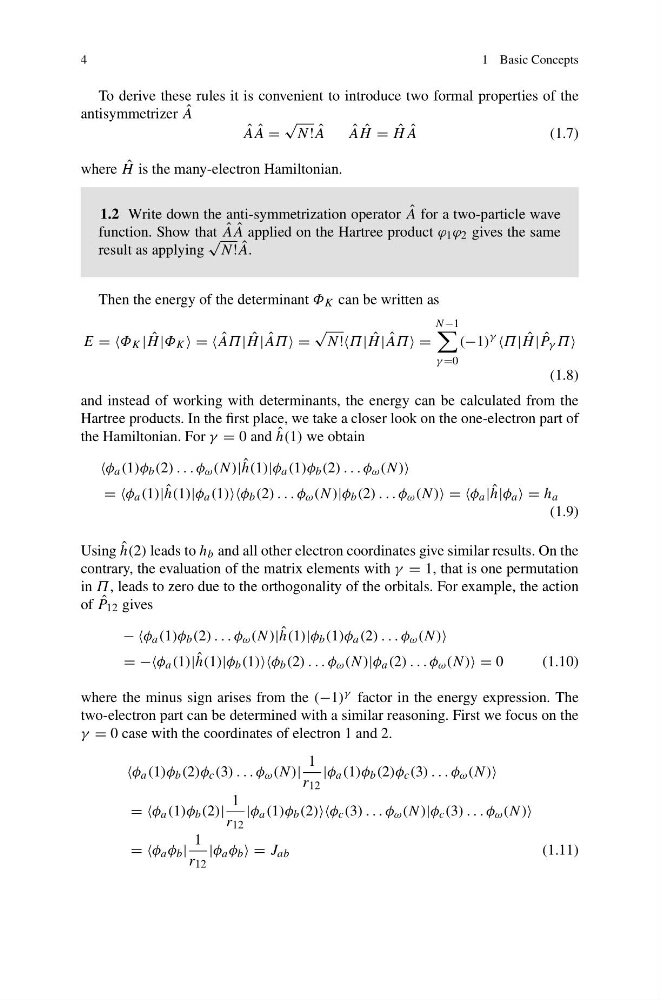
To derive these rules it is convenient to introduce two formal properties of the
antisymmetrizer ˆ
A
ˆ
A ˆ
A =
√
N ! ˆ
A
ˆ
A ˆ
H = ˆ
H ˆ
A
(1.7)
where ˆ
H is the many-electron Hamiltonian.
1.2 Write down the anti-symmetrization operator ˆ
A for a two-particle wave
function. Show that ˆ
A ˆ
A applied on the Hartree product ϕ 1 ϕ 2 gives the same
result as applying
√
N ! ˆ
A.
Then the energy of the determinant Φ K can be written as
E ==Φ K | ˆ
H |Φ K == ˆ
AΠ | ˆ
H | ˆ
AΠ=
√
N !!Π | ˆ
H | ˆ
AΠ =
N −1
γ =0
(−1)
γ Π | ˆ
H | ˆ
P γ Π
(1.8)
and instead of working with determinants, the energy can be calculated from the
Hartree products. In the first place, we take a closer look on the one-electron part of
the Hamiltonian. For γ = 0 and ˆ
h(1) we obtain
φ a (1)φ b (2)...φ ω (N )| ˆ
h(1)|φ a (1)φ b (2)...φ ω (N )
==φ a (1)| ˆ
h(1)|φ a (1)φ b (2)...φ ω (N )|φ b (2)...φ ω (N )==φ a | ˆ
h|φ a =h a
(1.9)
Using ˆ
h(2) leads to h b and all other electron coordinates give similar results. On the
contrary, the evaluation of the matrix elements with γ = 1, that is one permutation
in Π , leads to zero due to the orthogonality of the orbitals. For example, the action
of ˆ
P 12 gives
−−φ a (1)φ b (2)...φ ω (N )| ˆ
h(1)|φ b (1)φ a (2)...φ ω (N )
=−−φ a (1)| ˆ
h(1)|φ b (1)φ b (2)...φ ω (N )|φ a (2)...φ ω (N )=0
(1.10)
where the minus sign arises from the (−1) γ factor in the energy expression. The
two-electron part can be determined with a similar reasoning. First we focus on the
γ = 0 case with the coordinates of electron 1 and 2.
φ a (1)φ b (2)φ c (3)...φ ω (N )|
1
r 12
|φ a (1)φ b (2)φ c (3)...φ ω (N )
==φ a (1)φ b (2)|
1
r 12
|φ a (1)φ b (2)φ c (3)...φ ω (N )|φ c (3)...φ ω (N )
==φ a φ b |
1
r 12
|φ a φ b =J ab
(1.11)
1 Basic Concepts
To derive these rules it is convenient to introduce two formal properties of the
antisymmetrizer ˆ
A
ˆ
A ˆ
A =
√
N ! ˆ
A
ˆ
A ˆ
H = ˆ
H ˆ
A
(1.7)
where ˆ
H is the many-electron Hamiltonian.
1.2 Write down the anti-symmetrization operator ˆ
A for a two-particle wave
function. Show that ˆ
A ˆ
A applied on the Hartree product ϕ 1 ϕ 2 gives the same
result as applying
√
N ! ˆ
A.
Then the energy of the determinant Φ K can be written as
E ==Φ K | ˆ
H |Φ K == ˆ
AΠ | ˆ
H | ˆ
AΠ=
√
N !!Π | ˆ
H | ˆ
AΠ =
N −1
γ =0
(−1)
γ Π | ˆ
H | ˆ
P γ Π
(1.8)
and instead of working with determinants, the energy can be calculated from the
Hartree products. In the first place, we take a closer look on the one-electron part of
the Hamiltonian. For γ = 0 and ˆ
h(1) we obtain
φ a (1)φ b (2)...φ ω (N )| ˆ
h(1)|φ a (1)φ b (2)...φ ω (N )
==φ a (1)| ˆ
h(1)|φ a (1)φ b (2)...φ ω (N )|φ b (2)...φ ω (N )==φ a | ˆ
h|φ a =h a
(1.9)
Using ˆ
h(2) leads to h b and all other electron coordinates give similar results. On the
contrary, the evaluation of the matrix elements with γ = 1, that is one permutation
in Π , leads to zero due to the orthogonality of the orbitals. For example, the action
of ˆ
P 12 gives
−−φ a (1)φ b (2)...φ ω (N )| ˆ
h(1)|φ b (1)φ a (2)...φ ω (N )
=−−φ a (1)| ˆ
h(1)|φ b (1)φ b (2)...φ ω (N )|φ a (2)...φ ω (N )=0
(1.10)
where the minus sign arises from the (−1) γ factor in the energy expression. The
two-electron part can be determined with a similar reasoning. First we focus on the
γ = 0 case with the coordinates of electron 1 and 2.
φ a (1)φ b (2)φ c (3)...φ ω (N )|
1
r 12
|φ a (1)φ b (2)φ c (3)...φ ω (N )
==φ a (1)φ b (2)|
1
r 12
|φ a (1)φ b (2)φ c (3)...φ ω (N )|φ c (3)...φ ω (N )
==φ a φ b |
1
r 12
|φ a φ b =J ab
(1.11)