

5.1 Decomposition of the Magnetic Coupling
151
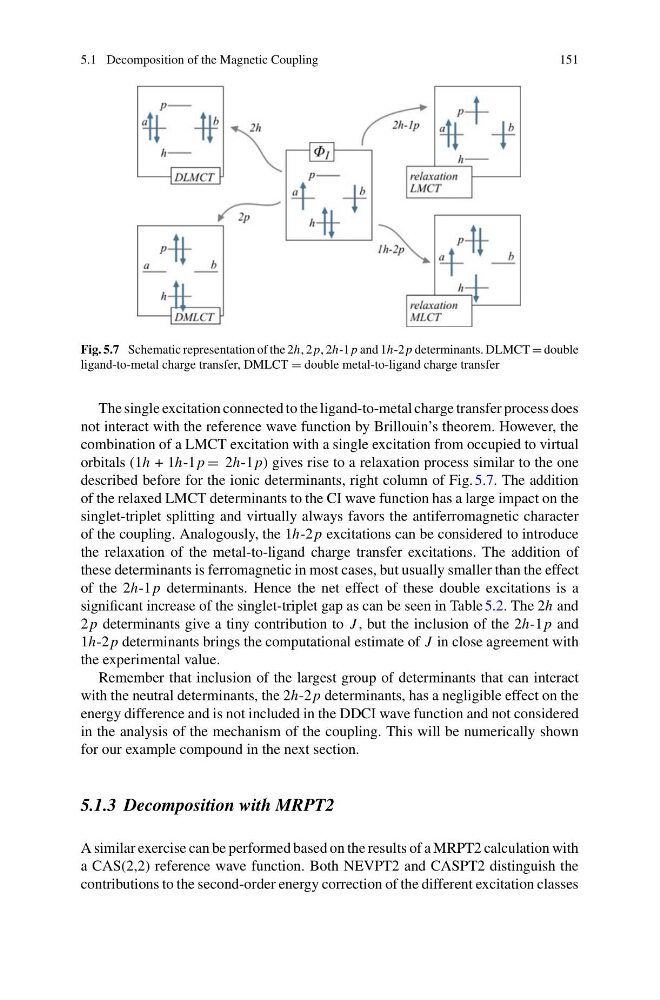
Fig. 5.7 Schematic representation of the 2h,2p,2h-1 p and 1h-2 p determinants. DLMCT = double
ligand-to-metal charge transfer, DMLCT = double metal-to-ligand charge transfer
The single excitation connected to the ligand-to-metal charge transfer process does
not interact with the reference wave function by Brillouin’s theorem. However, the
combination of a LMCT excitation with a single excitation from occupied to virtual
orbitals (1h +1h-1 p = 2h-1 p) gives rise to a relaxation process similar to the one
described before for the ionic determinants, right column of Fig. 5.7. The addition
of the relaxed LMCT determinants to the CI wave function has a large impact on the
singlet-triplet splitting and virtually always favors the antiferromagnetic character
of the coupling. Analogously, the 1h-2 p excitations can be considered to introduce
the relaxation of the metal-to-ligand charge transfer excitations. The addition of
these determinants is ferromagnetic in most cases, but usually smaller than the effect
of the 2h-1 p determinants. Hence the net effect of these double excitations is a
significant increase of the singlet-triplet gap as can be seen in Table 5.2.The2h and
2 p determinants give a tiny contribution to J , but the inclusion of the 2h-1 p and
1h-2 p determinants brings the computational estimate of J in close agreement with
the experimental value.
Remember that inclusion of the largest group of determinants that can interact
with the neutral determinants, the 2h-2 p determinants, has a negligible effect on the
energy difference and is not included in the DDCI wave function and not considered
in the analysis of the mechanism of the coupling. This will be numerically shown
for our example compound in the next section.
5.1.3 Decomposition with MRPT2
A similar exercise can be performed based on the results of a MRPT2 calculation with
a CAS(2,2) reference wave function. Both NEVPT2 and CASPT2 distinguish the
contributions to the second-order energy correction of the different excitation classes
151
Fig. 5.7 Schematic representation of the 2h,2p,2h-1 p and 1h-2 p determinants. DLMCT = double
ligand-to-metal charge transfer, DMLCT = double metal-to-ligand charge transfer
The single excitation connected to the ligand-to-metal charge transfer process does
not interact with the reference wave function by Brillouin’s theorem. However, the
combination of a LMCT excitation with a single excitation from occupied to virtual
orbitals (1h +1h-1 p = 2h-1 p) gives rise to a relaxation process similar to the one
described before for the ionic determinants, right column of Fig. 5.7. The addition
of the relaxed LMCT determinants to the CI wave function has a large impact on the
singlet-triplet splitting and virtually always favors the antiferromagnetic character
of the coupling. Analogously, the 1h-2 p excitations can be considered to introduce
the relaxation of the metal-to-ligand charge transfer excitations. The addition of
these determinants is ferromagnetic in most cases, but usually smaller than the effect
of the 2h-1 p determinants. Hence the net effect of these double excitations is a
significant increase of the singlet-triplet gap as can be seen in Table 5.2.The2h and
2 p determinants give a tiny contribution to J , but the inclusion of the 2h-1 p and
1h-2 p determinants brings the computational estimate of J in close agreement with
the experimental value.
Remember that inclusion of the largest group of determinants that can interact
with the neutral determinants, the 2h-2 p determinants, has a negligible effect on the
energy difference and is not included in the DDCI wave function and not considered
in the analysis of the mechanism of the coupling. This will be numerically shown
for our example compound in the next section.
5.1.3 Decomposition with MRPT2
A similar exercise can be performed based on the results of a MRPT2 calculation with
a CAS(2,2) reference wave function. Both NEVPT2 and CASPT2 distinguish the
contributions to the second-order energy correction of the different excitation classes