

150
5 Towards a Quantitative Understanding
the orbitals are not optimized for this ionic charge distribution but rather for the
neutral situation. Hence, there is a strong interaction of these determinants with the
|aa| and |bb| determinants, while the interaction with the neutral determinants is
much weaker. Since, the ionic determinants are only present in the reference wave
function of the S g state, the addition to the wave function of these 1h-1 p excitations
leads to a significant stabilization of the singlet with respect to the triplet state, and
consequently, an increase of the antiferromagnetic character of the coupling. Adding
single excitations to a determinant that is not expressed in its optimal orbitals is a
very efficient way to improve the orbitals. Therefore, this class of 1h-1 p excitations
is often interpreted as relaxing the ionic determinants in the wave function, lowering
their energy with respect to the neutral determinants, that is, a decrease of U . In line
with the expression for J given in Eq. 5.16, a smaller U makes the kinetic exchange
more effective and J more antiferromagnetic.
The total effect of the single excitations is a large step in the right direction, both
spin polarization and the relaxation of the ionic determinants cause antiferromagnetic
contributions, but still the value of the coupling is only ∼50 % of the final value and
other mechanisms have to be included.
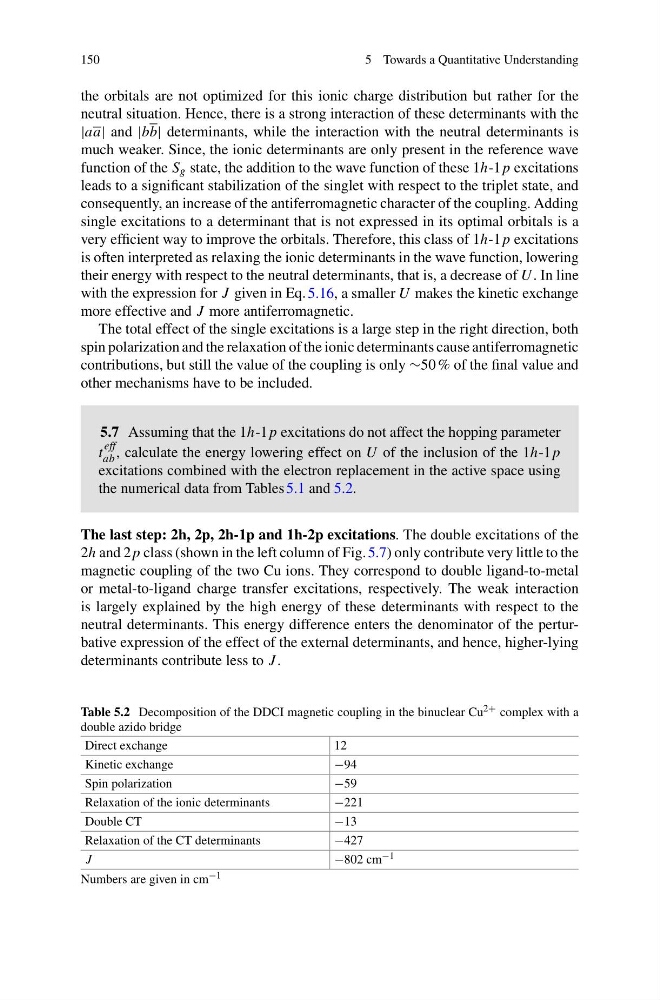
5.7 Assuming that the 1h-1 p excitations do not affect the hopping parameter
t
eff
ab , calculate the energy lowering effect on U of the inclusion of the 1h-1 p
excitations combined with the electron replacement in the active space using
the numerical data from Tables 5.1 and 5.2.
The last step: 2h, 2p, 2h-1p and 1h-2p excitations. The double excitations of the
2h and 2 p class (shown in the left column of Fig. 5.7) only contribute very little to the
magnetic coupling of the two Cu ions. They correspond to double ligand-to-metal
or metal-to-ligand charge transfer excitations, respectively. The weak interaction
is largely explained by the high energy of these determinants with respect to the
neutral determinants. This energy difference enters the denominator of the perturbative expression of the effect of the external determinants, and hence, higher-lying
determinants contribute less to J .
Table 5.2 Decomposition of the DDCI magnetic coupling in the binuclear Cu 2+ complex with a
double azido bridge
Direct exchange
12
Kinetic exchange
−94
Spin polarization
−59
Relaxation of the ionic determinants
−221
Double CT
−13
Relaxation of the CT determinants
−427
J
−802 cm −1
Numbers are given in cm −1
5 Towards a Quantitative Understanding
the orbitals are not optimized for this ionic charge distribution but rather for the
neutral situation. Hence, there is a strong interaction of these determinants with the
|aa| and |bb| determinants, while the interaction with the neutral determinants is
much weaker. Since, the ionic determinants are only present in the reference wave
function of the S g state, the addition to the wave function of these 1h-1 p excitations
leads to a significant stabilization of the singlet with respect to the triplet state, and
consequently, an increase of the antiferromagnetic character of the coupling. Adding
single excitations to a determinant that is not expressed in its optimal orbitals is a
very efficient way to improve the orbitals. Therefore, this class of 1h-1 p excitations
is often interpreted as relaxing the ionic determinants in the wave function, lowering
their energy with respect to the neutral determinants, that is, a decrease of U . In line
with the expression for J given in Eq. 5.16, a smaller U makes the kinetic exchange
more effective and J more antiferromagnetic.
The total effect of the single excitations is a large step in the right direction, both
spin polarization and the relaxation of the ionic determinants cause antiferromagnetic
contributions, but still the value of the coupling is only ∼50 % of the final value and
other mechanisms have to be included.
5.7 Assuming that the 1h-1 p excitations do not affect the hopping parameter
t
eff
ab , calculate the energy lowering effect on U of the inclusion of the 1h-1 p
excitations combined with the electron replacement in the active space using
the numerical data from Tables 5.1 and 5.2.
The last step: 2h, 2p, 2h-1p and 1h-2p excitations. The double excitations of the
2h and 2 p class (shown in the left column of Fig. 5.7) only contribute very little to the
magnetic coupling of the two Cu ions. They correspond to double ligand-to-metal
or metal-to-ligand charge transfer excitations, respectively. The weak interaction
is largely explained by the high energy of these determinants with respect to the
neutral determinants. This energy difference enters the denominator of the perturbative expression of the effect of the external determinants, and hence, higher-lying
determinants contribute less to J .
Table 5.2 Decomposition of the DDCI magnetic coupling in the binuclear Cu 2+ complex with a
double azido bridge
Direct exchange
12
Kinetic exchange
−94
Spin polarization
−59
Relaxation of the ionic determinants
−221
Double CT
−13
Relaxation of the CT determinants
−427
J
−802 cm −1
Numbers are given in cm −1