

5.1 Decomposition of the Magnetic Coupling
149
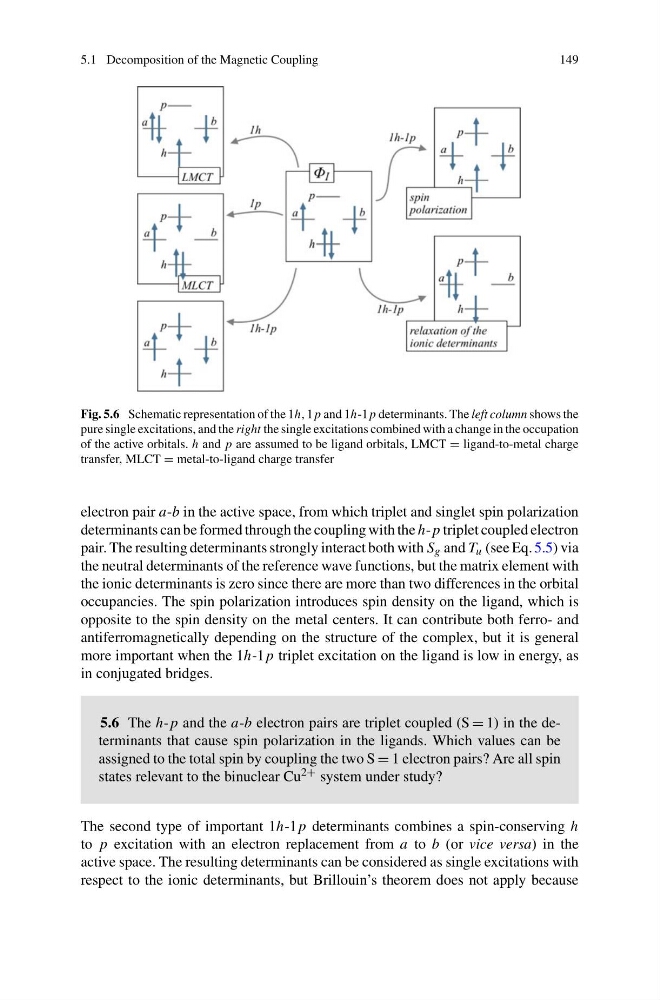
Fig. 5.6 Schematic representation of the 1h,1p and 1h-1 p determinants. The left column shows the
pure single excitations, and the right the single excitations combined with a change in the occupation
of the active orbitals. h and p are assumed to be ligand orbitals, LMCT = ligand-to-metal charge
transfer, MLCT = metal-to-ligand charge transfer
electron pair a-b in the active space, from which triplet and singlet spin polarization
determinants can be formed through the coupling with the h- p triplet coupled electron
pair. The resulting determinants strongly interact both with S g and T u (see Eq. 5.5)via
the neutral determinants of the reference wave functions, but the matrix element with
the ionic determinants is zero since there are more than two differences in the orbital
occupancies. The spin polarization introduces spin density on the ligand, which is
opposite to the spin density on the metal centers. It can contribute both ferro- and
antiferromagnetically depending on the structure of the complex, but it is general
more important when the 1h-1 p triplet excitation on the ligand is low in energy, as
in conjugated bridges.
5.6 The h- p and the a-b electron pairs are triplet coupled (S = 1) in the determinants that cause spin polarization in the ligands. Which values can be
assigned to the total spin by coupling the two S = 1 electron pairs? Are all spin
states relevant to the binuclear Cu 2+ system under study?
The second type of important 1h-1 p determinants combines a spin-conserving h
to p excitation with an electron replacement from a to b (or vice versa)i nt h e
active space. The resulting determinants can be considered as single excitations with
respect to the ionic determinants, but Brillouin’s theorem does not apply because
149
Fig. 5.6 Schematic representation of the 1h,1p and 1h-1 p determinants. The left column shows the
pure single excitations, and the right the single excitations combined with a change in the occupation
of the active orbitals. h and p are assumed to be ligand orbitals, LMCT = ligand-to-metal charge
transfer, MLCT = metal-to-ligand charge transfer
electron pair a-b in the active space, from which triplet and singlet spin polarization
determinants can be formed through the coupling with the h- p triplet coupled electron
pair. The resulting determinants strongly interact both with S g and T u (see Eq. 5.5)via
the neutral determinants of the reference wave functions, but the matrix element with
the ionic determinants is zero since there are more than two differences in the orbital
occupancies. The spin polarization introduces spin density on the ligand, which is
opposite to the spin density on the metal centers. It can contribute both ferro- and
antiferromagnetically depending on the structure of the complex, but it is general
more important when the 1h-1 p triplet excitation on the ligand is low in energy, as
in conjugated bridges.
5.6 The h- p and the a-b electron pairs are triplet coupled (S = 1) in the determinants that cause spin polarization in the ligands. Which values can be
assigned to the total spin by coupling the two S = 1 electron pairs? Are all spin
states relevant to the binuclear Cu 2+ system under study?
The second type of important 1h-1 p determinants combines a spin-conserving h
to p excitation with an electron replacement from a to b (or vice versa)i nt h e
active space. The resulting determinants can be considered as single excitations with
respect to the ionic determinants, but Brillouin’s theorem does not apply because