

148
5 Towards a Quantitative Understanding
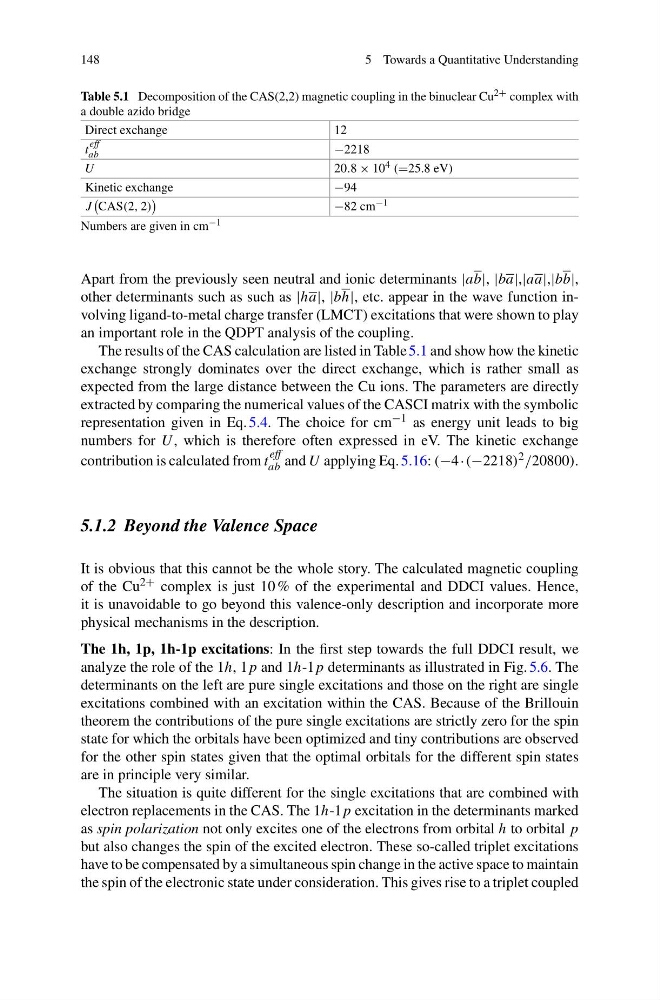
Table 5.1 Decomposition of the CAS(2,2) magnetic coupling in the binuclear Cu 2+ complex with
a double azido bridge
Direct exchange
12
t
eff
ab
−2218
U
20.8 × 10 4 (=25.8 eV)
Kinetic exchange
−94
J
CAS(2, 2)
−82 cm −1
Numbers are given in cm −1
Apart from the previously seen neutral and ionic determinants |ab|, |ba|,|aa|,|bb|,
other determinants such as such as |ha|, |bh|, etc. appear in the wave function involving ligand-to-metal charge transfer (LMCT) excitations that were shown to play
an important role in the QDPT analysis of the coupling.
The results of the CAS calculation are listed in Table 5.1 and show how the kinetic
exchange strongly dominates over the direct exchange, which is rather small as
expected from the large distance between the Cu ions. The parameters are directly
extracted by comparing the numerical values of the CASCI matrix with the symbolic
representation given in Eq. 5.4. The choice for cm −1 as energy unit leads to big
numbers for U , which is therefore often expressed in eV. The kinetic exchange
contribution is calculated from t
eff
ab and U applying Eq. 5.16: (−4·(−2218) 2 /20800).
5.1.2 Beyond the Valence Space
It is obvious that this cannot be the whole story. The calculated magnetic coupling
of the Cu 2+ complex is just 10 % of the experimental and DDCI values. Hence,
it is unavoidable to go beyond this valence-only description and incorporate more
physical mechanisms in the description.
The 1h, 1p, 1h-1p excitations: In the first step towards the full DDCI result, we
analyze the role of the 1h,1p and 1h-1 p determinants as illustrated in Fig. 5.6.The
determinants on the left are pure single excitations and those on the right are single
excitations combined with an excitation within the CAS. Because of the Brillouin
theorem the contributions of the pure single excitations are strictly zero for the spin
state for which the orbitals have been optimized and tiny contributions are observed
for the other spin states given that the optimal orbitals for the different spin states
are in principle very similar.
The situation is quite different for the single excitations that are combined with
electron replacements in the CAS. The 1h-1 p excitation in the determinants marked
as spin polarization not only excites one of the electrons from orbital h to orbital p
but also changes the spin of the excited electron. These so-called triplet excitations
have to be compensated by a simultaneous spin change in the active space to maintain
the spin of the electronic state under consideration. This gives rise to a triplet coupled
5 Towards a Quantitative Understanding
Table 5.1 Decomposition of the CAS(2,2) magnetic coupling in the binuclear Cu 2+ complex with
a double azido bridge
Direct exchange
12
t
eff
ab
−2218
U
20.8 × 10 4 (=25.8 eV)
Kinetic exchange
−94
J
CAS(2, 2)
−82 cm −1
Numbers are given in cm −1
Apart from the previously seen neutral and ionic determinants |ab|, |ba|,|aa|,|bb|,
other determinants such as such as |ha|, |bh|, etc. appear in the wave function involving ligand-to-metal charge transfer (LMCT) excitations that were shown to play
an important role in the QDPT analysis of the coupling.
The results of the CAS calculation are listed in Table 5.1 and show how the kinetic
exchange strongly dominates over the direct exchange, which is rather small as
expected from the large distance between the Cu ions. The parameters are directly
extracted by comparing the numerical values of the CASCI matrix with the symbolic
representation given in Eq. 5.4. The choice for cm −1 as energy unit leads to big
numbers for U , which is therefore often expressed in eV. The kinetic exchange
contribution is calculated from t
eff
ab and U applying Eq. 5.16: (−4·(−2218) 2 /20800).
5.1.2 Beyond the Valence Space
It is obvious that this cannot be the whole story. The calculated magnetic coupling
of the Cu 2+ complex is just 10 % of the experimental and DDCI values. Hence,
it is unavoidable to go beyond this valence-only description and incorporate more
physical mechanisms in the description.
The 1h, 1p, 1h-1p excitations: In the first step towards the full DDCI result, we
analyze the role of the 1h,1p and 1h-1 p determinants as illustrated in Fig. 5.6.The
determinants on the left are pure single excitations and those on the right are single
excitations combined with an excitation within the CAS. Because of the Brillouin
theorem the contributions of the pure single excitations are strictly zero for the spin
state for which the orbitals have been optimized and tiny contributions are observed
for the other spin states given that the optimal orbitals for the different spin states
are in principle very similar.
The situation is quite different for the single excitations that are combined with
electron replacements in the CAS. The 1h-1 p excitation in the determinants marked
as spin polarization not only excites one of the electrons from orbital h to orbital p
but also changes the spin of the excited electron. These so-called triplet excitations
have to be compensated by a simultaneous spin change in the active space to maintain
the spin of the electronic state under consideration. This gives rise to a triplet coupled