

146
5 Towards a Quantitative Understanding
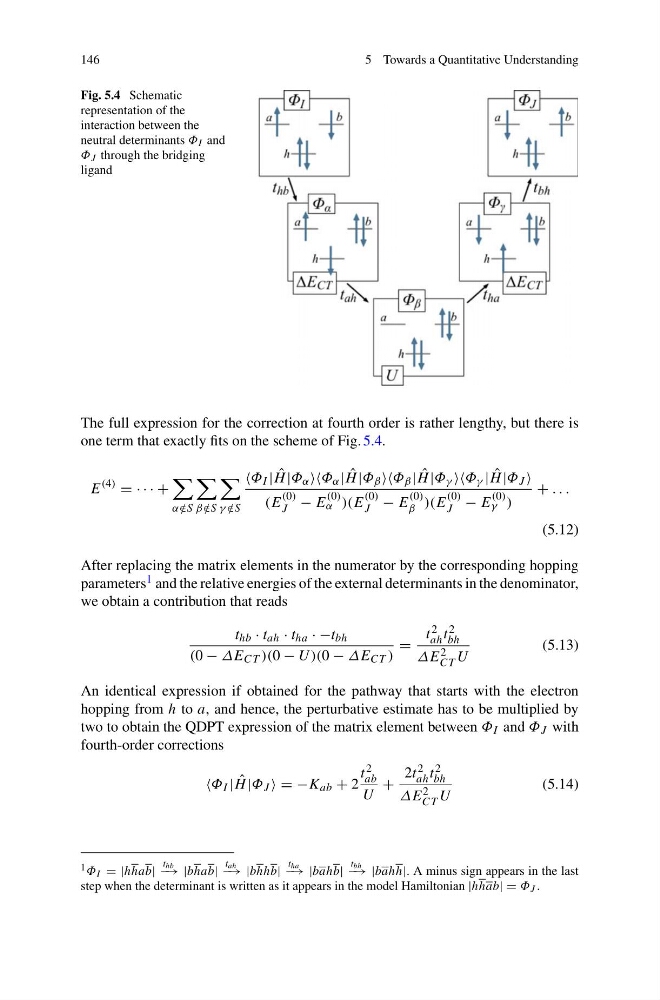
Fig. 5.4 Schematic
representation of the
interaction between the
neutral determinants Φ I and
Φ J through the bridging
ligand
The full expression for the correction at fourth order is rather lengthy, but there is
one term that exactly fits on the scheme of Fig. 5.4.
E
(4) = ···+
α/ ∈S
β/ ∈S
γ/ ∈S
Φ I | ˆ
H |Φ α Φ α | ˆ
H |Φ β Φ β | ˆ
H |Φ γ Φ γ | ˆ
H |Φ J
(E
(0)
J − E
(0)
α )(E
(0)
J − E
(0)
β )(E
(0)
J − E
(0)
γ )
+ ...
(5.12)
After replacing the matrix elements in the numerator by the corresponding hopping
parameters 1 and the relative energies of the external determinants in the denominator,
we obtain a contribution that reads
t hb · t ah · t ha ·−t bh
(0 − ∆E CT )(0 − U )(0 − ∆E CT )
=
t 2
ah t 2
bh
∆E 2
CT U
(5.13)
An identical expression if obtained for the pathway that starts with the electron
hopping from h to a, and hence, the perturbative estimate has to be multiplied by
two to obtain the QDPT expression of the matrix element between Φ I and Φ J with
fourth-order corrections
Φ I | ˆ
H |Φ J =−K ab + 2
t 2
ab
U
+
2t 2
ah t 2
bh
∆E 2
CT U
(5.14)
1 Φ I =| hhab|
t hb
− →| bhab|
t ah
− →| bhhb|
t ha
− →| bahb|
t bh
− →| bahh|. A minus sign appears in the last
step when the determinant is written as it appears in the model Hamiltonian |hhab|=Φ J .
5 Towards a Quantitative Understanding
Fig. 5.4 Schematic
representation of the
interaction between the
neutral determinants Φ I and
Φ J through the bridging
ligand
The full expression for the correction at fourth order is rather lengthy, but there is
one term that exactly fits on the scheme of Fig. 5.4.
E
(4) = ···+
α/ ∈S
β/ ∈S
γ/ ∈S
Φ I | ˆ
H |Φ α Φ α | ˆ
H |Φ β Φ β | ˆ
H |Φ γ Φ γ | ˆ
H |Φ J
(E
(0)
J − E
(0)
α )(E
(0)
J − E
(0)
β )(E
(0)
J − E
(0)
γ )
+ ...
(5.12)
After replacing the matrix elements in the numerator by the corresponding hopping
parameters 1 and the relative energies of the external determinants in the denominator,
we obtain a contribution that reads
t hb · t ah · t ha ·−t bh
(0 − ∆E CT )(0 − U )(0 − ∆E CT )
=
t 2
ah t 2
bh
∆E 2
CT U
(5.13)
An identical expression if obtained for the pathway that starts with the electron
hopping from h to a, and hence, the perturbative estimate has to be multiplied by
two to obtain the QDPT expression of the matrix element between Φ I and Φ J with
fourth-order corrections
Φ I | ˆ
H |Φ J =−K ab + 2
t 2
ab
U
+
2t 2
ah t 2
bh
∆E 2
CT U
(5.14)
1 Φ I =| hhab|
t hb
− →| bhab|
t ah
− →| bhhb|
t ha
− →| bahb|
t bh
− →| bahh|. A minus sign appears in the last
step when the determinant is written as it appears in the model Hamiltonian |hhab|=Φ J .