

5.1 Decomposition of the Magnetic Coupling
145
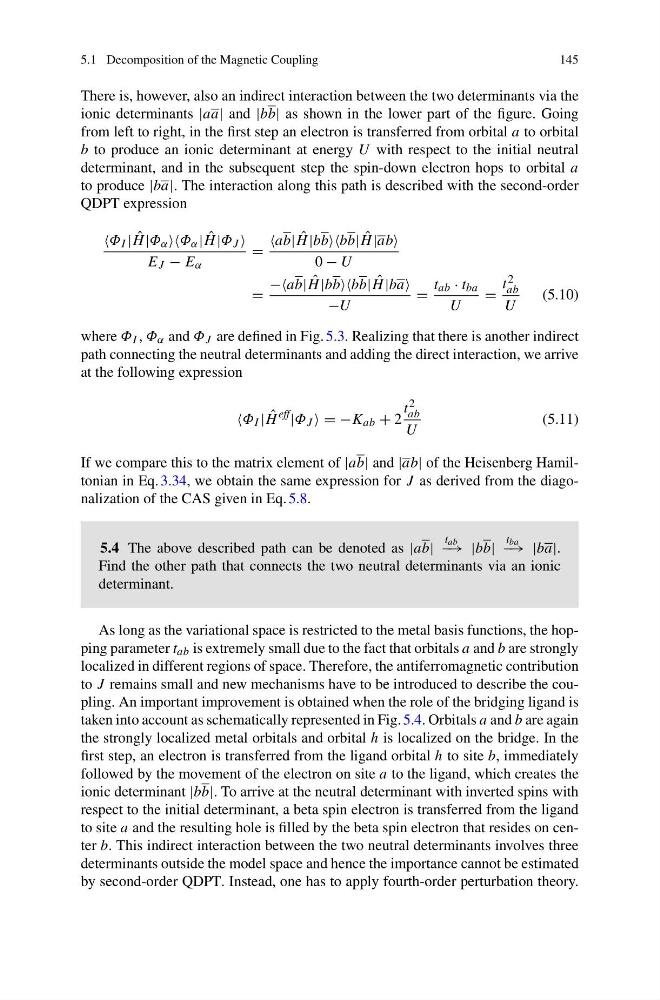
There is, however, also an indirect interaction between the two determinants via the
ionic determinants |aa| and |bb| as shown in the lower part of the figure. Going
from left to right, in the first step an electron is transferred from orbital a to orbital
b to produce an ionic determinant at energy U with respect to the initial neutral
determinant, and in the subsequent step the spin-down electron hops to orbital a
to produce |ba|. The interaction along this path is described with the second-order
QDPT expression
Φ I | ˆ
H |Φ α Φ α | ˆ
H |Φ J
E J − E α
=
ab| ˆ
H |bbbb| ˆ
H |ab
0 − U
=
−−ab| ˆ
H |bbbb| ˆ
H |ba
−U
=
t ab · t ba
U
=
t 2
ab
U
(5.10)
where Φ I , Φ α and Φ J are defined in Fig. 5.3. Realizing that there is another indirect
path connecting the neutral determinants and adding the direct interaction, we arrive
at the following expression
Φ I | ˆ
H
eff |Φ J =−K ab + 2
t 2
ab
U
(5.11)
If we compare this to the matrix element of |ab| and |ab| of the Heisenberg Hamiltonian in Eq. 3.34, we obtain the same expression for J as derived from the diagonalization of the CAS given in Eq. 5.8.
5.4 The above described path can be denoted as |ab|
t ab
− →| bb|
t ba
− →| ba|.
Find the other path that connects the two neutral determinants via an ionic
determinant.
As long as the variational space is restricted to the metal basis functions, the hopping parameter t ab is extremely small due to the fact that orbitals a and b are strongly
localized in different regions of space. Therefore, the antiferromagnetic contribution
to J remains small and new mechanisms have to be introduced to describe the coupling. An important improvement is obtained when the role of the bridging ligand is
taken into account as schematically represented in Fig. 5.4. Orbitals a and b are again
the strongly localized metal orbitals and orbital h is localized on the bridge. In the
first step, an electron is transferred from the ligand orbital h to site b, immediately
followed by the movement of the electron on site a to the ligand, which creates the
ionic determinant |bb|. To arrive at the neutral determinant with inverted spins with
respect to the initial determinant, a beta spin electron is transferred from the ligand
to site a and the resulting hole is filled by the beta spin electron that resides on center b. This indirect interaction between the two neutral determinants involves three
determinants outside the model space and hence the importance cannot be estimated
by second-order QDPT. Instead, one has to apply fourth-order perturbation theory.
145
There is, however, also an indirect interaction between the two determinants via the
ionic determinants |aa| and |bb| as shown in the lower part of the figure. Going
from left to right, in the first step an electron is transferred from orbital a to orbital
b to produce an ionic determinant at energy U with respect to the initial neutral
determinant, and in the subsequent step the spin-down electron hops to orbital a
to produce |ba|. The interaction along this path is described with the second-order
QDPT expression
Φ I | ˆ
H |Φ α Φ α | ˆ
H |Φ J
E J − E α
=
ab| ˆ
H |bbbb| ˆ
H |ab
0 − U
=
−−ab| ˆ
H |bbbb| ˆ
H |ba
−U
=
t ab · t ba
U
=
t 2
ab
U
(5.10)
where Φ I , Φ α and Φ J are defined in Fig. 5.3. Realizing that there is another indirect
path connecting the neutral determinants and adding the direct interaction, we arrive
at the following expression
Φ I | ˆ
H
eff |Φ J =−K ab + 2
t 2
ab
U
(5.11)
If we compare this to the matrix element of |ab| and |ab| of the Heisenberg Hamiltonian in Eq. 3.34, we obtain the same expression for J as derived from the diagonalization of the CAS given in Eq. 5.8.
5.4 The above described path can be denoted as |ab|
t ab
− →| bb|
t ba
− →| ba|.
Find the other path that connects the two neutral determinants via an ionic
determinant.
As long as the variational space is restricted to the metal basis functions, the hopping parameter t ab is extremely small due to the fact that orbitals a and b are strongly
localized in different regions of space. Therefore, the antiferromagnetic contribution
to J remains small and new mechanisms have to be introduced to describe the coupling. An important improvement is obtained when the role of the bridging ligand is
taken into account as schematically represented in Fig. 5.4. Orbitals a and b are again
the strongly localized metal orbitals and orbital h is localized on the bridge. In the
first step, an electron is transferred from the ligand orbital h to site b, immediately
followed by the movement of the electron on site a to the ligand, which creates the
ionic determinant |bb|. To arrive at the neutral determinant with inverted spins with
respect to the initial determinant, a beta spin electron is transferred from the ligand
to site a and the resulting hole is filled by the beta spin electron that resides on center b. This indirect interaction between the two neutral determinants involves three
determinants outside the model space and hence the importance cannot be estimated
by second-order QDPT. Instead, one has to apply fourth-order perturbation theory.