

144
5 Towards a Quantitative Understanding
E(S
′
g ) = K ab +
U +
U 2 + 16t 2
ab
2
(5.6)
E(T u ) =−K ab
E(S u ) = U − K ab
This gives direct access to an analytical expression of J in terms of the previously
defined electronic structure parameters
J = E(S g ) − E T = 2K ab +
U −
U 2 + 16t 2
ab
2
(5.7)
To simplify this expression we use the Taylor expansion
√
p + q =
√ p +
1
2 q/
√ p +
··· with p ≫ q.
J = 2K ab −
4t 2
ab
U
(5.8)
in which one can easily recognize the ferromagnetic (2K ab ) and antiferromagnetic
(4t 2
ab /U ) contributions of the qualitative Kahn–Briat and Hay–Thibeault–Hoffmann
models.
5.3 Use the Taylor expansion
√
p + q =
√ p +
1
2 q/
√ p +··· with p = U 2
and q = 16t 2
ab to derive the simplified expression for J .
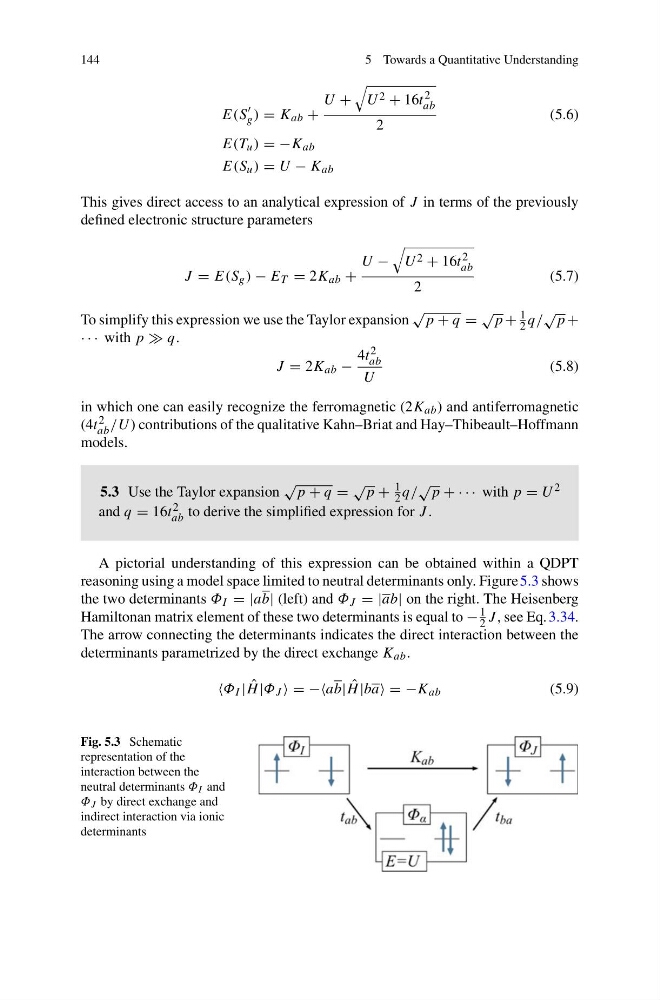
A pictorial understanding of this expression can be obtained within a QDPT
reasoning using a model space limited to neutral determinants only. Figure 5.3 shows
the two determinants Φ I =| ab| (left) and Φ J =| ab| on the right. The Heisenberg
Hamiltonan matrix element of these two determinants is equal to −
1
2 J ,seeEq.3.34.
The arrow connecting the determinants indicates the direct interaction between the
determinants parametrized by the direct exchange K ab .
Φ I | ˆ
H |Φ J =−−ab| ˆ
H |ba=−K ab
(5.9)
Fig. 5.3 Schematic
representation of the
interaction between the
neutral determinants Φ I and
Φ J by direct exchange and
indirect interaction via ionic
determinants
5 Towards a Quantitative Understanding
E(S
′
g ) = K ab +
U +
U 2 + 16t 2
ab
2
(5.6)
E(T u ) =−K ab
E(S u ) = U − K ab
This gives direct access to an analytical expression of J in terms of the previously
defined electronic structure parameters
J = E(S g ) − E T = 2K ab +
U −
U 2 + 16t 2
ab
2
(5.7)
To simplify this expression we use the Taylor expansion
√
p + q =
√ p +
1
2 q/
√ p +
··· with p ≫ q.
J = 2K ab −
4t 2
ab
U
(5.8)
in which one can easily recognize the ferromagnetic (2K ab ) and antiferromagnetic
(4t 2
ab /U ) contributions of the qualitative Kahn–Briat and Hay–Thibeault–Hoffmann
models.
5.3 Use the Taylor expansion
√
p + q =
√ p +
1
2 q/
√ p +··· with p = U 2
and q = 16t 2
ab to derive the simplified expression for J .
A pictorial understanding of this expression can be obtained within a QDPT
reasoning using a model space limited to neutral determinants only. Figure 5.3 shows
the two determinants Φ I =| ab| (left) and Φ J =| ab| on the right. The Heisenberg
Hamiltonan matrix element of these two determinants is equal to −
1
2 J ,seeEq.3.34.
The arrow connecting the determinants indicates the direct interaction between the
determinants parametrized by the direct exchange K ab .
Φ I | ˆ
H |Φ J =−−ab| ˆ
H |ba=−K ab
(5.9)
Fig. 5.3 Schematic
representation of the
interaction between the
neutral determinants Φ I and
Φ J by direct exchange and
indirect interaction via ionic
determinants