

4.3 Accurate Computational Models
137
symmetry (as in atomic multiplets or ligand-field states in coordination complexes)
but due to accidental (near-)degeneracies. This extended approach was named the
restricted ensemble Kohn–Sham (REKS) method [23, 24]. An optimal set of Kohn–
Sham orbitals and occupation numbers is obtained by a minimization procedure that
always maintains the spin and spatial symmetry of the N-electron state under study.
The approach has been used to calculate the coupling of two localized spin
moments in binuclear transition metal complexes and the singlet-triplet splitting in
biradical systems, such as twisted ethylene. Rather reasonable values of the magnetic
coupling parameters were obtained. In general, the couplings are slightly too small,
which may be attributed to the lack of spin polarization. An important advantage of
the method is the fact that geometries can be optimized for open-shell singlet states
within the DFT framework.
Spin-flip time-dependent DFT The energy differences of the spin states involved
in the magnetic interaction of two (or more) spin moments can be seen to some
extent as vertical excitation energies, and hence, time-dependent DFT (or other linear response methods as equation of motions coupled cluster [25]) could in principle
be used to determine the magnetic interaction between two spin moments. However,
the standard implementation of TD-DFT only considers single, spin-conserving excitations, which prevents accounting for the multideterminantal character of the states
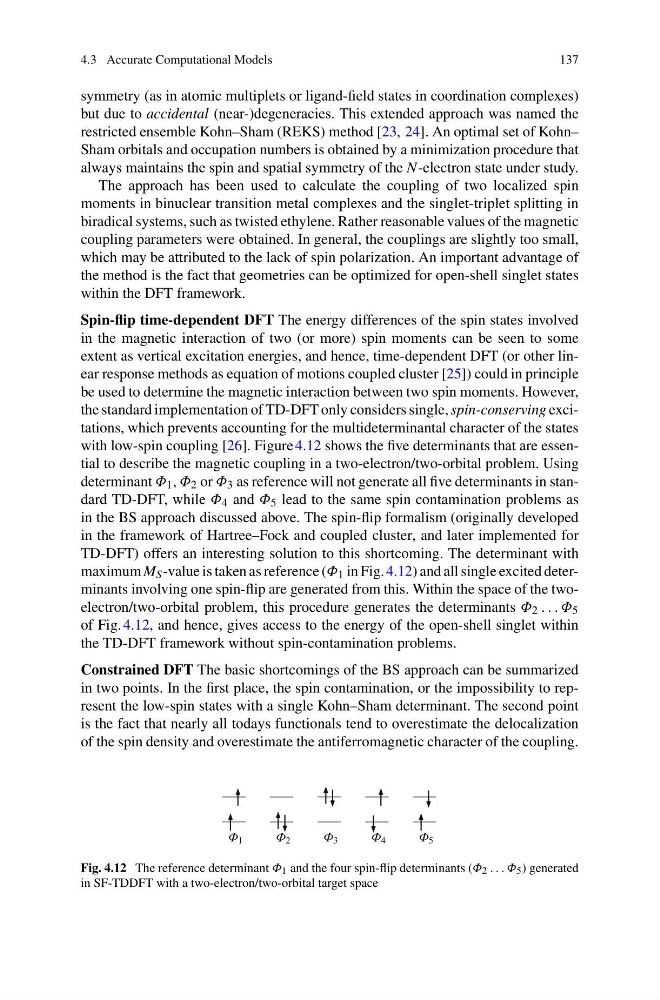
with low-spin coupling [26]. Figure 4.12 shows the five determinants that are essential to describe the magnetic coupling in a two-electron/two-orbital problem. Using
determinant Φ 1 , Φ 2 or Φ 3 as reference will not generate all five determinants in standard TD-DFT, while Φ 4 and Φ 5 lead to the same spin contamination problems as
in the BS approach discussed above. The spin-flip formalism (originally developed
in the framework of Hartree–Fock and coupled cluster, and later implemented for
TD-DFT) offers an interesting solution to this shortcoming. The determinant with
maximum M S -value is taken as reference (Φ 1 in Fig. 4.12) and all single excited determinants involving one spin-flip are generated from this. Within the space of the twoelectron/two-orbital problem, this procedure generates the determinants Φ 2 ...Φ 5
of Fig. 4.12, and hence, gives access to the energy of the open-shell singlet within
the TD-DFT framework without spin-contamination problems.
Constrained DFT The basic shortcomings of the BS approach can be summarized
in two points. In the first place, the spin contamination, or the impossibility to represent the low-spin states with a single Kohn–Sham determinant. The second point
is the fact that nearly all todays functionals tend to overestimate the delocalization
of the spin density and overestimate the antiferromagnetic character of the coupling.
1
2
3
4
5
Fig. 4.12 The reference determinant Φ 1 and the four spin-flip determinants (Φ 2 ...Φ 5 ) generated
in SF-TDDFT with a two-electron/two-orbital target space
137
symmetry (as in atomic multiplets or ligand-field states in coordination complexes)
but due to accidental (near-)degeneracies. This extended approach was named the
restricted ensemble Kohn–Sham (REKS) method [23, 24]. An optimal set of Kohn–
Sham orbitals and occupation numbers is obtained by a minimization procedure that
always maintains the spin and spatial symmetry of the N-electron state under study.
The approach has been used to calculate the coupling of two localized spin
moments in binuclear transition metal complexes and the singlet-triplet splitting in
biradical systems, such as twisted ethylene. Rather reasonable values of the magnetic
coupling parameters were obtained. In general, the couplings are slightly too small,
which may be attributed to the lack of spin polarization. An important advantage of
the method is the fact that geometries can be optimized for open-shell singlet states
within the DFT framework.
Spin-flip time-dependent DFT The energy differences of the spin states involved
in the magnetic interaction of two (or more) spin moments can be seen to some
extent as vertical excitation energies, and hence, time-dependent DFT (or other linear response methods as equation of motions coupled cluster [25]) could in principle
be used to determine the magnetic interaction between two spin moments. However,
the standard implementation of TD-DFT only considers single, spin-conserving excitations, which prevents accounting for the multideterminantal character of the states
with low-spin coupling [26]. Figure 4.12 shows the five determinants that are essential to describe the magnetic coupling in a two-electron/two-orbital problem. Using
determinant Φ 1 , Φ 2 or Φ 3 as reference will not generate all five determinants in standard TD-DFT, while Φ 4 and Φ 5 lead to the same spin contamination problems as
in the BS approach discussed above. The spin-flip formalism (originally developed
in the framework of Hartree–Fock and coupled cluster, and later implemented for
TD-DFT) offers an interesting solution to this shortcoming. The determinant with
maximum M S -value is taken as reference (Φ 1 in Fig. 4.12) and all single excited determinants involving one spin-flip are generated from this. Within the space of the twoelectron/two-orbital problem, this procedure generates the determinants Φ 2 ...Φ 5
of Fig. 4.12, and hence, gives access to the energy of the open-shell singlet within
the TD-DFT framework without spin-contamination problems.
Constrained DFT The basic shortcomings of the BS approach can be summarized
in two points. In the first place, the spin contamination, or the impossibility to represent the low-spin states with a single Kohn–Sham determinant. The second point
is the fact that nearly all todays functionals tend to overestimate the delocalization
of the spin density and overestimate the antiferromagnetic character of the coupling.
1
2
3
4
5
Fig. 4.12 The reference determinant Φ 1 and the four spin-flip determinants (Φ 2 ...Φ 5 ) generated
in SF-TDDFT with a two-electron/two-orbital target space