

136
4 From Orbital Models to Accurate Predictions
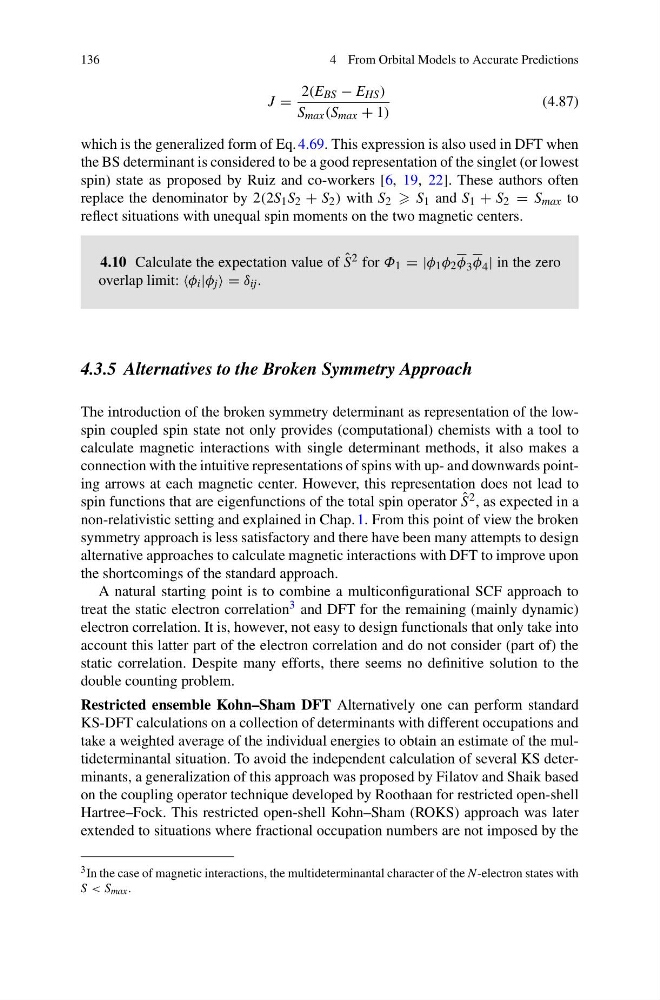
J =
2(E BS − E HS )
S max (S max + 1)
(4.87)
which is the generalized form of Eq. 4.69. This expression is also used in DFT when
the BS determinant is considered to be a good representation of the singlet (or lowest
spin) state as proposed by Ruiz and co-workers [6, 19, 22]. These authors often
replace the denominator by 2(2S 1 S 2 + S 2 ) with S 2 S 1 and S 1 + S 2 = S max to
reflect situations with unequal spin moments on the two magnetic centers.
4.10 Calculate the expectation value of ˆ
S 2 for Φ 1 =| φ 1 φ 2 φ 3 φ 4 | in the zero
overlap limit: φ i |φ j =δ ij .
4.3.5 Alternatives to the Broken Symmetry Approach
The introduction of the broken symmetry determinant as representation of the lowspin coupled spin state not only provides (computational) chemists with a tool to
calculate magnetic interactions with single determinant methods, it also makes a
connection with the intuitive representations of spins with up- and downwards pointing arrows at each magnetic center. However, this representation does not lead to
spin functions that are eigenfunctions of the total spin operator ˆ
S 2 , as expected in a
non-relativistic setting and explained in Chap. 1. From this point of view the broken
symmetry approach is less satisfactory and there have been many attempts to design
alternative approaches to calculate magnetic interactions with DFT to improve upon
the shortcomings of the standard approach.
A natural starting point is to combine a multiconfigurational SCF approach to
treat the static electron correlation 3 and DFT for the remaining (mainly dynamic)
electron correlation. It is, however, not easy to design functionals that only take into
account this latter part of the electron correlation and do not consider (part of) the
static correlation. Despite many efforts, there seems no definitive solution to the
double counting problem.
Restricted ensemble Kohn–Sham DFT Alternatively one can perform standard
KS-DFT calculations on a collection of determinants with different occupations and
take a weighted average of the individual energies to obtain an estimate of the multideterminantal situation. To avoid the independent calculation of several KS determinants, a generalization of this approach was proposed by Filatov and Shaik based
on the coupling operator technique developed by Roothaan for restricted open-shell
Hartree–Fock. This restricted open-shell Kohn–Sham (ROKS) approach was later
extended to situations where fractional occupation numbers are not imposed by the
3 In the case of magnetic interactions, the multideterminantal character of the N-electron states with
S < S max .
4 From Orbital Models to Accurate Predictions
J =
2(E BS − E HS )
S max (S max + 1)
(4.87)
which is the generalized form of Eq. 4.69. This expression is also used in DFT when
the BS determinant is considered to be a good representation of the singlet (or lowest
spin) state as proposed by Ruiz and co-workers [6, 19, 22]. These authors often
replace the denominator by 2(2S 1 S 2 + S 2 ) with S 2 S 1 and S 1 + S 2 = S max to
reflect situations with unequal spin moments on the two magnetic centers.
4.10 Calculate the expectation value of ˆ
S 2 for Φ 1 =| φ 1 φ 2 φ 3 φ 4 | in the zero
overlap limit: φ i |φ j =δ ij .
4.3.5 Alternatives to the Broken Symmetry Approach
The introduction of the broken symmetry determinant as representation of the lowspin coupled spin state not only provides (computational) chemists with a tool to
calculate magnetic interactions with single determinant methods, it also makes a
connection with the intuitive representations of spins with up- and downwards pointing arrows at each magnetic center. However, this representation does not lead to
spin functions that are eigenfunctions of the total spin operator ˆ
S 2 , as expected in a
non-relativistic setting and explained in Chap. 1. From this point of view the broken
symmetry approach is less satisfactory and there have been many attempts to design
alternative approaches to calculate magnetic interactions with DFT to improve upon
the shortcomings of the standard approach.
A natural starting point is to combine a multiconfigurational SCF approach to
treat the static electron correlation 3 and DFT for the remaining (mainly dynamic)
electron correlation. It is, however, not easy to design functionals that only take into
account this latter part of the electron correlation and do not consider (part of) the
static correlation. Despite many efforts, there seems no definitive solution to the
double counting problem.
Restricted ensemble Kohn–Sham DFT Alternatively one can perform standard
KS-DFT calculations on a collection of determinants with different occupations and
take a weighted average of the individual energies to obtain an estimate of the multideterminantal situation. To avoid the independent calculation of several KS determinants, a generalization of this approach was proposed by Filatov and Shaik based
on the coupling operator technique developed by Roothaan for restricted open-shell
Hartree–Fock. This restricted open-shell Kohn–Sham (ROKS) approach was later
extended to situations where fractional occupation numbers are not imposed by the
3 In the case of magnetic interactions, the multideterminantal character of the N-electron states with
S < S max .