

138
4 From Orbital Models to Accurate Predictions
Constrained DFT (C-DFT) remedies, at least partially, the latter by putting restrictions on the spatial distributions of the α and β electrons [27]. Two fragments p and
q are defined such that both include one magnetic center and the atoms around it.
Subsequently, the density is optimized under the restrictions that N
p
α − N
p
β = M
p
S
and N
q
α − N
q
β = M
q
S , where N
p,q
α,β are the summed spin populations of the atoms in
the fragments and M
p,q
S the prefixed excess of α or β electrons in each fragment.
C-DFT results in less delocalized spin densities and therefore, in general, to smaller
interaction parameters.
Problems
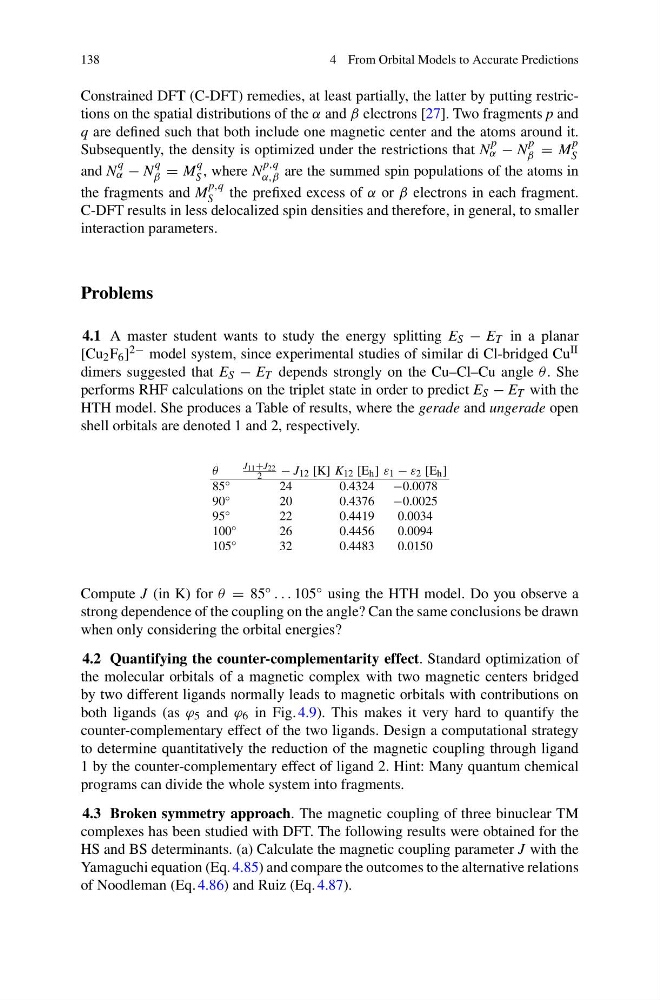
4.1 A master student wants to study the energy splitting E S − E T in a planar
[Cu 2 F 6 ] 2− model system, since experimental studies of similar di Cl-bridged Cu II
dimers suggested that E S − E T depends strongly on the Cu–Cl–Cu angle θ . She
performs RHF calculations on the triplet state in order to predict E S − E T with the
HTH model. She produces a Table of results, where the gerade and ungerade open
shell orbitals are denoted 1 and 2, respectively.
θ
J11+J22
2
− J 12 [K] K 12 [E h ] ε 1 − ε 2 [E h ]
85 ◦
24
0.4324 −0.0078
90 ◦
20
0.4376 −0.0025
95 ◦
22
0.4419
0.0034
100 ◦
26
0.4456
0.0094
105 ◦
32
0.4483
0.0150
Compute J (in K) for θ = 85 ◦ ...105 ◦ using the HTH model. Do you observe a
strong dependence of the coupling on the angle? Can the same conclusions be drawn
when only considering the orbital energies?
4.2 Quantifying the counter-complementarity effect. Standard optimization of
the molecular orbitals of a magnetic complex with two magnetic centers bridged
by two different ligands normally leads to magnetic orbitals with contributions on
both ligands (as ϕ 5 and ϕ 6 in Fig. 4.9). This makes it very hard to quantify the
counter-complementary effect of the two ligands. Design a computational strategy
to determine quantitatively the reduction of the magnetic coupling through ligand
1 by the counter-complementary effect of ligand 2. Hint: Many quantum chemical
programs can divide the whole system into fragments.
4.3 Broken symmetry approach. The magnetic coupling of three binuclear TM
complexes has been studied with DFT. The following results were obtained for the
HS and BS determinants. (a) Calculate the magnetic coupling parameter J with the
Yamaguchi equation (Eq. 4.85) and compare the outcomes to the alternative relations
of Noodleman (Eq. 4.86) and Ruiz (Eq. 4.87).
4 From Orbital Models to Accurate Predictions
Constrained DFT (C-DFT) remedies, at least partially, the latter by putting restrictions on the spatial distributions of the α and β electrons [27]. Two fragments p and
q are defined such that both include one magnetic center and the atoms around it.
Subsequently, the density is optimized under the restrictions that N
p
α − N
p
β = M
p
S
and N
q
α − N
q
β = M
q
S , where N
p,q
α,β are the summed spin populations of the atoms in
the fragments and M
p,q
S the prefixed excess of α or β electrons in each fragment.
C-DFT results in less delocalized spin densities and therefore, in general, to smaller
interaction parameters.
Problems
4.1 A master student wants to study the energy splitting E S − E T in a planar
[Cu 2 F 6 ] 2− model system, since experimental studies of similar di Cl-bridged Cu II
dimers suggested that E S − E T depends strongly on the Cu–Cl–Cu angle θ . She
performs RHF calculations on the triplet state in order to predict E S − E T with the
HTH model. She produces a Table of results, where the gerade and ungerade open
shell orbitals are denoted 1 and 2, respectively.
θ
J11+J22
2
− J 12 [K] K 12 [E h ] ε 1 − ε 2 [E h ]
85 ◦
24
0.4324 −0.0078
90 ◦
20
0.4376 −0.0025
95 ◦
22
0.4419
0.0034
100 ◦
26
0.4456
0.0094
105 ◦
32
0.4483
0.0150
Compute J (in K) for θ = 85 ◦ ...105 ◦ using the HTH model. Do you observe a
strong dependence of the coupling on the angle? Can the same conclusions be drawn
when only considering the orbital energies?
4.2 Quantifying the counter-complementarity effect. Standard optimization of
the molecular orbitals of a magnetic complex with two magnetic centers bridged
by two different ligands normally leads to magnetic orbitals with contributions on
both ligands (as ϕ 5 and ϕ 6 in Fig. 4.9). This makes it very hard to quantify the
counter-complementary effect of the two ligands. Design a computational strategy
to determine quantitatively the reduction of the magnetic coupling through ligand
1 by the counter-complementary effect of ligand 2. Hint: Many quantum chemical
programs can divide the whole system into fragments.
4.3 Broken symmetry approach. The magnetic coupling of three binuclear TM
complexes has been studied with DFT. The following results were obtained for the
HS and BS determinants. (a) Calculate the magnetic coupling parameter J with the
Yamaguchi equation (Eq. 4.85) and compare the outcomes to the alternative relations
of Noodleman (Eq. 4.86) and Ruiz (Eq. 4.87).