

134
4 From Orbital Models to Accurate Predictions
φ 1 = λχ 1 + µχ 2 + νχ 3
φ 2 = µχ 1 + λχ 2 + νχ 4
(4.73)
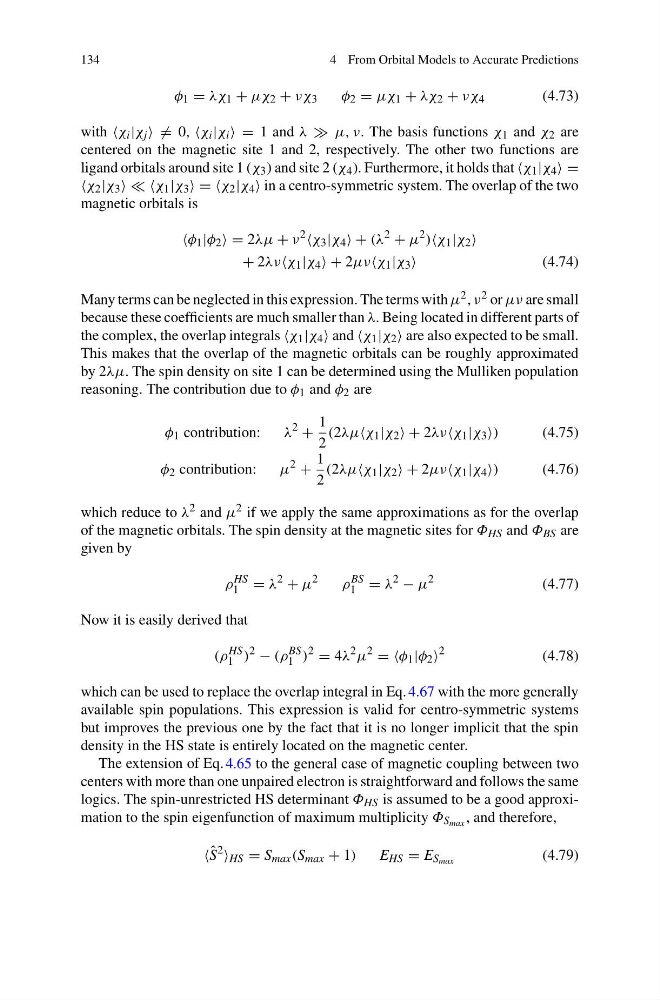
with χ i |χ j = 0, χ i |χ i =1 and λ ≫ µ, ν. The basis functions χ 1 and χ 2 are
centered on the magnetic site 1 and 2, respectively. The other two functions are
ligand orbitals around site 1 (χ 3 ) and site 2 (χ 4 ). Furthermore, it holds that χ 1 |χ 4 =
χ 2 |χ 3 ≪≪χ 1 |χ 3 ==χ 2 |χ 4 in a centro-symmetric system. The overlap of the two
magnetic orbitals is
φ 1 |φ 2 =2λµ + ν
2 χ 3 |χ 4 +(λ
2 + µ
2 )χ 1 |χ 2
+ 2λνχ 1 |χ 4 +2µνχ 1 |χ 3
(4.74)
Many terms can be neglected in this expression. The terms with µ 2 , ν 2 or µν are small
because these coefficients are much smaller than λ. Being located in different parts of
the complex, the overlap integrals χ 1 |χ 4 and χ 1 |χ 2 are also expected to be small.
This makes that the overlap of the magnetic orbitals can be roughly approximated
by 2λµ. The spin density on site 1 can be determined using the Mulliken population
reasoning. The contribution due to φ 1 and φ 2 are
φ 1 contribution:
λ
2 +
1
2
(2λµχ 1 |χ 2 +2λνχ 1 |χ 3 )
(4.75)
φ 2 contribution:
µ
2 +
1
2
(2λµχ 1 |χ 2 +2µνχ 1 |χ 4 )
(4.76)
which reduce to λ 2 and µ 2 if we apply the same approximations as for the overlap
of the magnetic orbitals. The spin density at the magnetic sites for Φ HS and Φ BS are
given by
ρ
HS
1 = λ
2 + µ
2
ρ
BS
1 = λ
2 − µ
2
(4.77)
Now it is easily derived that
(ρ
HS
1 )
2 − (ρ
BS
1 )
2 = 4λ
2 µ
2 ==φ 1 |φ 2
2
(4.78)
which can be used to replace the overlap integral in Eq. 4.67 with the more generally
available spin populations. This expression is valid for centro-symmetric systems
but improves the previous one by the fact that it is no longer implicit that the spin
density in the HS state is entirely located on the magnetic center.
The extension of Eq. 4.65 to the general case of magnetic coupling between two
centers with more than one unpaired electron is straightforward and follows the same
logics. The spin-unrestricted HS determinant Φ HS is assumed to be a good approximation to the spin eigenfunction of maximum multiplicity Φ S max , and therefore,
ˆ
S
2 HS = S max (S max + 1)
E HS = E S max
(4.79)
4 From Orbital Models to Accurate Predictions
φ 1 = λχ 1 + µχ 2 + νχ 3
φ 2 = µχ 1 + λχ 2 + νχ 4
(4.73)
with χ i |χ j = 0, χ i |χ i =1 and λ ≫ µ, ν. The basis functions χ 1 and χ 2 are
centered on the magnetic site 1 and 2, respectively. The other two functions are
ligand orbitals around site 1 (χ 3 ) and site 2 (χ 4 ). Furthermore, it holds that χ 1 |χ 4 =
χ 2 |χ 3 ≪≪χ 1 |χ 3 ==χ 2 |χ 4 in a centro-symmetric system. The overlap of the two
magnetic orbitals is
φ 1 |φ 2 =2λµ + ν
2 χ 3 |χ 4 +(λ
2 + µ
2 )χ 1 |χ 2
+ 2λνχ 1 |χ 4 +2µνχ 1 |χ 3
(4.74)
Many terms can be neglected in this expression. The terms with µ 2 , ν 2 or µν are small
because these coefficients are much smaller than λ. Being located in different parts of
the complex, the overlap integrals χ 1 |χ 4 and χ 1 |χ 2 are also expected to be small.
This makes that the overlap of the magnetic orbitals can be roughly approximated
by 2λµ. The spin density on site 1 can be determined using the Mulliken population
reasoning. The contribution due to φ 1 and φ 2 are
φ 1 contribution:
λ
2 +
1
2
(2λµχ 1 |χ 2 +2λνχ 1 |χ 3 )
(4.75)
φ 2 contribution:
µ
2 +
1
2
(2λµχ 1 |χ 2 +2µνχ 1 |χ 4 )
(4.76)
which reduce to λ 2 and µ 2 if we apply the same approximations as for the overlap
of the magnetic orbitals. The spin density at the magnetic sites for Φ HS and Φ BS are
given by
ρ
HS
1 = λ
2 + µ
2
ρ
BS
1 = λ
2 − µ
2
(4.77)
Now it is easily derived that
(ρ
HS
1 )
2 − (ρ
BS
1 )
2 = 4λ
2 µ
2 ==φ 1 |φ 2
2
(4.78)
which can be used to replace the overlap integral in Eq. 4.67 with the more generally
available spin populations. This expression is valid for centro-symmetric systems
but improves the previous one by the fact that it is no longer implicit that the spin
density in the HS state is entirely located on the magnetic center.
The extension of Eq. 4.65 to the general case of magnetic coupling between two
centers with more than one unpaired electron is straightforward and follows the same
logics. The spin-unrestricted HS determinant Φ HS is assumed to be a good approximation to the spin eigenfunction of maximum multiplicity Φ S max , and therefore,
ˆ
S
2 HS = S max (S max + 1)
E HS = E S max
(4.79)