

4.3 Accurate Computational Models
129
The operator ˆ
a
†
h ˆ
a h in the fourth term first annihilates an electron in orbital h and
subsequently creates it again in the same orbital. This leads to 0| ˆ
H|0, the CASSCF
energy of the N-electron system. The off-diagonal terms f hh ′ are all zero. Finally, we
consider the virtual-virtual diagonal elements of f :
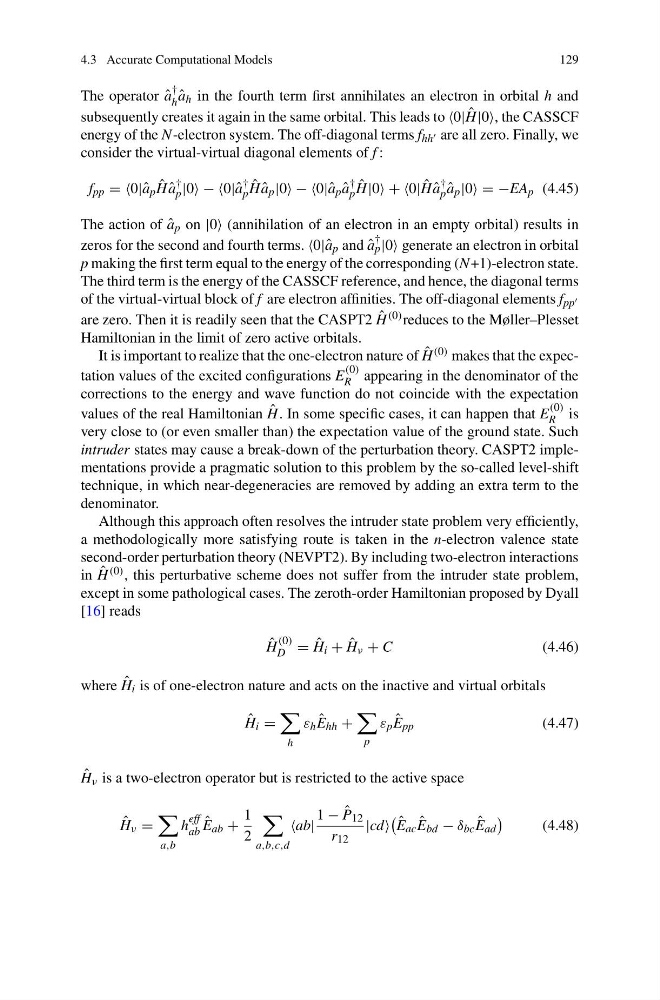
f pp ==0|ˆ a p ˆ
H ˆ
a
†
p |0−−0|ˆ a
†
p
ˆ
H ˆ
a p |0−−0|ˆ a p ˆ
a
†
p
ˆ
H|0++0| ˆ
H ˆ
a
†
p ˆ
a p |0=−EA p (4.45)
The action of ˆ
a p on |0 (annihilation of an electron in an empty orbital) results in
zeros for the second and fourth terms. 0|ˆ a p and ˆ
a
†
p |0 generate an electron in orbital
p making the first term equal to the energy of the corresponding (N+1)-electron state.
The third term is the energy of the CASSCF reference, and hence, the diagonal terms
of the virtual-virtual block of f are electron affinities. The off-diagonal elements f pp ′
are zero. Then it is readily seen that the CASPT2 ˆ
H (0) reduces to the Møller–Plesset
Hamiltonian in the limit of zero active orbitals.
It is important to realize that the one-electron nature of ˆ
H (0) makes that the expectation values of the excited configurations E
(0)
R appearing in the denominator of the
corrections to the energy and wave function do not coincide with the expectation
values of the real Hamiltonian ˆ
H. In some specific cases, it can happen that E
(0)
R is
very close to (or even smaller than) the expectation value of the ground state. Such
intruder states may cause a break-down of the perturbation theory. CASPT2 implementations provide a pragmatic solution to this problem by the so-called level-shift
technique, in which near-degeneracies are removed by adding an extra term to the
denominator.
Although this approach often resolves the intruder state problem very efficiently,
a methodologically more satisfying route is taken in the n-electron valence state
second-order perturbation theory (NEVPT2). By including two-electron interactions
in ˆ
H (0) , this perturbative scheme does not suffer from the intruder state problem,
except in some pathological cases. The zeroth-order Hamiltonian proposed by Dyall
[16] reads
ˆ
H
(0)
D = ˆ
H i + ˆ
H ν + C
(4.46)
where ˆ
H i is of one-electron nature and acts on the inactive and virtual orbitals
ˆ
H i =
h
ε h ˆ
E hh +
p
ε p ˆ
E pp
(4.47)
ˆ
H ν is a two-electron operator but is restricted to the active space
ˆ
H ν =
a,b
h
eff
ab
ˆ
E ab +
1
2
a,b,c,d
ab|
1 − ˆ
P 12
r 12
|cd
ˆ
E ac ˆ
E bd − δ bc ˆ
E ad
(4.48)
129
The operator ˆ
a
†
h ˆ
a h in the fourth term first annihilates an electron in orbital h and
subsequently creates it again in the same orbital. This leads to 0| ˆ
H|0, the CASSCF
energy of the N-electron system. The off-diagonal terms f hh ′ are all zero. Finally, we
consider the virtual-virtual diagonal elements of f :
f pp ==0|ˆ a p ˆ
H ˆ
a
†
p |0−−0|ˆ a
†
p
ˆ
H ˆ
a p |0−−0|ˆ a p ˆ
a
†
p
ˆ
H|0++0| ˆ
H ˆ
a
†
p ˆ
a p |0=−EA p (4.45)
The action of ˆ
a p on |0 (annihilation of an electron in an empty orbital) results in
zeros for the second and fourth terms. 0|ˆ a p and ˆ
a
†
p |0 generate an electron in orbital
p making the first term equal to the energy of the corresponding (N+1)-electron state.
The third term is the energy of the CASSCF reference, and hence, the diagonal terms
of the virtual-virtual block of f are electron affinities. The off-diagonal elements f pp ′
are zero. Then it is readily seen that the CASPT2 ˆ
H (0) reduces to the Møller–Plesset
Hamiltonian in the limit of zero active orbitals.
It is important to realize that the one-electron nature of ˆ
H (0) makes that the expectation values of the excited configurations E
(0)
R appearing in the denominator of the
corrections to the energy and wave function do not coincide with the expectation
values of the real Hamiltonian ˆ
H. In some specific cases, it can happen that E
(0)
R is
very close to (or even smaller than) the expectation value of the ground state. Such
intruder states may cause a break-down of the perturbation theory. CASPT2 implementations provide a pragmatic solution to this problem by the so-called level-shift
technique, in which near-degeneracies are removed by adding an extra term to the
denominator.
Although this approach often resolves the intruder state problem very efficiently,
a methodologically more satisfying route is taken in the n-electron valence state
second-order perturbation theory (NEVPT2). By including two-electron interactions
in ˆ
H (0) , this perturbative scheme does not suffer from the intruder state problem,
except in some pathological cases. The zeroth-order Hamiltonian proposed by Dyall
[16] reads
ˆ
H
(0)
D = ˆ
H i + ˆ
H ν + C
(4.46)
where ˆ
H i is of one-electron nature and acts on the inactive and virtual orbitals
ˆ
H i =
h
ε h ˆ
E hh +
p
ε p ˆ
E pp
(4.47)
ˆ
H ν is a two-electron operator but is restricted to the active space
ˆ
H ν =
a,b
h
eff
ab
ˆ
E ab +
1
2
a,b,c,d
ab|
1 − ˆ
P 12
r 12
|cd
ˆ
E ac ˆ
E bd − δ bc ˆ
E ad
(4.48)