

128
4 From Orbital Models to Accurate Predictions
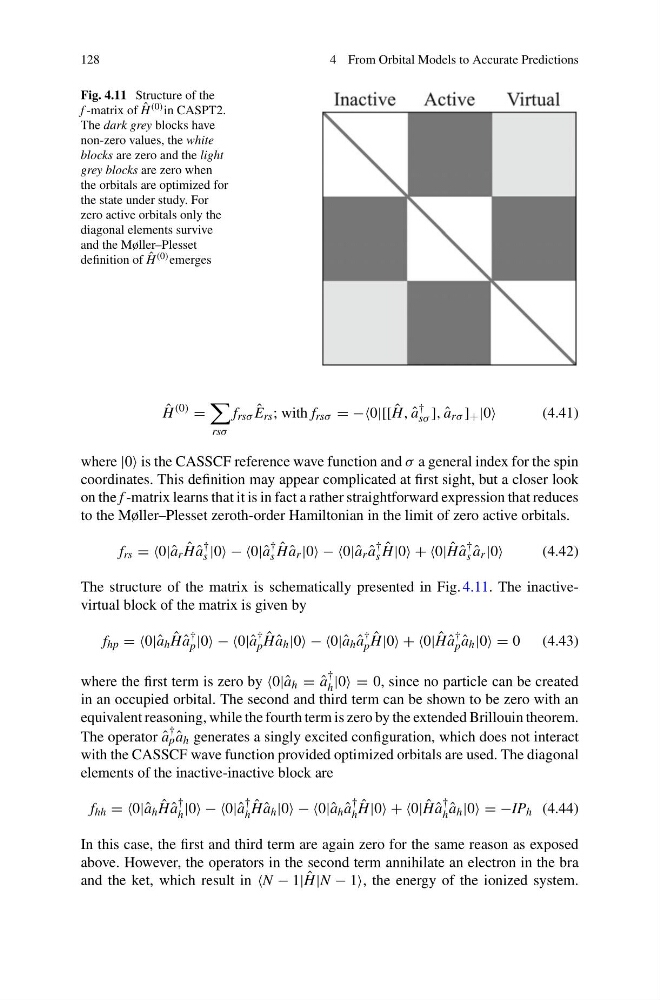
Fig. 4.11 Structure of the
f -matrix of ˆ
H (0) in CASPT2.
The dark grey blocks have
non-zero values, the white
blocks are zero and the light
grey blocks are zero when
the orbitals are optimized for
the state under study. For
zero active orbitals only the
diagonal elements survive
and the Møller–Plesset
definition of ˆ
H (0) emerges
ˆ
H
(0) =
rsσ
f rsσ ˆ
E rs ; with f rsσ =−−0|[[ ˆ
H, ˆ
a
†
sσ ], ˆ
a rσ ] + |0
(4.41)
where |0 is the CASSCF reference wave function and σ a general index for the spin
coordinates. This definition may appear complicated at first sight, but a closer look
on the f -matrix learns that it is in fact a rather straightforward expression that reduces
to the Møller–Plesset zeroth-order Hamiltonian in the limit of zero active orbitals.
f rs ==0|ˆ a r ˆ
H ˆ
a
†
s |0−−0|ˆ a
†
s
ˆ
H ˆ
a r |0−−0|ˆ a r ˆ
a
†
s
ˆ
H|0++0| ˆ
H ˆ
a
†
s ˆ
a r |0
(4.42)
The structure of the matrix is schematically presented in Fig. 4.11. The inactivevirtual block of the matrix is given by
f hp ==0|ˆ a h ˆ
H ˆ
a
†
p |0−−0|ˆ a
†
p
ˆ
H ˆ
a h |0−−0|ˆ a h ˆ
a
†
p
ˆ
H|0++0| ˆ
H ˆ
a
†
p ˆ
a h |0=0
(4.43)
where the first term is zero by 0|ˆ a h =ˆ a
†
h |0=0, since no particle can be created
in an occupied orbital. The second and third term can be shown to be zero with an
equivalent reasoning, while the fourth term is zero by the extended Brillouin theorem.
The operator ˆ
a
†
p ˆ
a h generates a singly excited configuration, which does not interact
with the CASSCF wave function provided optimized orbitals are used. The diagonal
elements of the inactive-inactive block are
f hh ==0|ˆ a h ˆ
H ˆ
a
†
h |0−−0|ˆ a
†
h
ˆ
H ˆ
a h |0−−0|ˆ a h ˆ
a
†
h
ˆ
H|0++0| ˆ
H ˆ
a
†
h ˆ
a h |0=−IP h (4.44)
In this case, the first and third term are again zero for the same reason as exposed
above. However, the operators in the second term annihilate an electron in the bra
and the ket, which result in N − 1| ˆ
H|N − 1, the energy of the ionized system.
4 From Orbital Models to Accurate Predictions
Fig. 4.11 Structure of the
f -matrix of ˆ
H (0) in CASPT2.
The dark grey blocks have
non-zero values, the white
blocks are zero and the light
grey blocks are zero when
the orbitals are optimized for
the state under study. For
zero active orbitals only the
diagonal elements survive
and the Møller–Plesset
definition of ˆ
H (0) emerges
ˆ
H
(0) =
rsσ
f rsσ ˆ
E rs ; with f rsσ =−−0|[[ ˆ
H, ˆ
a
†
sσ ], ˆ
a rσ ] + |0
(4.41)
where |0 is the CASSCF reference wave function and σ a general index for the spin
coordinates. This definition may appear complicated at first sight, but a closer look
on the f -matrix learns that it is in fact a rather straightforward expression that reduces
to the Møller–Plesset zeroth-order Hamiltonian in the limit of zero active orbitals.
f rs ==0|ˆ a r ˆ
H ˆ
a
†
s |0−−0|ˆ a
†
s
ˆ
H ˆ
a r |0−−0|ˆ a r ˆ
a
†
s
ˆ
H|0++0| ˆ
H ˆ
a
†
s ˆ
a r |0
(4.42)
The structure of the matrix is schematically presented in Fig. 4.11. The inactivevirtual block of the matrix is given by
f hp ==0|ˆ a h ˆ
H ˆ
a
†
p |0−−0|ˆ a
†
p
ˆ
H ˆ
a h |0−−0|ˆ a h ˆ
a
†
p
ˆ
H|0++0| ˆ
H ˆ
a
†
p ˆ
a h |0=0
(4.43)
where the first term is zero by 0|ˆ a h =ˆ a
†
h |0=0, since no particle can be created
in an occupied orbital. The second and third term can be shown to be zero with an
equivalent reasoning, while the fourth term is zero by the extended Brillouin theorem.
The operator ˆ
a
†
p ˆ
a h generates a singly excited configuration, which does not interact
with the CASSCF wave function provided optimized orbitals are used. The diagonal
elements of the inactive-inactive block are
f hh ==0|ˆ a h ˆ
H ˆ
a
†
h |0−−0|ˆ a
†
h
ˆ
H ˆ
a h |0−−0|ˆ a h ˆ
a
†
h
ˆ
H|0++0| ˆ
H ˆ
a
†
h ˆ
a h |0=−IP h (4.44)
In this case, the first and third term are again zero for the same reason as exposed
above. However, the operators in the second term annihilate an electron in the bra
and the ket, which result in N − 1| ˆ
H|N − 1, the energy of the ionized system.