

4.2 Magnetostructural Correlations
117
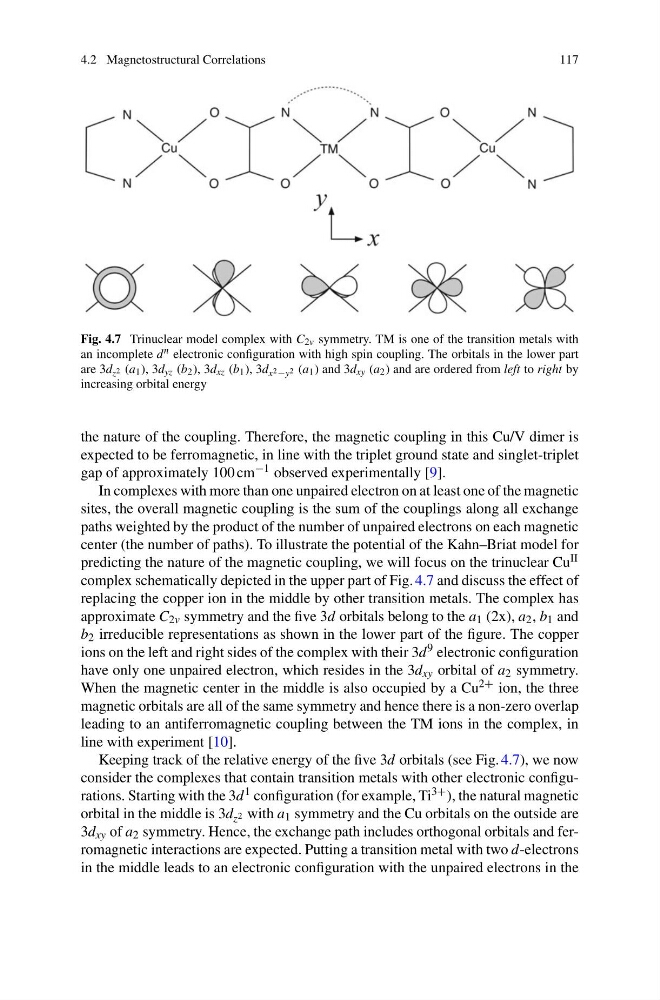
Fig. 4.7 Trinuclear model complex with C 2v symmetry. TM is one of the transition metals with
an incomplete d n electronic configuration with high spin coupling. The orbitals in the lower part
are 3d z 2 (a 1 ), 3d yz (b 2 ), 3d xz (b 1 ), 3d x 2 −y 2 (a 1 )and3d xy (a 2 ) and are ordered from left to right by
increasing orbital energy
the nature of the coupling. Therefore, the magnetic coupling in this Cu/V dimer is
expected to be ferromagnetic, in line with the triplet ground state and singlet-triplet
gap of approximately 100 cm −1 observed experimentally [9].
In complexes with more than one unpaired electron on at least one of the magnetic
sites, the overall magnetic coupling is the sum of the couplings along all exchange
paths weighted by the product of the number of unpaired electrons on each magnetic
center (the number of paths). To illustrate the potential of the Kahn–Briat model for
predicting the nature of the magnetic coupling, we will focus on the trinuclear Cu II
complex schematically depicted in the upper part of Fig. 4.7 and discuss the effect of
replacing the copper ion in the middle by other transition metals. The complex has
approximate C 2v symmetry and the five 3d orbitals belong to the a 1 (2x), a 2 , b 1 and
b 2 irreducible representations as shown in the lower part of the figure. The copper
ions on the left and right sides of the complex with their 3d 9 electronic configuration
have only one unpaired electron, which resides in the 3d xy orbital of a 2 symmetry.
When the magnetic center in the middle is also occupied by a Cu 2+ ion, the three
magnetic orbitals are all of the same symmetry and hence there is a non-zero overlap
leading to an antiferromagnetic coupling between the TM ions in the complex, in
line with experiment [10].
Keeping track of the relative energy of the five 3d orbitals (see Fig. 4.7), we now
consider the complexes that contain transition metals with other electronic configurations. Starting with the 3d 1 configuration (for example, Ti 3+ ), the natural magnetic
orbital in the middle is 3d z 2 with a 1 symmetry and the Cu orbitals on the outside are
3d xy of a 2 symmetry. Hence, the exchange path includes orthogonal orbitals and ferromagnetic interactions are expected. Putting a transition metal with two d-electrons
in the middle leads to an electronic configuration with the unpaired electrons in the
117
Fig. 4.7 Trinuclear model complex with C 2v symmetry. TM is one of the transition metals with
an incomplete d n electronic configuration with high spin coupling. The orbitals in the lower part
are 3d z 2 (a 1 ), 3d yz (b 2 ), 3d xz (b 1 ), 3d x 2 −y 2 (a 1 )and3d xy (a 2 ) and are ordered from left to right by
increasing orbital energy
the nature of the coupling. Therefore, the magnetic coupling in this Cu/V dimer is
expected to be ferromagnetic, in line with the triplet ground state and singlet-triplet
gap of approximately 100 cm −1 observed experimentally [9].
In complexes with more than one unpaired electron on at least one of the magnetic
sites, the overall magnetic coupling is the sum of the couplings along all exchange
paths weighted by the product of the number of unpaired electrons on each magnetic
center (the number of paths). To illustrate the potential of the Kahn–Briat model for
predicting the nature of the magnetic coupling, we will focus on the trinuclear Cu II
complex schematically depicted in the upper part of Fig. 4.7 and discuss the effect of
replacing the copper ion in the middle by other transition metals. The complex has
approximate C 2v symmetry and the five 3d orbitals belong to the a 1 (2x), a 2 , b 1 and
b 2 irreducible representations as shown in the lower part of the figure. The copper
ions on the left and right sides of the complex with their 3d 9 electronic configuration
have only one unpaired electron, which resides in the 3d xy orbital of a 2 symmetry.
When the magnetic center in the middle is also occupied by a Cu 2+ ion, the three
magnetic orbitals are all of the same symmetry and hence there is a non-zero overlap
leading to an antiferromagnetic coupling between the TM ions in the complex, in
line with experiment [10].
Keeping track of the relative energy of the five 3d orbitals (see Fig. 4.7), we now
consider the complexes that contain transition metals with other electronic configurations. Starting with the 3d 1 configuration (for example, Ti 3+ ), the natural magnetic
orbital in the middle is 3d z 2 with a 1 symmetry and the Cu orbitals on the outside are
3d xy of a 2 symmetry. Hence, the exchange path includes orthogonal orbitals and ferromagnetic interactions are expected. Putting a transition metal with two d-electrons
in the middle leads to an electronic configuration with the unpaired electrons in the