

116
4 From Orbital Models to Accurate Predictions
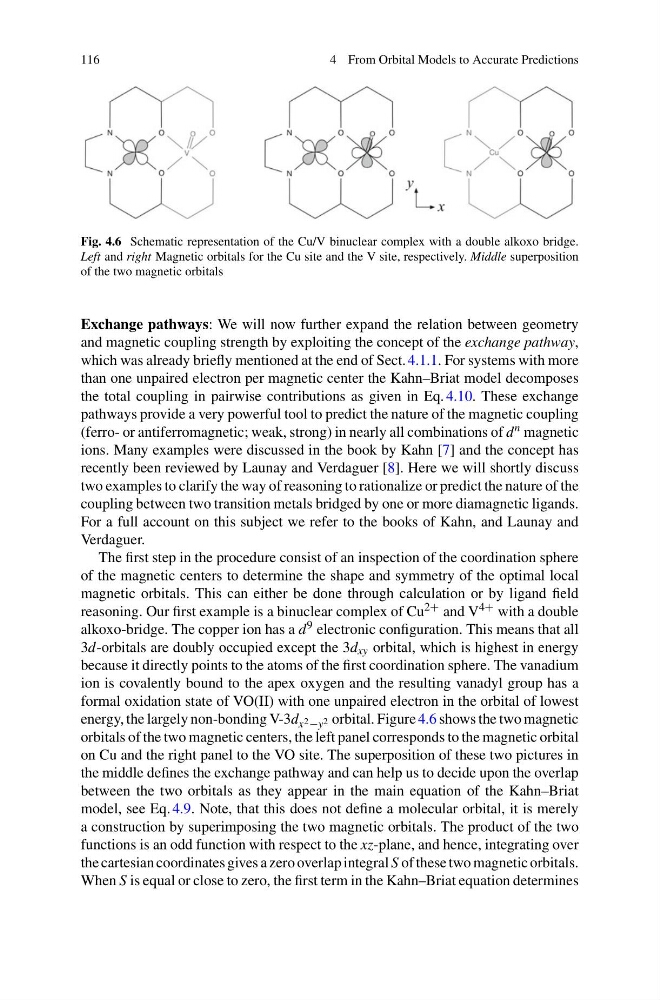
Fig. 4.6 Schematic representation of the Cu/V binuclear complex with a double alkoxo bridge.
Left and right Magnetic orbitals for the Cu site and the V site, respectively. Middle superposition
of the two magnetic orbitals
Exchange pathways: We will now further expand the relation between geometry
and magnetic coupling strength by exploiting the concept of the exchange pathway,
which was already briefly mentioned at the end of Sect. 4.1.1. For systems with more
than one unpaired electron per magnetic center the Kahn–Briat model decomposes
the total coupling in pairwise contributions as given in Eq. 4.10. These exchange
pathways provide a very powerful tool to predict the nature of the magnetic coupling
(ferro- or antiferromagnetic; weak, strong) in nearly all combinations of d n magnetic
ions. Many examples were discussed in the book by Kahn [7] and the concept has
recently been reviewed by Launay and Verdaguer [8]. Here we will shortly discuss
two examples to clarify the way of reasoning to rationalize or predict the nature of the
coupling between two transition metals bridged by one or more diamagnetic ligands.
For a full account on this subject we refer to the books of Kahn, and Launay and
Verdaguer.
The first step in the procedure consist of an inspection of the coordination sphere
of the magnetic centers to determine the shape and symmetry of the optimal local
magnetic orbitals. This can either be done through calculation or by ligand field
reasoning. Our first example is a binuclear complex of Cu 2+ and V 4+ with a double
alkoxo-bridge. The copper ion has a d 9 electronic configuration. This means that all
3d-orbitals are doubly occupied except the 3d xy orbital, which is highest in energy
because it directly points to the atoms of the first coordination sphere. The vanadium
ion is covalently bound to the apex oxygen and the resulting vanadyl group has a
formal oxidation state of VO(II) with one unpaired electron in the orbital of lowest
energy, the largely non-bonding V-3d x 2 −y 2 orbital. Figure 4.6 shows the two magnetic
orbitals of the two magnetic centers, the left panel corresponds to the magnetic orbital
on Cu and the right panel to the VO site. The superposition of these two pictures in
the middle defines the exchange pathway and can help us to decide upon the overlap
between the two orbitals as they appear in the main equation of the Kahn–Briat
model, see Eq. 4.9. Note, that this does not define a molecular orbital, it is merely
a construction by superimposing the two magnetic orbitals. The product of the two
functions is an odd function with respect to the xz-plane, and hence, integrating over
the cartesian coordinates gives a zero overlap integral S of these two magnetic orbitals.
When S is equal or close to zero, the first term in the Kahn–Briat equation determines
4 From Orbital Models to Accurate Predictions
Fig. 4.6 Schematic representation of the Cu/V binuclear complex with a double alkoxo bridge.
Left and right Magnetic orbitals for the Cu site and the V site, respectively. Middle superposition
of the two magnetic orbitals
Exchange pathways: We will now further expand the relation between geometry
and magnetic coupling strength by exploiting the concept of the exchange pathway,
which was already briefly mentioned at the end of Sect. 4.1.1. For systems with more
than one unpaired electron per magnetic center the Kahn–Briat model decomposes
the total coupling in pairwise contributions as given in Eq. 4.10. These exchange
pathways provide a very powerful tool to predict the nature of the magnetic coupling
(ferro- or antiferromagnetic; weak, strong) in nearly all combinations of d n magnetic
ions. Many examples were discussed in the book by Kahn [7] and the concept has
recently been reviewed by Launay and Verdaguer [8]. Here we will shortly discuss
two examples to clarify the way of reasoning to rationalize or predict the nature of the
coupling between two transition metals bridged by one or more diamagnetic ligands.
For a full account on this subject we refer to the books of Kahn, and Launay and
Verdaguer.
The first step in the procedure consist of an inspection of the coordination sphere
of the magnetic centers to determine the shape and symmetry of the optimal local
magnetic orbitals. This can either be done through calculation or by ligand field
reasoning. Our first example is a binuclear complex of Cu 2+ and V 4+ with a double
alkoxo-bridge. The copper ion has a d 9 electronic configuration. This means that all
3d-orbitals are doubly occupied except the 3d xy orbital, which is highest in energy
because it directly points to the atoms of the first coordination sphere. The vanadium
ion is covalently bound to the apex oxygen and the resulting vanadyl group has a
formal oxidation state of VO(II) with one unpaired electron in the orbital of lowest
energy, the largely non-bonding V-3d x 2 −y 2 orbital. Figure 4.6 shows the two magnetic
orbitals of the two magnetic centers, the left panel corresponds to the magnetic orbital
on Cu and the right panel to the VO site. The superposition of these two pictures in
the middle defines the exchange pathway and can help us to decide upon the overlap
between the two orbitals as they appear in the main equation of the Kahn–Briat
model, see Eq. 4.9. Note, that this does not define a molecular orbital, it is merely
a construction by superimposing the two magnetic orbitals. The product of the two
functions is an odd function with respect to the xz-plane, and hence, integrating over
the cartesian coordinates gives a zero overlap integral S of these two magnetic orbitals.
When S is equal or close to zero, the first term in the Kahn–Briat equation determines